Kirjojen hintavertailu. Mukana 12 390 323 kirjaa ja 12 kauppaa.

Kirjahaku

Etsi kirjoja tekijän nimen, kirjan nimen tai ISBN:n perusteella.

34 kirjaa tekijältä Paul Crowther

Critical Aesthetics and Postmodernism

Critical Aesthetics and Postmodernism

Paul Crowther

Clarendon Press
1996
nidottu
In this monograph Paul Crowther seeks to overcome some of the antagonistic positions taken in recent debates about postmodernism. He addresses such issues as the relation between art and politics, artistic creativity, and sublimity and the postmodern sensibility. His analysis of these themes centres on the interplay between what is constant and what is historically variable in human experience.
The Kantian Sublime

The Kantian Sublime

Paul Crowther

Clarendon Press
1991
nidottu
In recent years Kant's aesthetic theory has been the subject of a widespread revival of interest amongst English-speaking philosophers. This revival, however, has not so far encompassed Kant's aesthetic of the sublime. This neglect is unfortunate because, amongst Continental philosophers, the Kantian sublime is currently receiving widespread discussion in debates about the nature of postmodernism. Paul Crowther thus breaks new ground by providing what is probably the first monograph in any language to be devoted exclusively to Kant's theory of the sublime.
Art and Embodiment

Art and Embodiment

Paul Crowther

Oxford University Press
1993
sidottu
In his Critical Aesthetics and Postmodernism Paul Crowther argued that art and aesthetic experiences have the capacity to humanize. In Art and Embodiment he develops this theme in much greater depth, arguing that art can bridge the gap between philosophy's traditional striving for generality and completeness, and the concreteness and contingency of humanity's basic relation to the world. As the key element in his theory, he proposes an ecological definition of art. His strategy involves first mapping out and analysing the logical boundaries and ontological structures of the aesthetic domain. He then considers key concepts from this analysis in the light of a tradition in Continental philosophy (notably the work of Kant, Heidegger, Merleau-Ponty, and Hegel) which–by virtue of the philosophical significance that it assigns to art–significantly anticipates the ecological conception. On this basis Dr Crowther is able to give a full formulation of his ecological definition. Art, in making sensible or imaginative material into symbolic form, harmonizes and conserves what is unique and what is general in human experience. The aesthetic domain answers basic needs intrinsic to self-consciousness itself, and art is the highest realization of such needs. In the creation and reception of art the embodied subject is fully at home with his or her environment.
Defining Art, Creating the Canon

Defining Art, Creating the Canon

Paul Crowther

Clarendon Press
2007
sidottu
What is art; why should we value it; and what allows us to say that one work is better than another? Traditional answers have emphasized aesthetic form. But this has been challenged by institutional definitions of art and postmodern critique. The idea of distinctively artistic value based on aesthetic criteria is at best doubted, and at worst, rejected. This book, however, champions these notions in a new way. It does so through a rethink of the mimetic definition of art on the basis of factors which traditional answers neglect, namely the conceptual link between art's aesthetic value and 'non-exhibited' epistemological and historical relations. These factors converge on an expanded notion of the artistic image (a notion which can even encompass music, abstract art, and some conceptual idioms). The image's style serves to interpret its subject-matter. If this style is original (in comparative historical terms) it can manifest that special kind of aesthetic unity which we call art. Appreciation of this involves a heightened interaction of capacities (such as imagination and understanding) which are basic to knowledge and personal identity. By negotiating these factors, it is possible to define art and its canonic dimensions objectively, and to show that aforementioned sceptical alternatives are incomplete and self-contradictory.
Art and Embodiment

Art and Embodiment

Paul Crowther

Oxford University Press
2001
nidottu
In his Critical Aesthetics and Postmodernism (Clarendon Press, 1993) Paul Crowther argued that art and aesthetic experiences have the capacity to humanize. In Art and Embodiment he develops this theme in much greater depth, arguing that art can bridge the gap between philosophy's traditional striving for generality and completeness, and the concreteness and contingency of humanity's basic relation to the world. As the key element in his theory, he proposes an ecological definition of art. His strategy involves first mapping out and analysing the logical boundaries and ontological structures of the aesthetic domain. He then considers key concepts from this analysis in the light of a tradition in Continental philosophy (notably the work of Kant, Heidegger, Merleau-Ponty, and Hegel) which -- by virtue of the philosophical significance that it assigns to art -- significantly anticipates the ecological conception. On this basis Professor Crowther is able to give a full formulation of his ecological definition. Art, in making sensible or imaginative material into symbolic form, harmonizes and conserves what is unique and what is general in human experience. The aesthetic domain answers basic needs intrinsic to self-consciousness itself, and art is the highest realization of such needs. In the creation and reception of art the embodied subject is fully at home with his or her environment.
The Kantian Aesthetic

The Kantian Aesthetic

Paul Crowther

Oxford University Press
2010
sidottu
The Kantian Aesthetic explains the kind of perceptual knowledge involved in aesthetic judgments. It does so by linking Kant's aesthetics to a critically upgraded account of his theory of knowledge. This upgraded theory emphasizes those conceptual and imaginative structures which Kant terms, respectively, 'categories' and 'schemata'. By describing examples of aesthetic judgment, it is shown that these judgments must involve categories and fundamental schemata (even though Kant himself, and most commentators after him, have not fully appreciated the fact). It is argued, in turn, that this shows the aesthetic to be not just one kind of pleasurable experience amongst others, but one based on factors necessary to objective knowledge and personal identity, and which, indeed, itself plays a role in how these capacities develop. In order to explain how individual aesthetic judgments are justified, and the aesthetic basis of art, however, the Kantian position just outlined has to be developed further. This is done by exploring some of his other ideas concerning how critical comparisons inform our cultivation of taste, and art's relation to genius. By linking the points made earlier to a more developed account of this horizon of critical comparisons, a Kantian approach can be shown to be both a satisfying and comprehensive explanation of the cognitive basis of aesthetic experiences. It is shown also that the approach can even cover some of the kinds of avant-garde works which were thought previously to limit its relevance.
The Kantian Aesthetic

The Kantian Aesthetic

Paul Crowther

Oxford University Press
2013
nidottu
The Kantian Aesthetic explains the kind of perceptual knowledge involved in aesthetic judgments. It does so by linking Kant's aesthetics to a critically upgraded account of his theory of knowledge. This upgraded theory emphasizes those conceptual and imaginative structures which Kant terms, respectively, 'categories' and 'schemata'. By describing examples of aesthetic judgment, it is shown that these judgments must involve categories and fundamental schemata (even though Kant himself, and most commentators after him, have not fully appreciated the fact). It is argued, in turn, that this shows the aesthetic to be not just one kind of pleasurable experience amongst others, but one based on factors necessary to objective knowledge and personal identity, and which, indeed, itself plays a role in how these capacities develop. In order to explain how individual aesthetic judgments are justified, and the aesthetic basis of art, however, the Kantian position just outlined has to be developed further. This is done by exploring some of his other ideas concerning how critical comparisons inform our cultivation of taste, and art's relation to genius. By linking the points made earlier to a more developed account of this horizon of critical comparisons, a Kantian approach can be shown to be both a satisfying and comprehensive explanation of the cognitive basis of aesthetic experiences. It is shown also that the approach can even cover some of the kinds of avant-garde works which were thought previously to limit its relevance.
Defining Art, Creating the Canon

Defining Art, Creating the Canon

Paul Crowther

Oxford University Press
2011
nidottu
What is art; why should we value it; and what allows us to say that one work is better than another? Traditional answers have emphasized aesthetic form. But this has been challenged by institutional definitions of art and postmodern critique. The idea of distinctively artistic value based on aesthetic criteria is at best doubted, and at worst, rejected. This book, however, champions the traditional notions. It restores the mimetic definition of art on the basis of factors which traditional answers neglect, namely the conceptual link between art's aesthetic value and 'non-exhibited' epistemological and historical relations. These factors converge on an expanded notion of the artistic image (a notion which can even encompass music, abstract art, and some conceptual idioms). The image's style serves to interpret its subject-matter. If this style is original (in comparative historical terms) it can manifest that special kind of aesthetic unity which we call art. Appreciation of this involves a heightened interaction of capacities (such as imagination and understanding) which are basic to knowledge and personal identity. By negotiating these factors, it is possible to define art and its canonic dimensions objectively, and to show that aforementioned sceptical alternatives are incomplete and self-contradictory.
The Language of Twentieth-Century Art

The Language of Twentieth-Century Art

Paul Crowther

Yale University Press
1997
sidottu
Recent theory has tended to understand the meaning of art primarily as a function of original contexts of production and reception or in its relation to fashionable notions of gender, multiculturalism, and "scopic regimes." These approaches, however, fail to negotiate adequately art’s transhistorical and transcultural significance, a shortcoming that is particularly serious in relation to twentieth-century works because it confines their significance to contexts that are regulated by the specialist interests of a narrow managerial class of curators, critics, and historians. In this important book, Paul Crowther provides a radical reinterpretation of key phases and figures in twentieth-century art, focusing on the way artists and critics negotiate philosophically significant ideas.Crowther begins by discussing how and why form is significant. Using Derrida’s notion of "iterability"—a sign’s capacity to be used across different contexts—he links this possibility to key reciprocal cognitive relations that are the structural basis of self-consciousness. He then argues that while such relations are necessarily involved in any pictorial work, they are especially manifest in aesthetically valuable representation, and even more so in those twentieth-century works that radically transform or abandon conventional modes of representation. The involvement of key reciprocal relations gives such works a transhistorical and transcultural significance. To show this, Crowther investigates the theory and practice of important artists such as Malevich, Pollock, Mondrian, and Newman, and major tendencies such as Futurism, Surrealism, and Conceptual Art. By linking them to reciprocal relations, he is able to illuminate a language of twentieth-century art that cuts across those boundaries set out by such conventional notions as modern, avant-garde, and postmodern.
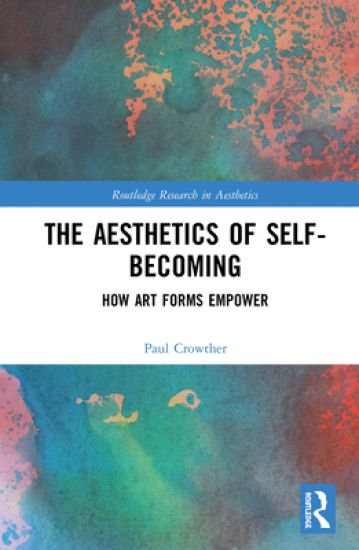
The Aesthetics of Self-Becoming

The Aesthetics of Self-Becoming

Paul Crowther

Routledge
2019
sidottu
This book shows that art involves an aesthetics of self-becoming, wherein we do not simply consume artistic meaning, but become empowered—by adapting ourselves to what creation in the different art forms makes possible. Paul Crowther argues that the great political task in aesthetics is no longer the creation of political art as such, but rather the winning back of art and aesthetics as central societal concerns. This involves the overcoming of neo-liberal treatments of art as mere commodity and misguided attitudes that dismiss it as the product of dead white European males. The book begins with a theory of self-consciousness which reveals the necessary role played by the aesthetic in personal identity. It then emphasises how art forms empower through processes of making and aesthetic effects that are unique to them individually. To show this, he considers the ontology of pictorial art, sculpture, installation and assemblage works, architecture, literature, cinema, and music. His arguments concerning these are supported, throughout, by in-depth discussions of specific artworks. The book’s effect, overall is to reorientate aesthetics by showing how art empowers through its revelation of new possibilities of experience.The Aesthetics of Self-Becoming will appeal to philosophers of art and aesthetics, as well as scholars in art history, literary studies, film studies, and music theory who are interested in the book’s central concerns.
Theory of the Art Object

Theory of the Art Object

Paul Crowther

Routledge
2019
sidottu
Meaning in the visual arts centers on how the physical work makes its content or presence visible. The art object is fundamental. Indeed, the different object forms of each visual medium allows our experience of space-time, and our relations to other people, to be aesthetically embodied in unique ways. Through these embodiments, visual art compensates for what is otherwise existentially lost, and becomes part of what makes life worth living. The present book shows this by discussing a range of visual art forms, namely pictorial representation, abstraction, sculpture and assemblage works, land art, architecture, photography, and varieties of digital art.
What Drawing and Painting Really Mean
There are as many meanings to drawing and painting as there are cultural contexts for them to exist in. But this is not the end of the story. Drawings and paintings are made, and in their making embody unique meanings that transform our perception of space-time and sense of finitude. These meanings have not been addressed by art history or visual studies hitherto, and have only been considered indirectly by philosophers (mainly in the phenomenological tradition). If these intrinsic meanings are explained and further developed, then the philosophy of art practice is significantly enhanced. The present work, accordingly, is a phenomenology of how the gestural and digital creation of visual imagery generates self-transformation through aesthetic space.
Philosophy After Postmodernism

Philosophy After Postmodernism

Paul Crowther

Routledge
2003
sidottu
Formulating a new approach to philosophy which, instead of simply rejecting postmodern thought, tries to assimilate some of its main features, Paul Crowther identifies conceptual links between value, knowledge, personal identity and civilization understood as a process of cumulative advance.To establish these links, Crowther deploys a mode of analytic philosophy influenced by Cassirer. This approach recontextualizes precisely those aspects of postmodernism which appear, superficially, to be fuel for the relativist fire. This method also enables him to illuminate some of the great practical dangers of the postmodern era - most notably the widespread inability or unwillingness to distinguish between signs and reality. Crowther renews analytic philosophy as a searching form of conceptual and cultural critique that pushes beyond the limits of postmodern thought.Essential reading for advanced students and academics interested in Twentieth Century Philosophy, Philosophy After Postmodernism will also be of value to scholars working in the fields of Cultural Studies and Sociology.
Philosophy After Postmodernism

Philosophy After Postmodernism

Paul Crowther

Routledge
2014
nidottu
Formulating a new approach to philosophy which, instead of simply rejecting postmodern thought, tries to assimilate some of its main features, Paul Crowther identifies conceptual links between value, knowledge, personal identity and civilization understood as a process of cumulative advance.To establish these links, Crowther deploys a mode of analytic philosophy influenced by Cassirer. This approach recontextualizes precisely those aspects of postmodernism which appear, superficially, to be fuel for the relativist fire. This method also enables him to illuminate some of the great practical dangers of the postmodern era - most notably the widespread inability or unwillingness to distinguish between signs and reality. Crowther renews analytic philosophy as a searching form of conceptual and cultural critique that pushes beyond the limits of postmodern thought.Essential reading for advanced students and academics interested in Twentieth Century Philosophy, Philosophy After Postmodernism will also be of value to scholars working in the fields of Cultural Studies and Sociology.
The Transhistorical Image

The Transhistorical Image

Paul Crowther

Cambridge University Press
2002
sidottu
Why are visual artworks experienced as having intrinsic significance or normative depth? Why are some works of art better able to manifest this significance than others? In this 2002 book Paul Crowther argues that we can answer these questions only if we have a full analytic definition of visual art. Crowther's approach focuses on the pictorial image, broadly construed to include abstract work and recent conceptually-based idioms. The significance of art depends, however, essentially on the transhistorical nature of the pictorial image, the way in which its illuminative power is extended through historical transformation of the relevant artistic medium. Crowther argues against fashionable forms of cultural relativism, while at the same time showing why it is important that an appreciation of the history of art is integral to aesthetic judgment.
Phenomenology of the Visual Arts (even the Frame)

Phenomenology of the Visual Arts (even the Frame)

Paul Crowther

Stanford University Press
2009
sidottu
Why are the visual arts so important and what is it that makes their forms significant? Countering recent interpretations of meaning that understand visual artworks on the model of literary texts, Crowther formulates a theory of the visual arts based on what their creation achieves both cognitively and aesthetically. He develops a phenomenology that emphasizes how visual art gives unique aesthetic expression to factors that are basic to perception. At the same time, he shows how various artistic media embody these factors in distinctive ways. Attentive to both the creation and reception of all major visual art forms (picturing, sculpture, architecture, and photography), Phenomenology of the Visual Arts also addresses complex idioms, including abstract, conceptual, and digital art.
Phenomenology of the Visual Arts (even the Frame)

Phenomenology of the Visual Arts (even the Frame)

Paul Crowther

Stanford University Press
2010
pokkari
Why are the visual arts so important and what is it that makes their forms significant? Countering recent interpretations of meaning that understand visual artworks on the model of literary texts, Crowther formulates a theory of the visual arts based on what their creation achieves both cognitively and aesthetically. He develops a phenomenology that emphasizes how visual art gives unique aesthetic expression to factors that are basic to perception. At the same time, he shows how various artistic media embody these factors in distinctive ways. Attentive to both the creation and reception of all major visual art forms (picturing, sculpture, architecture, and photography), Phenomenology of the Visual Arts also addresses complex idioms, including abstract, conceptual, and digital art.
How Pictures Complete Us

How Pictures Complete Us

Paul Crowther

Stanford University Press
2016
sidottu
Despite the wonders of the digital world, people still go in record numbers to view drawings and paintings in galleries. Why? What is the magic that pictures work on us? This book provides a provocative explanation, arguing that some pictures have special kinds of beauty and sublimity that offer aesthetic transcendence. They take us imaginatively beyond our finite limits and even invoke a sense of the divine. Such aesthetic transcendence forges a relationship with the ultimate and completes us psychologically. Philosophers and theologians sometimes account for this as an effect of art, but How Pictures Complete Us distinguishes itself by revealing how this experience is embodied in pictorial structures and styles. Through detailed discussions of artworks from the Renaissance through postmodern times, Paul Crowther reappraises the entire scope of beauty and the sublime in the context of both representational and abstract art, offering unexpected insights into familiar phenomena such as ideal beauty, pictorial perspective, and what pictures are in the first place.
How Pictures Complete Us

How Pictures Complete Us

Paul Crowther

Stanford University Press
2016
pokkari
Despite the wonders of the digital world, people still go in record numbers to view drawings and paintings in galleries. Why? What is the magic that pictures work on us? This book provides a provocative explanation, arguing that some pictures have special kinds of beauty and sublimity that offer aesthetic transcendence. They take us imaginatively beyond our finite limits and even invoke a sense of the divine. Such aesthetic transcendence forges a relationship with the ultimate and completes us psychologically. Philosophers and theologians sometimes account for this as an effect of art, but How Pictures Complete Us distinguishes itself by revealing how this experience is embodied in pictorial structures and styles. Through detailed discussions of artworks from the Renaissance through postmodern times, Paul Crowther reappraises the entire scope of beauty and the sublime in the context of both representational and abstract art, offering unexpected insights into familiar phenomena such as ideal beauty, pictorial perspective, and what pictures are in the first place.
The Phenomenology of Aesthetic Consciousness and Phantasy
This is the first book dedicated to Husserl’s aesthetics. Paul Crowther pieces together Husserl’s ideas of phantasy and image and presents them as a unified and innovative account of aesthetic consciousness. He also shows how Husserl’s ideas can be developed to solve problems in aesthetics, especially those related to visual art, literature, theatre, and nature.After outlining the major components of Husserl’s phenomenological method, Crowther addresses the scope and structure of Husserl’s notion of aesthetic consciousness. For Husserl, aesthetic consciousness in all its forms involves phantasy—where items or states of affairs are represented as if actually perceived or experienced, even though they are not, in fact, given in the present perceptual field. Husserl also makes some extraordinarily interesting links between aesthetic consciousness and nature, showing how natural things and environments become instigators of such consciousness when apprehended in the appropriate terms. This "unreality" of the object of aesthetic consciousness anticipates contemporary debates about pictorial representation and is also relevant to Husserl’s accounts of literature and theatre.The Phenomenology of Aesthetic Consciousness and Phantasy will appeal to scholars and advanced students interested in aesthetics, philosophy of art, phenomenological aesthetics, and Husserl’s philosophy.