

Kirjahaku
Etsi kirjoja tekijän nimen, kirjan nimen tai ISBN:n perusteella.
19 kirjaa tekijältä Paul Davidson

Chronic Muscle Pain Syndrome: The 7-Step Plan to Recognize and Treat It--And Feel Better All Over
Paul Davidson
BERKLEY BOOKS
2001
nidottu
Millions suffer from such symptoms as muscle aches, pains, and stiffness, chronic fatigue, joint swelling, tension or migraine-type headaches, irritable bowels, sleep disturbances, numbness, and hypersensitivity to temperature and humidity. Sadly, these people believe they have to live with their ailments, because even their doctors are unaware they have fibrositis, a highly treatable syndrome caused by stress--and often mistaken for arthritis, rheumatism, and Epstein-Barr infection.In this book, Dr. Paul Davidson will help you determine whether you are a prime candidate for fibrositis--and introduce you to the 7-step RETRAIN method that will enable you to overcome your symptoms by eliminating the underlying stress that causes them: Rest and RelaxationEducationTherapeutic Muscle TrainingResponding to StressAnalgesics and Other MedicationsInvolvementNever Give Up Hope

""Theories of Aggregate Income Distribution"" by Paul Davidson is a comprehensive study of the different theories regarding the distribution of income in a society. The book delves into the various economic theories that explain the factors that influence the distribution of income, including classical economics, neoclassical economics, Keynesian economics, and Marxist economics. Davidson explores the different approaches to measuring income distribution, including the Gini coefficient and the Lorenz curve, and evaluates the strengths and weaknesses of each method. He also discusses the impact of government policies on income distribution, such as taxes and welfare programs. The book provides a historical overview of income distribution in different countries, including the United States, Japan, and Europe. Davidson also examines the role of globalization and technological change in shaping income distribution in the modern world. Overall, ""Theories of Aggregate Income Distribution"" is a valuable resource for economists, policymakers, and anyone interested in understanding the complex factors that influence income distribution in society.This scarce antiquarian book is a facsimile reprint of the old original and may contain some imperfections such as library marks and notations. Because we believe this work is culturally important, we have made it available as part of our commitment for protecting, preserving, and promoting the world's literature in affordable, high quality, modern editions, that are true to their original work.

Uncertainty, International Money, Employment and Theory
Paul Davidson
Palgrave Macmillan
1999
nidottu
The book contains Paul Davidson's major contributions to the economics and policy debates of our times. The relationship between uncertainty, economic theory, international financial markets and global unemployment is analysed throughout. Davidson suggests new solutions for the major problems of the twenty-first century, including volatile financial markets in Asia and beyond, challenging orthodox responses. The differences between the Old-, New-, and Post-Keynesians all vying for Keynes's mantle, are explored.

The purpose of this volume is to reopen the discussion of how to develop the economic theory of investment to better model the facts of experience and to provide policy makers with a better understanding of how capital markets work. In this final decade of the twentieth century, almost everyone agrees that human progress will be closely related to the decisions regarding the investments made to promote economic growth of output. Despite the Nobel prize work done in recent decades, economic performance in this area seems to have worsened. Clearly, a reopening of public discussion on what is required is necessary. Until we get our theory right, it is impossible to get our public policy right. This book does not promise to provide “the” correct theory. Instead, it hopes to stimulate the reader into an understanding of where we may have gone wrong, and how we might rectify our mistakes.

The purpose of this volume is to reopen the discussion of how to develop the economic theory of investment to better model the facts of experience and to provide policy makers with a better understanding of how capital markets work. In this final decade of the twentieth century, almost everyone agrees that human progress will be closely related to the decisions regarding the investments made to promote economic growth of output. Despite the Nobel prize work done in recent decades, economic performance in this area seems to have worsened. Clearly, a reopening of public discussion on what is required is necessary. Until we get our theory right, it is impossible to get our public policy right. This book does not promise to provide “the” correct theory. Instead, it hopes to stimulate the reader into an understanding of where we may have gone wrong, and how we might rectify our mistakes.

Josh Allen always dreamed of finding his soulmate, only to be told it wasn't ever going to happen. Maggie Mills found who she thought was hers, only for the relationship to end in disaster. Now, the two are struggling to make their way in the City of Angels, with zero faith they'll ever find that one true love. Fortunately, the universe has other plans, as Josh and Maggie will soon discover.Meet the village of people around them: family, friends, local auto body clerks, homeless journeymen, famous chefs, and nighttime talk show hosts-people whose small, insignificant decisions in life are the reason why Josh and Maggie will finally meet once and for all. But when the two realize they've been unknowingly crossing paths all their lives, their small love story takes on even bigger significance.A romantic comedy for the new millennium, The Small Stuff asks the ultimate question: What if the reason we find the love of our life isn't due to fate or chance or plain dumb luck-but because of the decisions everyone around us ends up making?
How did economic ''experts'' worldwide fail to predict the financial crisis of 2007-2008? Eminent economist Paul Davidson discusses how mainstream economic theory may not be applicable to the world of experience. Post Keynesian theory, on the other hand, is designed to be applicable to the real world, and this book shows how applying it to policy formulation could help practically resolve economic problems. Davidson goes on to show how many Post Keynesian economists warned of the crisis as early as 2002.Post Keynesian Theory and Policy challenges the axioms on which orthodox economic theory is based and argues against their applicability to a money-using, market-oriented economy. It explores the basis for Keynes's revolutionary general theory and seeks to dispel misconceptions often found in orthodox textbooks. This accessible and expertly constructed book explains why modern economies use money-denominated contracts to organize all market transactions for production and exchange and why the law of comparative advantage's argument for free trade is not applicable to mass production industries' exports and imports. This book is a valuable resource for professional economists as well as students and academics in economics, political Science, and history, who will appreciate its new perspective and analysis of global financial events.
How did economic ''experts'' worldwide fail to predict the financial crisis of 2007-2008? Eminent economist Paul Davidson discusses how mainstream economic theory may not be applicable to the world of experience. Post Keynesian theory, on the other hand, is designed to be applicable to the real world, and this book shows how applying it to policy formulation could help practically resolve economic problems. Davidson goes on to show how many Post Keynesian economists warned of the crisis as early as 2002.Post Keynesian Theory and Policy challenges the axioms on which orthodox economic theory is based and argues against their applicability to a money-using, market-oriented economy. It explores the basis for Keynes's revolutionary general theory and seeks to dispel misconceptions often found in orthodox textbooks. This accessible and expertly constructed book explains why modern economies use money-denominated contracts to organize all market transactions for production and exchange and why the law of comparative advantage's argument for free trade is not applicable to mass production industries' exports and imports. This book is a valuable resource for professional economists as well as students and academics in economics, political Science, and history, who will appreciate its new perspective and analysis of global financial events.

Two young boys are caught up in the world of fighting. Problems between pretty girls and guys are the catalyst for the fights.In the story violence or bullying is a matter of everyday life. There is real fighting and suffering. There are victims but no heroes. Bullying and fighting are the featured story. Fighting organizations and bullies combine to put a stranglehold on an entire community. Names and races of those in the story are changed. This is not a feel good book.Ninety percent of the book is the story. About ten percent is practical advice. As a practical matter, many people enjoy fighting for theater. This book is that too. Thus, those not interested in bullying and fighting issues may find the book interesting. The book is a journey to experience a fight.The feature story provides a nice window to look at fighting and bullying issues. Martial art concepts of eliminating fighting and stopping bullying are on display.Fighters are not exonerated or extolled. Fighting and bullying are topics which are addressed in meaningful ways. Limitations and productiveness of fighting are issues, and both are thoughtfully discussed. The feature story provides prerogatives to enable a better understanding of bullying and fighting issues. Stopping bully behavior can be extraordinarily difficult. This story is no exception because it took five years to stop bullying around a handful of young beautiful girls. Accuracy in describing social conditions around fighting and bullying is the intent of the manuscript. Advice to stop bullying behavior is provided.Profanity in the book is minimal. Some words are highlighted with asterisks in order to allow the book to be readable for a youthful audience. Profanity is only used in rare exceptions where no other explanation completes the narrative. There is no explicit sexual material in the book, but sex was a factor in living conditions. Sex is only mentioned because it was a catalyst for fighting, and the topic is handled with extreme care and caution.

Paul Davidson investigates why the 1990s was a decade of financial crises that almost precipitated a global market crash. He explores the reasons why the global economy still struggles with the aftermath of these crises and discusses the possibility that volatile financial markets in the future will have real impacts on whole industries and national economic systems.The author highlights the central role that domestic and international financial markets play in determining the economic growth rate, unemployment rate and international payments position of capitalist economies. He explains why the primary function of financial markets is to create liquidity and demonstrates that a liquid market cannot be efficient, and an efficient market cannot be liquid. He also proves that preventing liquidity problems from developing in national and international financial markets is the key element in fostering prosperity. Statistical evidence and theoretical analysis are combined to demonstrate why orthodox prescriptions for 'liberalizing' labor, product, and capital markets are the wrong policies for promoting a civilized society in the 21st century.Professional economists, financial reporters, government policy makers, those working in international economic organizations such as the IMF, the World Bank and the WTO, and concerned citizens will all benefit greatly from reading this highly acclaimed book.
Paul Davidson investigates why the 1990s was a decade of financial crises that almost precipitated a global market crash. He explores the reasons why the global economy still struggles with the aftermath of these crises and discusses the possibility that volatile financial markets in the future will have real impacts on whole industries and national economic systems.The author highlights the central role that domestic and international financial markets play in determining the economic growth rate, unemployment rate and international payments position of capitalist economies. He explains why the primary function of financial markets is to create liquidity and demonstrates that a liquid market cannot be efficient, and an efficient market cannot be liquid. He also proves that preventing liquidity problems from developing in national and international financial markets is the key element in fostering prosperity. Statistical evidence and theoretical analysis are combined to demonstrate why orthodox prescriptions for 'liberalizing' labor, product, and capital markets are the wrong policies for promoting a civilized society in the 21st century.Professional economists, financial reporters, government policy makers, those working in international economic organizations such as the IMF, the World Bank and the WTO, and concerned citizens will all benefit greatly from reading this highly acclaimed book.
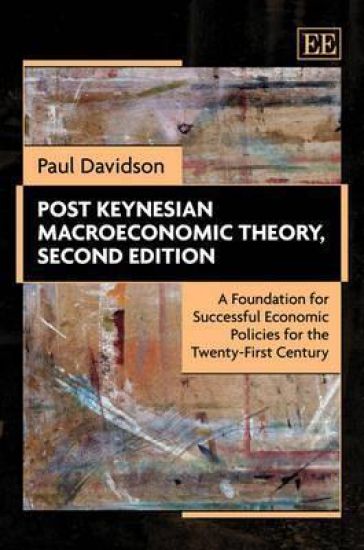
Post Keynesian Macroeconomic Theory, Second Edition
Paul Davidson
Edward Elgar Publishing Ltd
2011
sidottu
In this updated and revised edition of Post Keynesian Macroeconomic Theory, Paul Davidson explains how and why contemporary macroeconomic textbooks fail to incorporate Keynes's liquidity and financial analysis framework to explain the importance of money and financial markets in the real world of experience. This important text develops Keynes's analytical framework for both closed and open economies and provides policy guidance for the global economy of the twenty-first century. In particular, it deals with problems such as inflation, financial contagion, global unemployment, outsourcing, trade patterns, and developing an international financial system that encourages expansionary growth among all trading partners while avoiding sovereign debt problems. Using this textbook in macroeconomics courses will provide students with a pragmatic insight that will be both useful and productive. Contents: 1. The Background for Keynes's Revolution 2. The Essential Difference between the General Theory and the Classical System 3. Taxonomy, Axioms and Expenditures Related to Income: Keynes's D1 Category 4. Investment Spending 5. Government and the Level of Output 6. Delving Further into the Relationship between Money, Liquidity and Uncertainty 7. Liquidity Preference the Basis of Keynes's Revolution 8. The Finance Motive and the Interdependence of the Real and Monetary Sectors 9. Financial Markets, Fast Exits and Great Depressions and Recessions 10. Inflation: Causes and Cures 11. Keynes's Aggregate Supply and Demand Analysis 12. The Demand and Supply of Labour 13. Money in an International Setting 14. Trade Imbalances and International Payments 15. International Liquidity and Exchange Rate Stability 16. Financing the Wealth of Nations 17. Export-led Growth and a Proposal for an International Payments Scheme 18. Epilogue: Truth in Labelling and Economic Textbooks Index
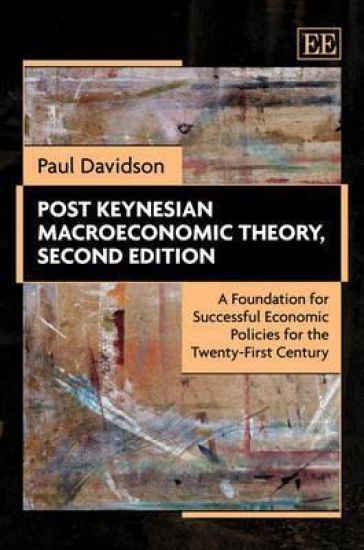
Post Keynesian Macroeconomic Theory, Second Edition
Paul Davidson
Edward Elgar Publishing Ltd
2011
nidottu
In this updated and revised edition of Post Keynesian Macroeconomic Theory, Paul Davidson explains how and why contemporary macroeconomic textbooks fail to incorporate Keynes's liquidity and financial analysis framework to explain the importance of money and financial markets in the real world of experience. This important text develops Keynes's analytical framework for both closed and open economies and provides policy guidance for the global economy of the twenty-first century. In particular, it deals with problems such as inflation, financial contagion, global unemployment, outsourcing, trade patterns, and developing an international financial system that encourages expansionary growth among all trading partners while avoiding sovereign debt problems. Using this textbook in macroeconomics courses will provide students with a pragmatic insight that will be both useful and productive. Contents: 1. The Background for Keynes's Revolution 2. The Essential Difference between the General Theory and the Classical System 3. Taxonomy, Axioms and Expenditures Related to Income: Keynes's D1 Category 4. Investment Spending 5. Government and the Level of Output 6. Delving Further into the Relationship between Money, Liquidity and Uncertainty 7. Liquidity Preference the Basis of Keynes's Revolution 8. The Finance Motive and the Interdependence of the Real and Monetary Sectors 9. Financial Markets, Fast Exits and Great Depressions and Recessions 10. Inflation: Causes and Cures 11. Keynes's Aggregate Supply and Demand Analysis 12. The Demand and Supply of Labour 13. Money in an International Setting 14. Trade Imbalances and International Payments 15. International Liquidity and Exchange Rate Stability 16. Financing the Wealth of Nations 17. Export-led Growth and a Proposal for an International Payments Scheme 18. Epilogue: Truth in Labelling and Economic Textbooks Index
Controversies in Post Keynesian Economics proves that it is possible to meet the most exacting scholarly standards while also managing to make economics enjoyable to read. Professor Davidson provides a lucid review of the debates between neoclassical Keynesians, monetarists and post Keynesians. These debates have been rekindled as a result of the revitalisation of the post Keynesian tradition coupled with the failure of the monetarist approach to explain economic developments in the 1980s. He develops this history of the struggle for the minds of economists, as well as explaining in intelligible language, the different roles assigned to money, contracts and the uncertainty of the inflationary process. In conclusion, he discusses which of these theories is likely to be most relevant to the economic problems that will be facing the free world in the 21st century.

SUBMARINE! The Australian Submarine Service in History
Paul Davidson
Connor Court Publishing Pty Ltd
2024
sidottu
Commander Paul Davidson is not a submariner himself, but through detailed research, wide reading, and lengthy discussions with current and former submarine commanding officers, he has written a most comprehensive and interesting account of the capabilities and utilization of the submarine as both a tactical and strategic weapon over the past 100 years. His book gives the reader a unique insight into the world of the undersea warrior. - Commodore Michael Dunne AM RAN Retd.This book presents a comprehensive exploration of the Australian submarine service within the broader context of global submarine warfare history. Delving into extensive research and literature, it meticulously traces the evolution and operational trajectory of submarines, spanning from their rudimentary forms a century ago to their pivotal roles in both World Wars, the Cold War era, and the contemporary proliferation of conventional and nuclear-powered submarines across various naval fleets worldwide.A focal point of analysis is the in-depth examination of the renowned 'Perisher' course, illuminating the training regimen for submarine commanders. Through insightful interviews with multiple Australian captains, the book extracts valuable lessons on effective leadership that transcend maritime warfare.Throughout its narrative, the book interweaves historical anecdotes highlighting the formidable potency of submarines as formidable instruments of war, capable of serving as deterrents and, if necessary, as destructive forces. Consequently, it provides a timely and pertinent overview of the burgeoning significance of submarines within the landscape of international naval conflicts.Paul Davidson did national service as an Air Force officer in the Vietnam War era, before spending 15 years as a clinical psychologist in Australia and New Zealand, and 30 years as a university business educator, including six years teaching in the Royal Australian Naval Staff College at HMAS Penguin. More recently he served as a naval officer in the Submarine branch and instructor in the Australian Defence College, and in naval strategy. He published academic papers and widely recommended books in the field of Management, Human Resource Management, and Project Management. Now, he has brought his scholarship to bear as an amateur naval historian, in writing about Australian Submarines and their place in the history of naval warfare.

SUBMARINE! The Australian Submarine Service in History
Paul Davidson
Connor Court Publishing Pty Ltd
2025
pokkari
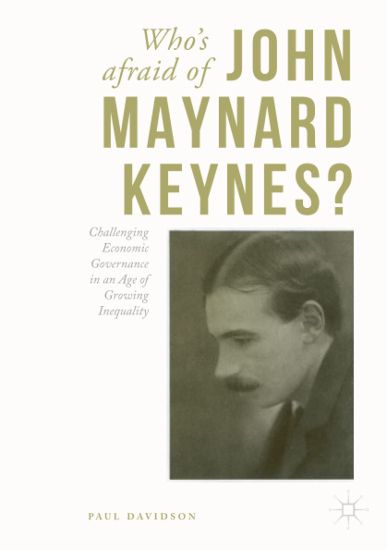
Who's Afraid of John Maynard Keynes?
Paul Davidson
Springer International Publishing AG
2017
nidottu
This is a book with many benefits. Davidson explains the importance of the market economy, and unveils how and why global financial crises occur when the liquidity of financial assets traded in the market, suddenly collapse.70 years after Keynes’ death, in another era of financial crisis and economic slump, Keynes’ ideas have made a comeback within economic circles. Yet these ideas are not represented in contemporary government policy decisions. This book explains why Keynes’ ideas need to be used by political parties in order to restore global prosperity and close the gap between income and wealth inequality. This book will is essential reading for researchers, practitioners, students and the wider public interested in an economic understanding of today's global economic problems.