Kirjojen hintavertailu. Mukana 11 453 014 kirjaa ja 12 kauppaa.

Kirjahaku

Etsi kirjoja tekijän nimen, kirjan nimen tai ISBN:n perusteella.

7 kirjaa tekijältä Paul Franco

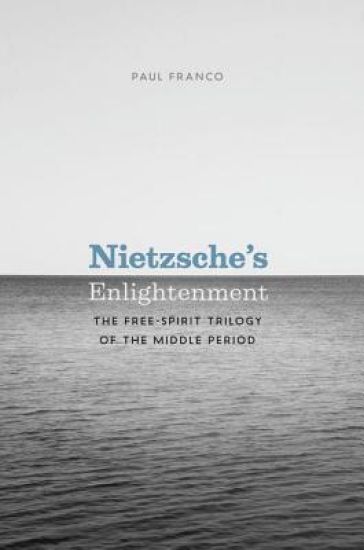
Nietzsche's Enlightenment

Nietzsche's Enlightenment

Paul Franco

University of Chicago Press
2011
sidottu
While much attention has been lavished on Friedrich Nietzsche's earlier and later works, those of his so-called middle period have been generally neglected, perhaps because of their aphoristic style or perhaps because they are perceived to be inconsistent with the rest of his thought. With "Nietzsche's Enlightenment", Paul Franco gives this crucial section of Nietzsche's oeuvre its due, offering a thoughtful analysis of the three works that make up the philosopher's middle period: "Human, All too Human"; "Daybreak"; and, "The Gay Science". It is Nietzsche himself who suggests that these works are connected, saying that their "common goal is to erect a new image and ideal of the free spirit". Franco argues that in their more favorable attitude toward reason, science, and the Enlightenment, these works mark a sharp departure from Nietzsche's earlier, more romantic writings, and differ in important ways from his later, more prophetic writings, beginning with "Thus Spoke Zarathustra". The Nietzsche these works reveal is radically different from the popular image of him and even from the Nietzsche depicted in much of the secondary literature; they reveal a rational Nietzsche, one who preaches moderation instead of passionate excess and Dionysian frenzy. Franco concludes with a wide-ranging examination of Nietzsche's later works, tracking how his outlook changes from the middle period to the later and how the commitment to reason and intellectual honesty in his middle works continues to inform his final writings.
Nietzsche's Enlightenment

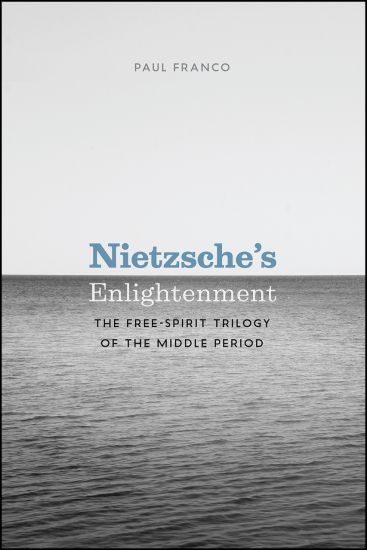
Nietzsche's Enlightenment

Paul Franco

University of Chicago Press
2020
nidottu
While much attention has been lavished on Friedrich Nietzsche’s earlier and later works, those of his so-called middle period have been generally neglected, perhaps because of their aphoristic style or perhaps because they are perceived to be inconsistent with the rest of his thought. With Nietzsche’s Enlightenment, Paul Franco gives this crucial section of Nietzsche’s oeuvre its due, offering a thoughtful analysis of the three works that make up the philosopher’s middle period: Human, All too Human; Daybreak; and The Gay Science. It is Nietzsche himself who suggests that these works are connected, saying that their “common goal is to erect a new image and ideal of the free spirit.” Franco argues that in their more favorable attitude toward reason, science, and the Enlightenment, these works mark a sharp departure from Nietzsche’s earlier, more romantic writings and differ in important ways from his later, more prophetic writings, beginning with Thus Spoke Zarathustra. The Nietzsche these works reveal is radically different from the popular image of him and even from the Nietzsche depicted in much of the secondary literature; they reveal a rational Nietzsche, one who preaches moderation instead of passionate excess and Dionysian frenzy. Franco concludes with a wide-ranging examination of Nietzsche’s later works, tracking not only how his outlook changes from the middle period to the later but also how his commitment to reason and intellectual honesty in his middle works continues to inform his final writings.
Rousseau, Nietzsche, and the Image of the Human

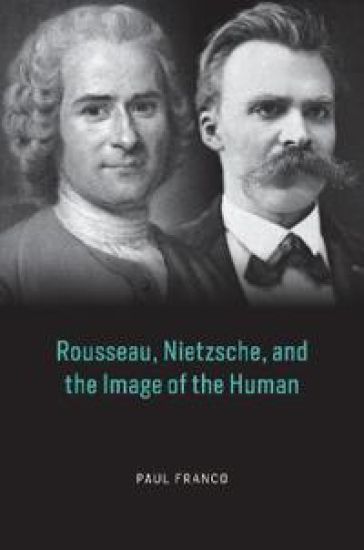
Rousseau, Nietzsche, and the Image of the Human

Paul Franco

University of Chicago Press
2021
sidottu
In Rousseau, Nietzsche, and the Image of the Human, Paul Franco examines the relationship between Jean-Jacques Rousseau and Friedrich Nietzsche, arguably the two most influential shapers and explorers of the moral and cultural imagination of late modernity. Both thinkers leveled radical critiques of modern life, but those critiques differed in important respects. Whereas Rousseau focused on the growing inequality of modern society and the hypocrisy, self-division, and loss of civic virtue it spawned, Nietzsche decried the democratic equality he identified with Rousseau and the loss of individual and cultural greatness it entailed. Franco argues, however, that Rousseau and Nietzsche are more than mere critics; they both put forward powerful alternative visions of how we ought to live. Franco focuses specifically on their views of the self and its realization, their understandings of women and the relation between the sexes, and their speculative conceptions of politics. While there are many similarities in their positive visions, Franco argues that it is the differences between them from which we have most to learn.
Hegel's Philosophy of Freedom

Hegel's Philosophy of Freedom

Paul Franco

Yale University Press
2002
pokkari
Human freedom is the central theme of modern political philosophy, and G. W. F. Hegel offers perhaps the most profound and systematic modern attempt to understand the state as the realization of human freedom. In this comprehensive examination of Hegel’s philosophy of freedom, Paul Franco traces the development of Hegel’s ideas of freedom, situates them within his general philosophical system, and relates them to the larger tradition of modern political philosophy. Franco then applies Hegel’s understanding of liberty to certain problems in contemporary political theory. He argues that Hegel offers a powerful reformulation of liberalism that escapes many of the problematic assumptions of traditional liberal doctrine and yet avoids falling into the romantic and relativistic excesses of a substantial communitarianism.Devoting the major portion of his attention to Hegel’s masterpiece the Philosophy of Right, published in 1821, Franco provides a clear and nontechnical guide to the challenging arguments Hegel presents. Franco establishes the necessary context within which to understand the work and draws on Hegel’s other writings, including the unpublished lecture notes, to illuminate it. For the Hegel specialist as well as the reader with a more general interest in political philosophy and modern intellectual history, this book offers significant insights into Hegel’s ideas on the theme of human liberty.
The Political Philosophy of Michael Oakeshott

The Political Philosophy of Michael Oakeshott

Paul Franco

Yale University Press
2014
pokkari
This is the first full-length study of the thought of Michael Oakeshott (1901-1990), arguably the most important British political philosopher of the twentieth century. Paul Franco places Oakeshott's political philosophy in the context of his ideas as a whole, drawing on all of his published writings. Franco begins with a detailed analysis of an early work, 'Experience and its Modes'. He argues that Oakeshott's vindication in this book of the possibility of philosophy and his establishment of its autonomy in relation to the limited standpoints of science, history and practice form the essential starting point of his political philosophy. Franco also examines the 'concrete' logic of human experience that underlies Oakeshott's analyses of the various forms of knowledge in 'Experience and its Modes'. According to Franco, this concrete logic not only establishes the basis of Oakeshott's influential theory of history, but it also provides the foundation for the view of practical activity found in the essays of 'Rationalism in Politics'. By reading these essays in the light of his early work, says Franco, we have a better understanding of Oakeshott's critique of rationalism as well as of his development of a richer, more contextual conception of rationality in opposition to it. We also see a revision of the conventional portrait of Oakeshott as a 'Burkean conservative', for Franco shows that Oakeshott's traditionalism rests on completely different grounds from that of Burke. Franco locates Oakeshott's substantive political philosophy within the liberal tradition as it had been elaborated from Hobbes through Hegel and Bosanquet. He concludes by demonstrating that in his theory of civil association in 'On Human Conduct', Oakeshott provides us with perhaps the most sophisticated and satisfying contemporary statement of liberalism to date. Paul Franco is William Rainey Harper Instructor at the University of Chicago.
Michael Oakeshott

Michael Oakeshott

Paul Franco

Yale University Press
2015
pokkari
In this book Paul Franco provides an authoritative introduction to the life and thought of Michael Oakeshott, one of the most important philosophical voices of the twentieth century. After sketching a brief biography of Oakeshott, Franco then examines his most distinctive ideas, including his early idealist theory of knowledge, his influential critique of rationalism and central social planning, and his liberal theory of civil association.Though best known as a political philosopher, Oakeshott also made significant contributions to the philosophy of history, aesthetics, the philosophy of religion, and the philosophy of education. Franco highlights Oakeshott’s impressive achievements in each of these areas. His book is an essential introduction to the whole range of Oakeshott’s thought, and it sets the philosopher’s work in historical context while also demonstrating its relevance to contemporary debates in political philosophy.
Success with Succession

Success with Succession

Paul Franco

Lioncrest Publishing
2024
pokkari
You've spent your career preparing clients for retirement, but are you prepared for your own? The strategies that could make or break you when selling your practice as a financial advisor are easy to overlook. From succession planning and exit strategies to valuation drivers and payout plans, your options are nearly endless-don't leave the most lucrative one on the table.In Success with Succession, financial advisor and practice acquisition expert Paul Daniel Franco presents key considerations, common misconceptions, and insightful strategies that can help you reap rewards from years of hard work. Whether you are approaching retirement or have years to go, are a sole practitioner or work with a firm, you'll learn how to secure your legacy, protect your assets, and choose a strategy to maximize returns. It's your turn to plan now. Success with Succession is the template every financial advisor needs to safeguard their work, their wealth, and their future.