Kirjahaku
Etsi kirjoja tekijän nimen, kirjan nimen tai ISBN:n perusteella.
15 kirjaa tekijältä Paul Goodman
Published in 1908, this book details the development and establishment of Judaism and Jewish culture in contrast to the spread and presence of the Christian church and community. Focusing on the spiritual importance of Jewish scripture and its prominence in other Abrahamic religions, Goodman presents a discussion on spiritual and ethical perspectives in Judaism in comparison to Christianity.
Published in 1908, this book details the development and establishment of Judaism and Jewish culture in contrast to the spread and presence of the Christian church and community. Focusing on the spiritual importance of Jewish scripture and its prominence in other Abrahamic religions, Goodman presents a discussion on spiritual and ethical perspectives in Judaism in comparison to Christianity.
Making Do by Paul Goodman is a collection of essays that explore the concept of ""making do"" in various aspects of life. Goodman argues that the ability to make do, or to be resourceful and creative with limited resources, is a valuable skill that is often overlooked in modern society. He examines the ways in which people have historically made do in areas such as food, clothing, shelter, and transportation, and suggests that these practices can be applied in contemporary contexts to promote sustainability and self-sufficiency. The book also touches on broader social and political issues, such as the role of technology in modern life and the importance of community and cooperation. Overall, Making Do offers a thought-provoking perspective on the value of resourcefulness and resilience in the face of challenges.This scarce antiquarian book is a facsimile reprint of the old original and may contain some imperfections such as library marks and notations. Because we believe this work is culturally important, we have made it available as part of our commitment for protecting, preserving, and promoting the world's literature in affordable, high quality, modern editions, that are true to their original work.

It's Never Too Late to Finish Well: A Man's Guide to Finishing Well
Paul Goodman
Createspace Independent Publishing Platform
2010
nidottu
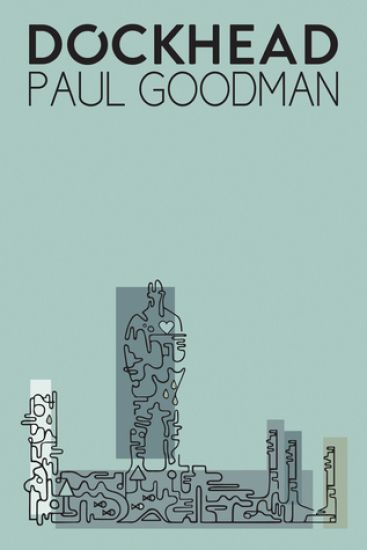
Everyone wants to be filled. Modern-lifers long for meaning, and from Dockhead, London, Ed Fisher sees this clearer than most: in Nancy, his novelist wife in search of her working-class roots; in lovelorn friends; in his workaholic editor, and in Blake, his famous and distant father, filled with regret. So when Nancy disappears midway through writing her third book, Ed must figure out why before she is swallowed by a media frenzy and he is forced to live out the plots to her past and future works. The first from a trilogy of books on belonging in modern terms, Dockhead is about finding identity in love, in art, through work, sex and drugs, and finding fulfilment through the worlds created by fiction - though fulfilment may be a fiction itself.
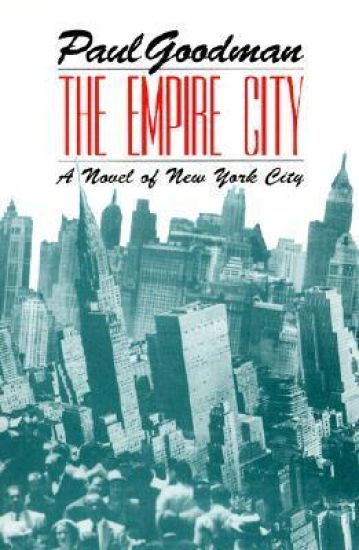
The thirty year epic story of Horatio, an idealist who struggles to take his place in a conformist society and still retain his personal identity.“If we conformed to the mad society, we became mad,” Paul Goodman writes in Empire City, “but if we did not conform to the only society that there is, we became mad.” That theme prevades much of this novel that the Review of Contemporary Fiction, among others, praised as “a remarkable achievement.” This comic-picaresque epic is about the coming-of-age of Horatio, a sane man in an absurd world. Our endearingly optimistic hero resists his compulsory mis-education, does battle with the System, and scours post–World War II Manhattan for an elective family of fellow-thinkers and, more important, fellow-feelers. It’s a big book, but Horatio’s is a big world, and his question the biggest a man can ask: “How does one live the right life?” As Goodman once said, “I might seem to have a number of divergent interests—community planning, psychotherapy, education, politics—but they are all one concern: how to make it possible to grow up as a human being into a culture without losing nature. I simply refuse to acknowledge that a sensible and honorable community does not exist.”
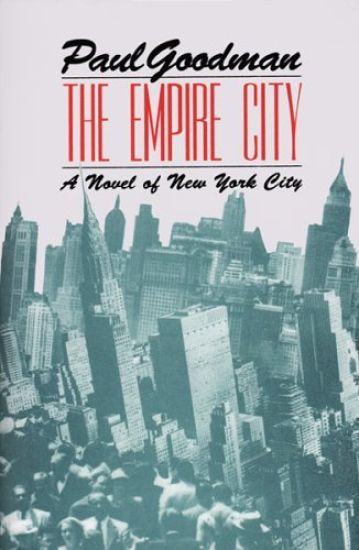
The thirty year epic story of Horatio, an idealist who struggles to take his place in a conformist society and still retain his personal identity. “If we conformed to the mad society, we became mad,” Paul Goodman writes in Empire City, “but if we did not conform to the only society that there is, we became mad.” That theme prevades much of this novel that the Review of Contemporary Fiction, among others, praised as “a remarkable achievement.” This comic-picaresque epic is about the coming-of-age of Horatio, a sane man in an absurd world. Our endearingly optimistic hero resists his compulsory mis-education, does battle with the System, and scours post–World War II Manhattan for an elective family of fellow-thinkers and, more important, fellow-feelers. It’s a big book, but Horatio’s is a big world, and his question the biggest a man can ask: “How does one live the right life?” As Goodman once said, “I might seem to have a number of divergent interests—community planning, psychotherapy, education, politics—but they are all one concern: how to make it possible to grow up as a human being into a culture without losing nature. I simply refuse to acknowledge that a sensible and honorable community does not exist.”
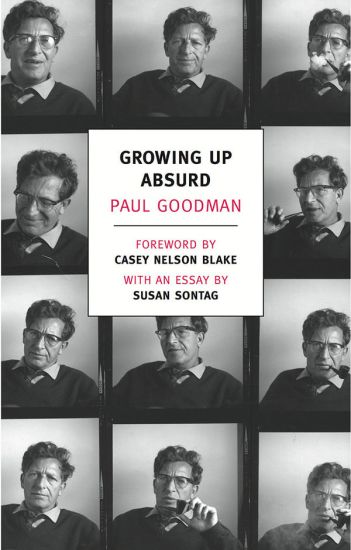
Paul Goodman's Growing Up Absurd was a runaway best seller when it was first published in 1960, and it became one of the defining texts of the New Left. Goodman was a writer and thinker who broke every mold and did it brilliantly--he was a novelist, poet, and a social theorist, among a host of other things--and the book's surprise success established him as one of America's most unusual and trenchant critics, combining vast learning, an astute mind, utopian sympathies, and a wonderfully hands-on way with words. For Goodman, the unhappiness of young people was a concentrated form of the unhappiness of American society as a whole, run by corporations that provide employment (if and when they do) but not the kind of meaningful work that engages body and soul. Goodman saw the young as the first casualties of a humanly re-pressive social and economic system and, as such, the front line of potential resistance. Noam Chomsky has said, "Paul Goodman's impact is all about us," and certainly it can be felt in the powerful localism of today's renascent left. A classic of anarchist thought, Growing Up Absurd not only offers a penetrating indictment of the human costs of corporate capitalism but points the way forward. It is a tale of yesterday's youth that speaks directly to our common future.