Kirjojen hintavertailu. Mukana 11 699 587 kirjaa ja 12 kauppaa.

Kirjahaku

Etsi kirjoja tekijän nimen, kirjan nimen tai ISBN:n perusteella.

7 kirjaa tekijältä Paul H. Robinson

Structure and Function in Criminal Law

Structure and Function in Criminal Law

Paul H. Robinson

Clarendon Press
1997
sidottu
Professor Robinson provides a new critique of the often neglected problem of classification within the criminal law. He presents a discussion of the present conceptual framework of the law, and offers explanations of how and why formal structures do not match the operation of law in practice. In this scholarly exposition of applied criminal theory, Robinson argues that the current operational structure of the criminal law fails to take account of its different functions. He goes on to suggest new sample codes of criminal conduct and criminal adjudication which mark a real departure from the pragmatic approach which presently dominates code-making. This rounded exploration of the structure of systems of criminal law is an important work for law teachers and policy makers world-wide.
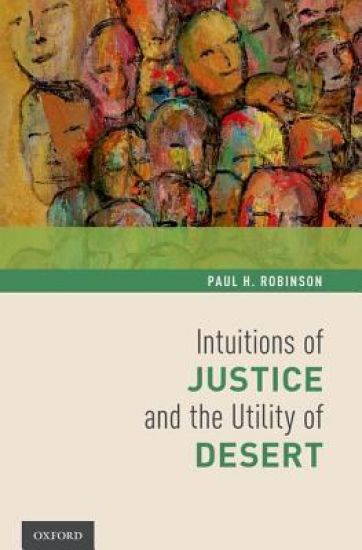
Intuitions of Justice and the Utility of Desert

Intuitions of Justice and the Utility of Desert

Paul H. Robinson

Oxford University Press Inc
2013
sidottu
Research suggests that people of all demographics have nuanced and sophisticated notions of justice. In this intriguing new book, Paul H. Robinson demonstrates that judicial decisions that deviate from public conceptions of justice and desert can seriously undermine the American criminal justice system's integrity and legitimacy by failing to recognize or meet the needs of the communities it serves. Intuitions of Justice and the Utility of Desert sketches the contours of a wide range of lay conceptions of justice, touching many if not most of the issues that penal code drafters or policy makers must face, including normative crime control, universal understandings of justice, culpability, principles of adjudication, grading sentencing, justification defenses, and judicial discretion. Robinson warns that compromising the American criminal justice system to satisfy other interests can uncover hidden the costs incurred when a community's notions about justice are not reflected in its criminal laws. By ignoring the intuitions of justice held by the communities they serve, legislators, policymakers, and judges undermine the relevance of the criminal justice system and reduce its strength and legitimacy, creating a gap between what justice a community needs and what justice a court or law prescribes.
Justice, Liability, and Blame

Justice, Liability, and Blame

Paul H. Robinson

Routledge
2019
sidottu
Drafters of legal codes often implicitly or explicitly seek to incorporate community standards. To what extent have they succeeded? This book examines shared intuitive notions of justice among laypersons and compares the discovered principles to those instantiated in current American criminal codes. After discussion of the proper role of community views in formulating legal doctrine, Robinson and Darley report eighteen original studies on a wide range of issues in dispute among legal theorists. The authors compare lay intuitions and code provisions on such questions as the justified use of force, insanity, causation, complicity, risk-creation, omission liability, culpability requirements, duress, entrapment, multiple offenses, and criminalization matters such as felony-murder and sexual offenses. Many important differences between the legal code and community views are found, and the authors discuss the implications of those differences. One implication is the possibility that such conflicts could lead to reduced compliance as the code loses its moral authority with the community.
Justice, Liability, and Blame

Justice, Liability, and Blame

Paul H. Robinson

Routledge
2020
nidottu
This book examines shared intuitive notions of justice among laypersons and compares the discovered principles to those instantiated in American criminal codes. It reports eighteen original studies on a wide range of issues that are central to criminal law formulation.
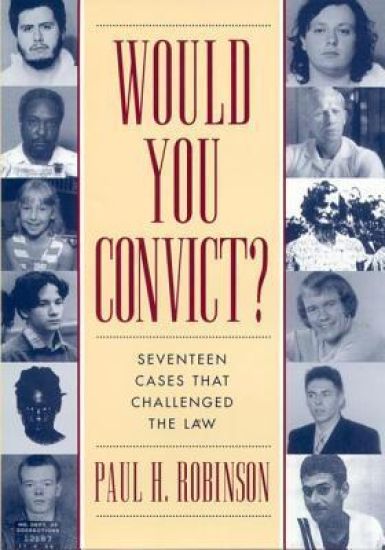
Would You Convict?

Would You Convict?

Paul H. Robinson

New York University Press
1999
sidottu
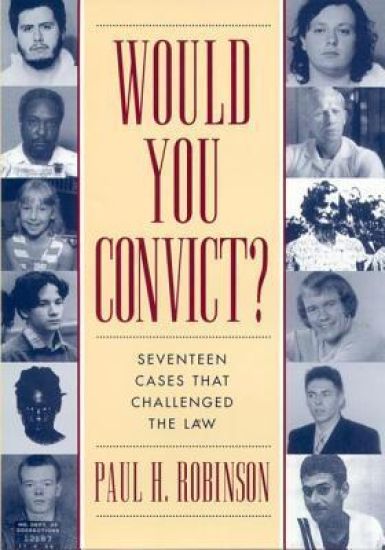
An illuminating exercise that challenges the reader's beliefs about the justice system A police trooper inspects a car during a routine traffic stop and finds a vast cache of weapons, complete with automatic rifles, thousands of rounds of ammunition, and black ski masks-a veritable bank robber's kit. Should the men in the car be charged? If so, with what? A son neglects to care for his elderly mother, whose emaciated form is discovered shortly before she dies a painful death. Is the son's neglect punishable, and if so how? A career con man writes one bad check too many and is sentenced to life in prison-for a check in the amount of $129.75. Is this just? A thief steals a backpack, only to find it contains a terrorist bomb. He alerts the police and saves lives, transforming himself from petty criminal to national hero. These are just a few of the many provocative cases that Paul Robinson presents and unravels in Would You Convict? Judging crimes and meting out punishment has long been an informal national pasttime. High-profile crimes or particularly brutal ones invariably prompt endless debate, in newspapers, on television, in coffee shops, and on front porches. Our very nature inclines us to be armchair judges, freely waving our metaphorical gavels and opining as to the innocence or guilt-and suitable punishment-of alleged criminals. Confronting this impulse, Paul Robinson here presents a series of unusual episodes that not only challenged the law, but that defy a facile or knee-jerk verdict. Narrating the facts in compelling, but detached detail, Robinson invites readers to sentence the transgressor (or not), before revealing the final outcome of the case. The cases described in Would You Convict? engage, shock, even repel. Without a doubt, they will challenge you and your belief system. And the way in which juries and judges have resolved them will almost certainly surprise you.
Would You Convict?

Would You Convict?

Paul H. Robinson

New York University Press
2001
pokkari
An illuminating exercise that challenges the reader's beliefs about the justice system A police trooper inspects a car during a routine traffic stop and finds a vast cache of weapons, complete with automatic rifles, thousands of rounds of ammunition, and black ski masks-a veritable bank robber's kit. Should the men in the car be charged? If so, with what? A son neglects to care for his elderly mother, whose emaciated form is discovered shortly before she dies a painful death. Is the son's neglect punishable, and if so how? A career con man writes one bad check too many and is sentenced to life in prison-for a check in the amount of $129.75. Is this just? A thief steals a backpack, only to find it contains a terrorist bomb. He alerts the police and saves lives, transforming himself from petty criminal to national hero. These are just a few of the many provocative cases that Paul Robinson presents and unravels in Would You Convict? Judging crimes and meting out punishment has long been an informal national pasttime. High-profile crimes or particularly brutal ones invariably prompt endless debate, in newspapers, on television, in coffee shops, and on front porches. Our very nature inclines us to be armchair judges, freely waving our metaphorical gavels and opining as to the innocence or guilt-and suitable punishment-of alleged criminals. Confronting this impulse, Paul Robinson here presents a series of unusual episodes that not only challenged the law, but that defy a facile or knee-jerk verdict. Narrating the facts in compelling, but detached detail, Robinson invites readers to sentence the transgressor (or not), before revealing the final outcome of the case. The cases described in Would You Convict? engage, shock, even repel. Without a doubt, they will challenge you and your belief system. And the way in which juries and judges have resolved them will almost certainly surprise you.
The Structure and Limits of Criminal Law
This volume brings together a collection of essays, many of them scholarly classics, which form part of the debates on three questions central to criminal law theory. The first of these questions is: what conduct should be necessary for criminal liability, and what sufficient? The answer to this question has wider implications for the debate about morality enforcement given the concern that the ’harm principle’ may have collapsed under its own weight. Secondly, essays address the question of what culpability should be necessary for criminal liability, and what sufficient? Here, the battles continue over whether the formulation of doctrines - such as the insanity defense, criminal negligence, strict liability, and others - should ignore or minimize the extent of an offender's blameworthiness in the name of effective crime-control. Or, are methods of accommodating the tension now in sight? Finally, essays consider the question of how criminal law rules should be best organized into a coherent and clarifying doctrinal structure. The structure grown by the common law process competes not only with that of modern comprehensive codifications, such as the America Law Institute's Model Penal Code, but also with alternative structures imagined but not yet tried.