Kirjojen hintavertailu. Mukana 11 627 484 kirjaa ja 12 kauppaa.

Kirjahaku

Etsi kirjoja tekijän nimen, kirjan nimen tai ISBN:n perusteella.

3 kirjaa tekijältä Paul Kens

Justice Stephen Field

Justice Stephen Field

Paul Kens

University Press of Kansas
1997
sidottu
This study of Justice Stephen Field of the US Supreme Court, explains his jurisprudence in terms of conflicting views of liberty and individualism. The text establishes him as a spokesman for one side of the conflict, and as a prototype for the modern activist judge.
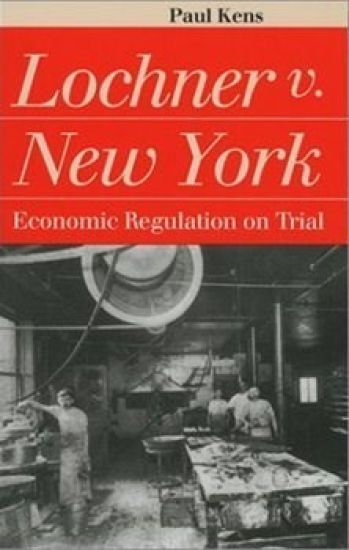
Lochner v.New York

Lochner v.New York

Paul Kens

University Press of Kansas
1998
nidottu
Lochner v. New York (1905), which pitted a conservative activist judiciary against a reform-minded legislature, remains one of the most important and most frequently cited cases in Supreme Court history. In this concise and readable guide, Paul Kens shows us why the case remains such an important marker in the ideological battles between the free market and the regulatory state.The Supreme Court's decision declared unconstitutional a New York State law limiting bakery workers to no more than ten hours per day or sixty hours per week. By evoking its "police power," the state hoped to eliminate the employers' abuse of these workers. But the 5-4 majority opinion, authored by Justice Rufus Peckham and renounced by Justice Oliver Wendell Holmes, cited the state's violation of due process and the "right of contract between employers and employees," which the majority believed was protected by the Fourteenth Amendment.Critics jumped on the decision as an example of conservative judicial activism promoting laissez-faire capitalism at the expense of progressive reform. As series editors Peter Hoffer and N.E.H. Hull note in their preface, "the case also raised a host of significant questions regarding the impetus of state legislatures to enter the workplace and regulate hours, wages, and working conditions; of the role of courts as monitors of the constitutionality of state regulation of the economy; and of the place of economic and moral theories in judicial thinking."Kens, however, reminds us that these hotly contested ideas and principles emerged from a very real human drama involving workers, owners, legislators, lawyers, and judges. Within the crucible of an industrializing America, their story reflected the fierce competition between two powerful ideologies.
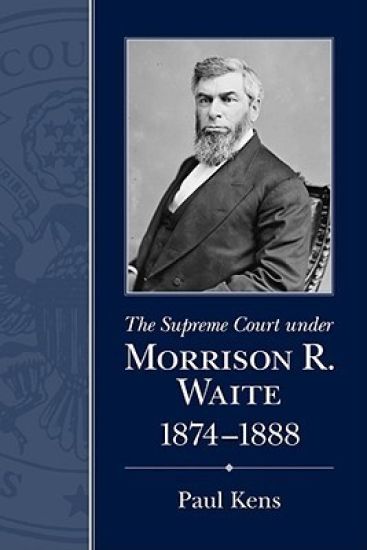
The Supreme Court Under Morrison R. Waite, 1874-1888

The Supreme Court Under Morrison R. Waite, 1874-1888

Paul Kens

University of South Carolina Press
2010
sidottu
In The Supreme Court under Morrison R. Waite, 1874-1888, Paul Kens provides a history of the Court during a time that began in the shadow of the Civil War and ended with America on the verge of establishing itself as an industrial world power. Morrison R. Waite (1816-1888) led the Court through a period that experienced great racial violence and sectional strife. At the same time, a commercial revolution produced powerful new corporate businesses and, in turn, dissatisfaction among agrarian and labor interests. The nation was also consolidating the territory west of the Mississippi River, an expansion often marred with bloodshed and turmoil. It was an era that strained America's thinking about the purpose, nature, and structure of government and ultimately about the meaning of the constitution.Challenging the conventional portrayal of the Waite Court as being merely transitional, Kens observes that the majority of these justices viewed themselves as guardians of tradition. Even while facing legal disputes that grew from the drastic changes in post-Civil War America's social, political, and economic order, the Waite Court tended to look backward for its cues. Its rulings on issues of liberty and equality, federalism and the powers of government, and popular sovereignty and the rights of the community were driven by constitutional traditions established prior to the Civil War. This is an important distinction because the conventional portrayal of this Court as transitional leaves the impression that later changes in legal doctrine were virtually inevitable, especially with respect to the subjects of civil rights and economic regulation. By demonstrating that there was nothing inevitable about the way constitutional doctrine has evolved, Kens provides an original and insightful interpretation that enhances our understanding of American constitutional traditions as well as the development of constitutional doctrine in the late nineteenth century.