Kirjojen hintavertailu. Mukana 11 627 383 kirjaa ja 12 kauppaa.

Kirjahaku

Etsi kirjoja tekijän nimen, kirjan nimen tai ISBN:n perusteella.

24 kirjaa tekijältä Paul Levinson

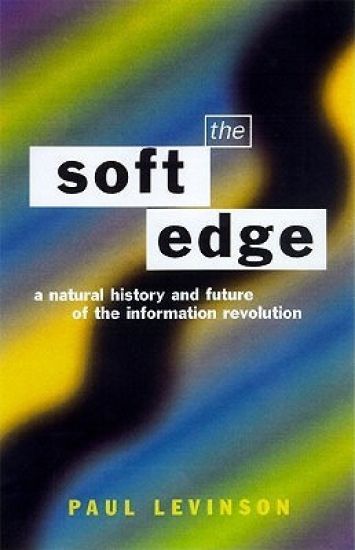
Soft Edge:Nat Hist&Future Info

Soft Edge:Nat Hist&Future Info

Paul Levinson

Routledge
1997
sidottu
The Soft Edge is a one-of-a-kind history of the information revolution. In his lucid and direct style, Paul Levinson, historian and philosopher of media and communications, gives us more than just a history of information technologies. The Soft Edge is a book about theories on the evolution of technology, the effects that human choice has on this (r)evolution, and what's in store for us in the future.Paul Levinson's engaging voice guides us on a tour that explains how communications media have been responsible for major developments in history and for profound changes in our day-to-day lives. Levinson presents the intriguing argument that technology actually becomes more human. We see how information technologies are selected on the basis of how well they meet human needs. Why is email more like speech than print is? Why didn't the arrival of television destroy the radio? These and many more thought provoking questions are answered in The Soft Edge.Boldly extending and deepening the pathways blazed by McLuhan, Paul Levinson has provided us with a brilliant and exciting study of life with our old media, our new media, and the media still to come.
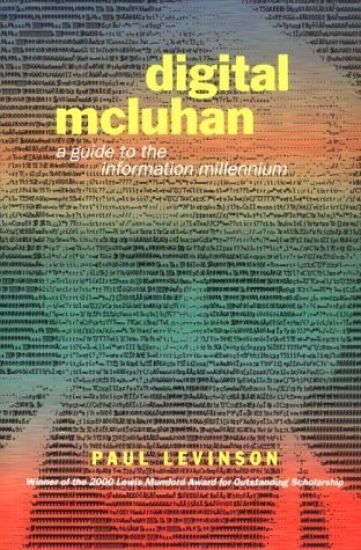
Digital McLuhan

Digital McLuhan

Paul Levinson

Routledge
1999
sidottu
Marshall McLuhan died on the last day of 1980, on the doorstep of the personal computer revolution. Yet McLuhan's ideas anticipated a world of media in motion, and its impact on our lives on the dawn of the new millennium.Paul Levinson examines why McLuhan's theories about media are more important to us today than when they were first written, and why the Wired generation is now turning to McLuhan's work to understand the global village in the digital age.
Soft Edge:Nat Hist&Future Info

Soft Edge:Nat Hist&Future Info

Paul Levinson

Routledge
1998
nidottu
The Soft Edge is a one-of-a-kind history of the information revolution. In his lucid and direct style, Paul Levinson, historian and philosopher of media and communications, gives us more than just a history of information technologies. The Soft Edge is a book about theories on the evolution of technology, the effects that human choice has on this (r)evolution, and what's in store for us in the future.Boldly extending and deepening the pathways blazed by McLuhan, Paul Levinson has provided us with a brilliant and exciting study of life with our old media, our new media, and the media still to come.
Digital McLuhan

Digital McLuhan

Paul Levinson

Routledge
2001
nidottu
Marshall McLuhan died on the last day of 1980, on the doorstep of the personal computer revolution. Yet McLuhan's ideas anticipated a world of media in motion, and its impact on our lives on the dawn of the new millennium.Paul Levinson examines why McLuhan's theories about media are more important to us today than when they were first written, and why the Wired generation is now turning to McLuhan's work to understand the global village in the digital age.
Real Space

Real Space

Paul Levinson

Routledge
2003
sidottu
Is planet earth the end of the line, or is space itself the next stop?Cyberspace. It's incredible, taking us to any part of the planet we want to visit. But as Paul Levinson shows in his brilliant new book, when it comes to transport, we're still stuck in the past, preferring to take our bodies with us. Whether it's trains, yachts, scooters or pogo-sticks, we're compelled to keep moving, our movements curtailed only by the earth itself. In our imaginations however, we soar way past the limits of current technology. With a lucid but reflective style that takes in everything from robots and science fiction to religion and philosophy, Paul Levinson asks why there is a deep seated human desire to know what's 'out there'. Why, after getting a man on the moon, did the US space program develop so slowly? In a world where space is constantly repackaged, how do we know what real space is? Is our desire to get into space natural, or a religious craving, and is it a modern phenomenon, or did our ancestors also dream of escaping the clutches of Mother Earth? Jam-packed with exciting, innovative, even revolutionary thinking about our future, Realspace is essential reading for everyone who has ever sat at their desk, gazed into the distance and imagined boarding a space shuttle...
Real Space

Real Space

Paul Levinson

Routledge
2016
nidottu
Is planet earth the end of the line, or is space itself the next stop?Cyberspace. It's incredible, taking us to any part of the planet we want to visit. But as Paul Levinson shows in his brilliant new book, when it comes to transport, we're still stuck in the past, preferring to take our bodies with us. Whether it's trains, yachts, scooters or pogo-sticks, we're compelled to keep moving, our movements curtailed only by the earth itself. In our imaginations however, we soar way past the limits of current technology. With a lucid but reflective style that takes in everything from robots and science fiction to religion and philosophy, Paul Levinson asks why there is a deep seated human desire to know what's 'out there'. Why, after getting a man on the moon, did the US space program develop so slowly? In a world where space is constantly repackaged, how do we know what real space is? Is our desire to get into space natural, or a religious craving, and is it a modern phenomenon, or did our ancestors also dream of escaping the clutches of Mother Earth? Jam-packed with exciting, innovative, even revolutionary thinking about our future, Realspace is essential reading for everyone who has ever sat at their desk, gazed into the distance and imagined boarding a space shuttle...
McLuhan in an Age of Social Media

McLuhan in an Age of Social Media

Paul Levinson

Connected Editions
2016
pokkari
This essay can be considered a new chapter in my book Digital McLuhan, published in 1999, or before the advent of Twitter, Facebook, YouTube, and the social media of our age. Marshall McLuhan's ideas, including hot and cool, the medium is the message, and the tetrad, are applied to help us understand selfies, tweeting, fake news, iconic television shows such as The Sorpanos and Mad Men, the advent of streaming television and binge watching, the Arab Spring, the U.S. Presidential elections of 2016 and 2020, and the Kindle revolution itself.
Fake News in Real Context

Fake News in Real Context

Paul Levinson

Connected Editions, Incorporated
2017
pokkari
This essay explores the historical and current context of fake news - with comparisons to government propaganda, and professional and citizen journalism - as well as what impact it may have had on the 2016 and 2020 U.S. Presidential elections, and the COVID pandemic, and what can best be done about it.
The Chronology Protection Case

The Chronology Protection Case

Paul Levinson

Connected Editions, Incorporated
2017
nidottu
When NYPD forensic detective Phil D'Amato takes a call from a lady physicist about her missing husband, he has no idea that her life, his life, and every other scientist working on a top-secret time travel project will soon be in dire jeopardy. As the number of dead begins to mount, D'Amato starts to realize that the suspect is not any one person or group but something much more sinister and dangerous."The Chronology Protection Case" was a finalist for the Nebula Award for Best Science Fiction Novelette of 1995. The story was adapted into a low-budget movie by Jay Kensinger, and an Edgar-nominated radio play by Mark Shanahan.
Chronica

Chronica

Paul Levinson

Connected Editions, Incorporated
2017
nidottu
Sierra and Max arrive in 2062, and find the world has somewhat changed. Joe Biden was President from 2009-2017, and train travel is much more prominent. Was this due to the scrolls that she rescued from the Library of Alexandria? Heron's Chronica, which describes how to build a time travel device and was one of the texts Sierra saved from burning, has not yet been published, and Sierra soon realizes that Heron is doing everything in his lethal power to prevent that from happening. Her attempt to safeguard the Chronica, which she left in William Henry Appleton's keeping, takes her to the end of the 1890s, where she dines, plots, and otherwise interacts with John Jacob Astor IV, Nikola Tesla, Thomas Edison, J. P. Morgan, film pioneers William Dickson and Edwin Porter, and other denizens of The Gilded Age.
Human Replay

Human Replay

Paul Levinson

Connected Education
2017
pokkari
This is my original doctoral dissertation, which I submitted to New York University and successfully defended in 1978. The dissertation presents my "anthropotropic" theory of media evolution (anthropo = human; tropic = towards) which argues that as media evolve, they become increasingly human in function. Thus, telegraph gives way to telephone (we hear words not dots and dashes), photography changes from black-and-white to color, etc. The theory also explains why some media survive the advent of successor media and others do not: radio survived the advent of television because hearing without seeing is a natural mode of human communication (it gets dark every night and we still hear, we can easily close our eyes and continue to hear), whereas silent movies were obliterated by talkies (it is very difficult in the natural world to see without hearing something or other). The theory also predicts the creation of media that will enable us to access all kinds of information from any place in the world, any time, regardless of where we and that information might be - or, exactly what we now do with smartphones.