Kirjojen hintavertailu. Mukana 11 342 296 kirjaa ja 12 kauppaa.

Kirjahaku

Etsi kirjoja tekijän nimen, kirjan nimen tai ISBN:n perusteella.

5 kirjaa tekijältä Paul Magid

George Crook

George Crook

Paul Magid

University of Oklahoma Press
2014
nidottu
Renowned for his prominent role in the Apache and Sioux wars, General George Crook (1828-90) was considered by William Tecumseh Sherman to be his greatest Indian-fighting general. Although Crook was feared by Indian opponents on the battlefield, in defeat the tribes found him a true friend and advocate who earned their trust and friendship when he spoke out in their defense against political corruption and greed.Paul Magid's detailed and engaging narrative focuses on Crook's early years through the end of the Civil War. Magid begins with Crook's boyhood on the Ohio frontier and his education at West Point, then recounts his nine years' military service in California during the height of the Gold Rush. It was in the Far West that Crook acquired the experience and skills essential to his success as an Indian fighter.This is primarily an account of Crook's dramatic and sometimes controversial role in the Civil War, in which he was involved on three fronts, in West Virginia, Tennessee, and Virginia. Crook saw action during the battle of Antietam and played important roles in two major offensives in the Shenandoah Valley and in the Chattanooga and Appomattox campaigns. His courage, leadership, and tactical skills won him the respect and admiration of his commanding officers, including Generals Grant and Sheridan. He soon rose to the rank of major general and received four brevet promotions for bravery and meritorious service. Along the way, he led both infantry and cavalry, pioneered innovations in guerrilla warfare, conducted raids deep into enemy territory, and endured a kidnapping by Confederate partisans.George Crook offers insight into the influences that later would make this general both a nemesis of the Indian tribes and their ardent advocate, and it illuminates the personality of this most enigmatic and eccentric of army officers.
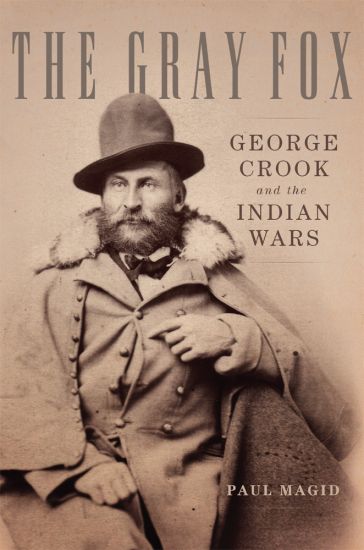
The Gray Fox

The Gray Fox

Paul Magid

University of Oklahoma Press
2015
sidottu
George Crook was one of the most prominent military figures of the late-nineteenth-century Indian Wars. Yet today his name is largely unrecognized despite the important role he played in such pivotal events in western history as the Custer fight at the Little Big Horn, the death of Crazy Horse, and the Geronimo campaigns. As Paul Magid portrays Crook in this highly readable second volume of a projected three-volume biography, the general was an innovative and eccentric soldier, with a complex and often contradictory personality, whose activities often generated intense controversy. Though known for his uncompromising ferocity in battle, he nevertheless respected his enemies and grew to know and feel compassion for them. Describing campaigns against the Paiutes, Apaches, Sioux, and Cheyennes, Magid's vivid narrative explores Crook's abilities as an Indian fighter. The Apaches, among the fiercest peoples in the West, called Crook the Gray Fox after an animal viewed in their culture as a herald of impending death. Generals Grant and Sherman both regarded him as indispensable to their efforts to subjugate the western tribes. Though noted for his aggressiveness in combat, Crook was a reticent officer who rarely raised his voice, habitually dressed in shabby civilian attire, and often rode a mule in the field. He was also self-confident to the point of arrogance, harbored fierce grudges, and because he marched to his own beat, got along poorly with his superiors. He had many enduring friendships both in- and outside the army, though he divulged little of his inner self to others and some of his closest comrades knew he could be cold and insensitive. As Magid relates these crucial episodes of Crook's life, a dominant contradiction emerges: while he was an unforgiving warrior in the field, he not infrequently risked his career to do battle with his military superiors and with politicians in Washington to obtain fair treatment for the very people against whom he fought. Upon hearing of the general's death in 1890, Chief Red Cloud spoke for his Sioux people: ""He, at least, never lied to us. His words gave the people hope.
The Gray Fox

The Gray Fox

Paul Magid

University of Oklahoma Press
2018
nidottu
George Crook was one of the most prominent military figures of the late-nineteenth-century Indian Wars. Yet today his name is largely unrecognized despite the important role he played in such pivotal events in western history as the Custer fight at the Little Big Horn, the death of Crazy Horse, and the Geronimo campaigns. As Paul Magid portrays Crook in this highly readable second volume of a projected three-volume biography, the general was an innovative and eccentric soldier, with a complex and often contradictory personality, whose activities often generated intense controversy. Though known for his uncompromising ferocity in battle, he nevertheless respected his enemies and grew to know and feel compassion for them. Describing campaigns against the Paiutes, Apaches, Sioux, and Cheyennes, Magid's vivid narrative explores Crook's abilities as an Indian fighter. The Apaches, among the fiercest peoples in the West, called Crook the Gray Fox after an animal viewed in their culture as a herald of impending death. Generals Grant and Sherman both regarded him as indispensable to their efforts to subjugate the western tribes. Though noted for his aggressiveness in combat, Crook was a reticent officer who rarely raised his voice, habitually dressed in shabby civilian attire, and often rode a mule in the field. He was also self-confident to the point of arrogance, harbored fierce grudges, and because he marched to his own beat, got along poorly with his superiors. He had many enduring friendships both in- and outside the army, though he divulged little of his inner self to others and some of his closest comrades knew he could be cold and insensitive. As Magid relates these crucial episodes of Crook's life, a dominant contradiction emerges: while he was an unforgiving warrior in the field, he not infrequently risked his career to do battle with his military superiors and with politicians in Washington to obtain fair treatment for the very people against whom he fought. Upon hearing of the general's death in 1890, Chief Red Cloud spoke for his Sioux people: ""He, at least, never lied to us. His words gave the people hope.
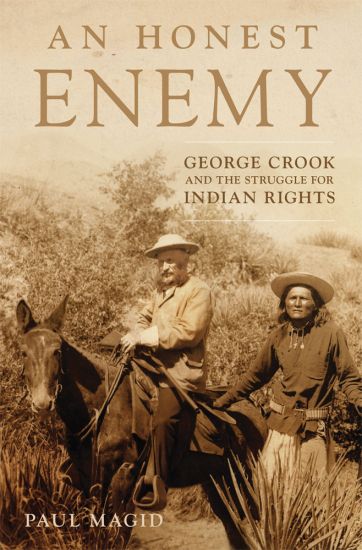
An Honest Enemy

An Honest Enemy

Paul Magid

University of Oklahoma Press
2020
sidottu
Over the course of his military career, George Crook developed empathy and admiration for American Indians both as foes and as allies. As Paul Magid has demonstrated in the previous two volumes of his groundbreaking biography, this experience prepared Crook well for his metamorphosis from Indian fighter to outspoken advocate of Indian rights.An Honest Enemy is the third and final volume of Magid's account of George Crook's life and involvement in the Indian wars. Using rarely tapped information, including Crook's own diaries, the work documents in dramatic detail the general's arduous and dangerous campaigns against the Chiricahua Apaches and their leader Geronimo, action that forms a backdrop to the transformation in the general's role vis-à-vis Native Americans. In a story by turns harrowing and tragic, Magid details the plight of Indians who, in the aftermath of their defeat, were consigned to reservations too barren to sustain them, where they were subjected to impoverishment, indifference, and in many cases, outright corruption. With growing anger, Crook watched as many tribes faced death from starvation and disease and, unwilling to passively accept their fate, desperately sought to flee their reservations and return to their homelands. Charged with the grim task of returning the Indians to such conditions, Crook was forced to choose between fulfilling his duties as a soldier and his humanitarian values. Magid describes Crook's struggle to reconcile these conflicting concerns while promoting policies he regarded as essential to the welfare of the Indians in the face of a hostile public, jealous fellow officers, and an unsympathetic government that regarded his efforts as quixotic and misguided. Here is a tale that readers will not soon forget.
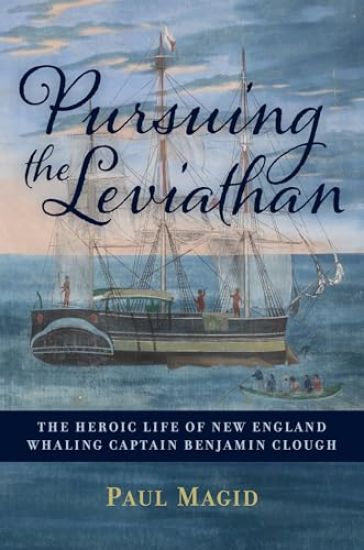
Pursuing the Leviathan

Pursuing the Leviathan

Paul Magid

Naval Institute Press
2025
sidottu
Set in the golden age of whaling in the nineteenth century, this book brings to life the adventures of Benjamin Clough, best known for single-handedly rescuing the ship Sharon from mutineers in 1842. Clough’s heroism earned him a whaling command, which led to a whaling career that for a quarter-century took him into the Atlantic, Pacific, and Arctic Oceans. The extraordinary event that merited Clough his promotion to a captaincy occurred when he was just twenty-three years old. At sea since the age of sixteen, by 1842 Clough’s impressive skills and seamanship had earned him an appointment as third mate aboard the whaling ship Sharon. While most of the crew, including Clough, were in smaller boats pursuing whales, three Pacific Island crewmembers, enraged by their captain’s wanton cruelty, mutinied and subsequently murdered him and seized the ship. Raising its sails, they prepared to abandon the other men to die a terrifying death on the open sea. The crew, cowed by the mutineers’ ferocity, was at a loss as to what to do when Clough stepped up and volunteered to retake the vessel. Alone, he swam in the pitch-black of night through shark-infested waters, boarded the Sharon, overcame two of the Islanders in hand-to-hand combat, and recaptured the ship. The Sharon’s owners rewarded his heroism by giving him command on its next voyage, launching him on the second phase of his whaling career as a successful, much-admired whaling captain. Drawing on whaling logs, journals, and family documents, author Paul Magid follows Clough from his first voyage in 1835 to his retirement from whaling in 1867. Clough’s story is set in the context of the book’s gritty portrayal of the dangerous and brutal conditions endured by whalers during this period. At the same time, Clough’s time ashore on Martha’s Vineyard allows the author to explore a little-known period in the island’s history and the protagonist’s role in transforming the Vineyard into a coveted destination for mainland vacationers.