Kirjojen hintavertailu. Mukana 12 016 292 kirjaa ja 12 kauppaa.

Kirjahaku

Etsi kirjoja tekijän nimen, kirjan nimen tai ISBN:n perusteella.

9 kirjaa tekijältä Paul Mattick

Art In Its Time

Art In Its Time

Paul Mattick

Routledge
2003
sidottu
Art In Its Time takes a close look at the way in which art has become integral to the everyday 'ordinary' life of modern society. It explores the prevalent notion of art as transcending its historical moment, and argues that art cannot be separated from the everyday as it often provides material to represent social struggles and class, to explore sexuality, and to think about modern industry and our economic relationships.
Art In Its Time

Art In Its Time

Paul Mattick

Routledge
2003
nidottu
Art In Its Time takes a close look at the way in which art has become integral to the everyday 'ordinary' life of modern society. It explores the prevalent notion of art as transcending its historical moment, and argues that art cannot be separated from the everyday as it often provides material to represent social struggles and class, to explore sexuality, and to think about modern industry and our economic relationships.
Anti-Bolshevik Communism

Anti-Bolshevik Communism

Paul Mattick

The Merlin Press Ltd
2007
nidottu
Communism aims at putting working people in charge of their lives. A multiplicity of Councils, rather than a big state bureaucracy is needed to empower working people and to focus control over society. Mattick develops a theory of a council communism through his survey of the history of the left in Germany and Russia. He challenges Bolshevik politics: especially their perspectives on questions of Party and Class, and the role of Trade Unions. Mattick argues that a??The revolutions which succeeded, first of all, in Russia and China, were not proletarian revolutions in the Marxist sense, leading to the a??association of free and equal producersa??, but state-capitalist revolutions, which were objectively unable to issue into socialism. Marxism served here as a mere ideology to justify the rise of modified capitalist systems, which were no longer determined by market competition but controlled by way of the authoritarian state. Based on the peasantry, but designed with accelerated industrialisation to create an industrial proletariat, they were ready to abolish the traditional bourgeoisie but not capital as a social relationship. This type of capitalism had not been foreseen by Marx and the early Marxists, even though they advocated the capture of state-power to overthrow the bourgeoisie a?? but only in order to abolish the state itself.a??
Economics, Politics and the Age of Inflation
Originally published in 1978, the essays in this text discuss issues surrounding inflation, governmental roles in economic matters and varying economic systems and theories with a particular lean towards discussing capitalism evaluating how all of these factors affect the economic state of America. Mattick takes on the view that Economics is not an exact science and calls into question its predictive powers and as such, emphasises the issues that he felt needed most attention at the time of writing. This title will be of interest to students of economics and politics.
Economics, Politics and the Age of Inflation
Originally published in 1978, the essays in this text discuss issues surrounding inflation, governmental roles in economic matters and varying economic systems and theories with a particular lean towards discussing capitalism evaluating how all of these factors affect the economic state of America. Mattick takes on the view that Economics is not an exact science and calls into question its predictive powers and as such, emphasises the issues that he felt needed most attention at the time of writing. This title will be of interest to students of economics and politics.
Theory as Critique

Theory as Critique

Paul Mattick

Haymarket Books
2019
pokkari
Theory as Critique, while discussing many central issues of Marxian theory, has two main emphases: First, as the title suggests, it takes seriously Capital’s claim to be a critique of economic theory, rather than a contribution to political economy. Understanding what this means, it shows, goes far to unravelling many difficulties traditionally found in Marx’s book, from the nature of his theory of class to the 'transformation problem'. Secondly, Mattick’s volume carefully explores how to bridge the gap between the extreme abstraction of Marx’s ideas and the complex reality that they are intended to help us understand.
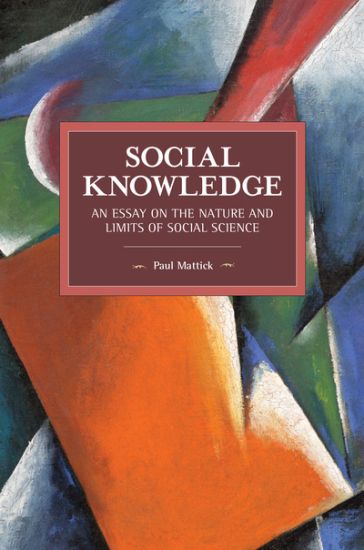
Social Knowledge

Social Knowledge

Paul Mattick

Haymarket Books
2021
pokkari
How is scientific knowledge of social life possible? If there are social sciences, must they employ methods different from those of the natural sciences? In Social Knowledge, Paul Mattick argues that the well-known difficulties of the social sciences -- in particular the predictive and explanatory failures of economics -- are due not to an inherent resistance of social life to scientific explanation, but to the failure of social scientists to include their own categories of social explanation among the objects of scientific study. Looking at Marx as an anthropological theorist, Mattick compares his critique of political economy with Evans-Pritchard 's analysis of Azande witchcraft. Just as the British anthropologist attempted to explain Azande ideas and rituals in terms of their place in native life, Marx wished to explain the continued faith in economics -- despite its striking weakness as a science -- in terms of the central role played by this system of ideas in the daily lives of natives of capitalist society. This comparison leads to the questions about the nature of scientific thinking and its relation to our everyday knowledge of social reality that are the subject of this book. Second edition, with a new Preface by the author. The first edition was published in 1986 by Hutchinson, ISBN 9780091654603.
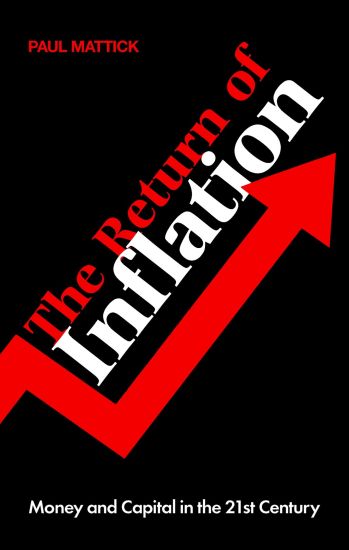
The Return of Inflation

The Return of Inflation

Paul Mattick

REAKTION BOOKS
2023
nidottu
The last year has seen the return of inflation as a preoccupation of political decision-makers, economists and the general public. After two decades of wondering why inflation was so low, despite vast economic stimulus, economists were surprised by the recent surge of price increases. Despite disagreement about what exactly is happening in the economy, there is unanimity that growth must be slowed in order to control inflation. To focus on inflation’s return, Paul Mattick looks at past and present, placing current events in the context of capitalism’s history. Exploring in novel terms the nature of money itself, he provides a concise, jargon-free understanding of recent inflation, and official efforts to control it, illuminating the state of our contemporary economy.