Kirjojen hintavertailu. Mukana 11 244 527 kirjaa ja 12 kauppaa.

Kirjahaku

Etsi kirjoja tekijän nimen, kirjan nimen tai ISBN:n perusteella.

6 kirjaa tekijältä Paul Rorem

Pseudo-Dionysius

Pseudo-Dionysius

Paul Rorem

Oxford University Press Inc
1993
sidottu
Dionysius the Areopagite is the peudonymous author of an influential body of early (about 500 AD) Christian theological texts. The Pseudo-Dionysian writings offer a synthesis of Christian dogma and Neo-platonic thought. Their leading idea which has made them the charter of Christian mysticism, is the intimate union between God and the soul and the progressive deification of man. In this book, Paul Rorem examines and elucidates these difficult texts and explores their profound influence on medieval theology both in the East and west. As Rorem shows, the Pseudo-Dionysian writings were regarded almost as a "Summa Theologica" in the Eastern Church. In the West, they were commented on by virtually all of the great medieval theologians. Thomas Aquinas alone cites Dionysius is some 1,700 places. Rorem is co-translator of the 1984 edition (Paulist Press) of the complete Pseudo-Dionysius (the first English-language edition in modern times) and provided the notes, indices, and bibliography. The present book will make these texts more accessible to both scholars and students. A comprehensive bibliography of secondary sources will be included.
Hugh of Saint Victor

Hugh of Saint Victor

Paul Rorem

Oxford University Press Inc
2009
sidottu
Born in Saxony in 1096, Hugh became an Augustinian monk and in 1115 moved to the monastery of Saint Victor, Paris, where he spent the remainder of his life, eventually becoming the head of the school there. His writings cover the whole range of arts and sacred science taught in his day. Paul Rorem offers a basic introduction to Hugh's theology, through a comprehensive survey of his works. He argues that Hugh is best understood as a teacher of theology, and that his numerous and varied writings are best appreciated as a comprehensive pedagogical program of theological education and spiritual formation. Drawing his evidence not only from Hugh's own descriptions of his work but from the earliest manuscript traditions of his writings, Rorem organizes and presents his corpus within a tri-part framework. Upon a foundation of training in the liberal arts and history, a structure of doctrine is built up, which is finally adorned with moral formation. Within this scheme of organization, Rorem treats each of Hugh's major works (and many minor ones) in its appropriate place, orienting the reader briefly yet accurately to its contents, as well as its location in Hugh's overarching program of theological pedagogy.
Hugh of Saint Victor

Hugh of Saint Victor

Paul Rorem

Oxford University Press Inc
2009
nidottu
Born in Saxony in 1096, Hugh became an Augustinian monk and in 1115 moved to the monastery of Saint Victor, Paris, where he spent the remainder of his life, eventually becoming the head of the school there. His writings cover the whole range of arts and sacred science taught in his day. Paul Rorem offers a basic introduction to Hugh's theology, through a comprehensive survey of his works. He argues that Hugh is best understood as a teacher of theology, and that his numerous and varied writings are best appreciated as a comprehensive pedagogical program of theological education and spiritual formation. Drawing his evidence not only from Hugh's own descriptions of his work but from the earliest manuscript traditions of his writings, Rorem organizes and presents his corpus within a tri-part framework. Upon a foundation of training in the liberal arts and history, a structure of doctrine is built up, which is finally adorned with moral formation. Within this scheme of organization, Rorem treats each of Hugh's major works (and many minor ones) in its appropriate place, orienting the reader briefly yet accurately to its contents, as well as its location in Hugh's overarching program of theological pedagogy.
Pseudo Dionysius

Pseudo Dionysius

Paul Rorem

Paulist Press International,U.S.
1987
nidottu
"Reading these books one is brought yet again to hope that our society as a whole will be seriously drawn to a more systematic study of the deeper aspects of man's life..." A.M. Allchin Pseudo-Dionysius: The Complete Works translation by Colm Luibheid forward, notes, and translation collaboration by Paul Rorem preface by René Roques introductions by Jaroslav Pelikan, Jean Leclercq, and Karlfried Froehlich "Indeed the inscrutable One is out of the reach of every rational process. Nor can any words come up to the inexpressible Good, this One, this Source of all unity, this supra existent Being. Mind beyond mind, word beyond speech, it is gathered up by no discourse, by no intuition, by no name." Pseudo-Dionysius (5th or 6th century) There are few figures in the history of Western Spirituality who are more enigmatic than the fifth or sixth-century writer known as the Pseudo-Dionysius. The real identity of the person who chose to write under the pseudonym of Dionysius the Areopagite is unknown. Even the exact dates of his writings have never been determined. Moreover the texts themselves, though relatively short, are at points seemingly impenetrable and have mystified readers over the centuries. Yet the influence of this shadowy figure on broad range of mystical writers from the early Middle Ages on is readily discernible. His formulation of a method of negative theology that stresses the impotence of humans' attempt to penetrate the "cloud of unknowing" is famous, as is his meditation on the divine names. Despite his influence, relatively few attempts have been made to translate the entire corpus of his written into English. Here in one volume are collected all of the Pseudo-Dionysius's works. Each has been translated from the Migne edition, with reference to the forthcoming Göttingen critical edition of A.M. Ritter, G. Heil, and B. Suchla. To present these works to the English-speaking public, an outstanding team of six research scholars has been assembled. The lucid translation of Colm Luibheid has been augmented by Paul Rorem's notes and textual collaboration. The reader is presented a rich and varied examination of the main themes of Dionysian spirituality by René Roques, an incisive discussion of the original questions of the authenticity and alleged heresies in the Dionysian corpus by Jaroslav Pelikan, a comprehensive tracing Dionysius'sinfluence on medieval authors by Jean Leclercq, and a survey by Karlfried Froehlich of the reception given the corpus by Humanists and sixteenth-century Reformers. †
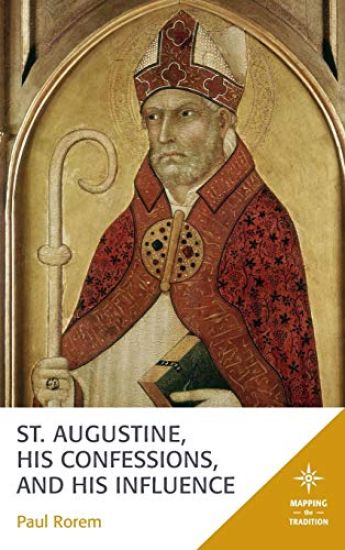
St. Augustine, His Confessions, and His Influence

St. Augustine, His Confessions, and His Influence

Paul Rorem

Lexington Books/Fortress Academic
2019
sidottu
This book introduces Augustine of Hippo and his influence on Christian theology. It introduces the reader to Augustine’s Confessions and their historical reception, especially during the Middle Ages and the Reformation. Part One works through all thirteen books of the Confessions, introducing the life and thought of the Bishop of Hippo with commentary on frequent but brief quotations. The Confessions reveal Augustine’s major doctrinal concerns, some of them explicitly and thoroughly (such as the Manichees, Platonists, scripture), others implicitly (monasticism, Donatism, ministry), and some in passing (Trinity) or as a preview (Pelagians). Part Two sketches the medieval reception of the Augustinian theological legacy, not chronologically but topically, in the order of the concerns in the Confessions, such as original sin, St. Monica, medieval Manichees, monastic communities, new Donatists, Neo-Platonism, the introspective soul, symbolic scripture, the Trinity, and above all the recurring Pelagian controversies over free will and grace, election and predestination, into the Reformation.