Kirjojen hintavertailu. Mukana 12 016 292 kirjaa ja 12 kauppaa.

Kirjahaku

Etsi kirjoja tekijän nimen, kirjan nimen tai ISBN:n perusteella.

6 kirjaa tekijältä Paula Rabinowitz

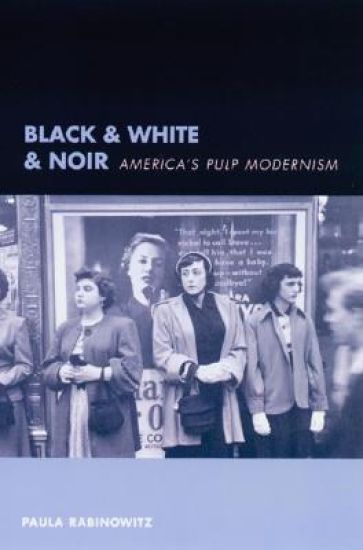
Black & White & Noir

Black & White & Noir

Paula Rabinowitz

Columbia University Press
2002
pokkari
Black & White & Noir explores America's pulp modernism through penetrating readings of the noir sensibility lurking in an eclectic array of media: Office of War Information photography, women's experimental films, and African-American novels, among others. It traces the dark edges of cultural detritus blowing across the postwar landscape, finding in pulp a political theory that helps explain America's fascination with lurid spectacles of crime. We are accustomed to thinking of noir as a film form popularized in movies like The Maltese Falcon, The Big Sleep, and, more recently, Quentin Tarantino's Pulp Fiction. But it is also, Paula Rabinowitz argues, an avenue of social and political expression. This book offers an unparalleled historical and theoretical overview of the noir shadows cast when the media's glare is focused on the unseen and the unseemly in our culture. Through far-ranging discussions of the Starr Report, movies such as Double Indemnity and The Big Heat, and figures as various as Barbara Stanwyck, Kenneth Fearing, and Richard Wright, Rabinowitz finds in film noir the representation of modern America's attempt to submerge and mask its violent history of racial and class anatagonisms. Black & White & Noir also explores the theory and practice of stilettos, the ways in which girls in the 1950s viewed film noir as a secret language about their mothers' pasts, the extraordinary tone-setting photographs of Esther Bubley, and the smutty aspect of social workers' case studies, among other unexpected twists and provocative turns.

American Pulp

American Pulp

Paula Rabinowitz

Princeton University Press
2014
sidottu
"There is real hope for a culture that makes it as easy to buy a book as it does a pack of cigarettes."--a civic leader quoted in a New American Library ad (1951) American Pulp tells the story of the midcentury golden age of pulp paperbacks and how they brought modernism to Main Street, democratized literature and ideas, spurred social mobility, and helped readers fashion new identities. Drawing on extensive original research, Paula Rabinowitz unearths the far-reaching political, social, and aesthetic impact of the pulps between the late 1930s and early 1960s. Published in vast numbers of titles, available everywhere, and sometimes selling in the millions, pulps were throwaway objects accessible to anyone with a quarter. Conventionally associated with romance, crime, and science fiction, the pulps in fact came in every genre and subject. American Pulp tells how these books ingeniously repackaged highbrow fiction and nonfiction for a mass audience, drawing in readers of every kind with promises of entertainment, enlightenment, and titillation. Focusing on important episodes in pulp history, Rabinowitz looks at the wide-ranging effects of free paperbacks distributed to World War II servicemen and women; how pulps prompted important censorship and First Amendment cases; how some gay women read pulp lesbian novels as how-to-dress manuals; the unlikely appearance in pulp science fiction of early representations of the Holocaust; how writers and artists appropriated pulp as a literary and visual style; and much more. Examining their often-lurid packaging as well as their content, American Pulp is richly illustrated with reproductions of dozens of pulp paperback covers, many in color. A fascinating cultural history, American Pulp will change the way we look at these ephemeral yet enduringly intriguing books.
American Pulp

American Pulp

Paula Rabinowitz

Princeton University Press
2016
pokkari
"There is real hope for a culture that makes it as easy to buy a book as it does a pack of cigarettes."--a civic leader quoted in a New American Library ad (1951) American Pulp tells the story of the midcentury golden age of pulp paperbacks and how they brought modernism to Main Street, democratized literature and ideas, spurred social mobility, and helped readers fashion new identities. Drawing on extensive original research, Paula Rabinowitz unearths the far-reaching political, social, and aesthetic impact of the pulps between the late 1930s and early 1960s. Published in vast numbers of titles, available everywhere, and sometimes selling in the millions, pulps were throwaway objects accessible to anyone with a quarter. Conventionally associated with romance, crime, and science fiction, the pulps in fact came in every genre and subject. American Pulp tells how these books ingeniously repackaged highbrow fiction and nonfiction for a mass audience, drawing in readers of every kind with promises of entertainment, enlightenment, and titillation. Focusing on important episodes in pulp history, Rabinowitz looks at the wide-ranging effects of free paperbacks distributed to World War II servicemen and women; how pulps prompted important censorship and First Amendment cases; how some gay women read pulp lesbian novels as how-to-dress manuals; the unlikely appearance in pulp science fiction of early representations of the Holocaust; how writers and artists appropriated pulp as a literary and visual style; and much more. Examining their often-lurid packaging as well as their content, American Pulp is richly illustrated with reproductions of dozens of pulp paperback covers, many in color. A fascinating cultural history, American Pulp will change the way we look at these ephemeral yet enduringly intriguing books.
Noir Affect

Noir Affect

Paula Rabinowitz

Fordham University Press
2020
pokkari
Noir Affect proposes a new understanding of noir as defined by negative affect. This new understanding emphasizes that noir is, first and foremost, an affective disposition rather than a specific cycle of films or novels associated with a given time period or national tradition. Instead, the essays in Noir Affect trace noir's negativity as it manifests in different national contexts from the United States to Mexico, France, and Japan and in a range of different media, including films, novels, video games, and manga. The forms of affect associated with noir are resolutely negative: These are narratives centered on loss, sadness, rage, shame, guilt, regret, anxiety, humiliation, resentment, resistance, and refusal. Moreover, noir often asks us to identify with those on the losing end of cultural narratives, especially the criminal, the lost, the compromised, the haunted, the unlucky, the cast-aside, and the erotically "perverse," including those whose greatest erotic attachment is to death. Drawing on contemporary work in affect theory, while also re-orienting some of its core assumptions to address the resolutely negative affects narrated by noir, Noir Affect is invested in thinking through the material, bodily, social, and political–economic impact of the various forms noir affect takes. If much affect theory asks us to consider affect as a space of possibility and becoming, Noir Affect asks us to consider affect as also a site of repetition, dissolution, redundancy, unmaking, and decay. It also asks us to consider the way in which the affective dimensions of noir enable the staging of various forms of social antagonism, including those associated with racial, gendered, sexual, and economic inequality. Featuring an Afterword by the celebrated noir scholar Paula Rabinowitz and essays by an array of leading scholars, Noir Affect aims to fundamentally re-orient our understanding of noir. Contributors: Alexander Dunst, Sean Grattan, Peter Hitchcock, Justus Nieland, Andrew Pepper, Ignacio Sánchez Prado, Brian Rejack, Pamela Thoma, Kirin Wachter-Grene
Noir Affect

Noir Affect

Paula Rabinowitz

FORDHAM UNIVERSITY PRESS
2020
sidottu
Noir Affect proposes a new understanding of noir as defined by negative affect. This new understanding emphasizes that noir is, first and foremost, an affective disposition rather than a specific cycle of films or novels associated with a given time period or national tradition. Instead, the essays in Noir Affect trace noir's negativity as it manifests in different national contexts from the United States to Mexico, France, and Japan and in a range of different media, including films, novels, video games, and manga. The forms of affect associated with noir are resolutely negative: These are narratives centered on loss, sadness, rage, shame, guilt, regret, anxiety, humiliation, resentment, resistance, and refusal. Moreover, noir often asks us to identify with those on the losing end of cultural narratives, especially the criminal, the lost, the compromised, the haunted, the unlucky, the cast-aside, and the erotically "perverse," including those whose greatest erotic attachment is to death. Drawing on contemporary work in affect theory, while also re-orienting some of its core assumptions to address the resolutely negative affects narrated by noir, Noir Affect is invested in thinking through the material, bodily, social, and political–economic impact of the various forms noir affect takes. If much affect theory asks us to consider affect as a space of possibility and becoming, Noir Affect asks us to consider affect as also a site of repetition, dissolution, redundancy, unmaking, and decay. It also asks us to consider the way in which the affective dimensions of noir enable the staging of various forms of social antagonism, including those associated with racial, gendered, sexual, and economic inequality. Featuring an Afterword by the celebrated noir scholar Paula Rabinowitz and essays by an array of leading scholars, Noir Affect aims to fundamentally re-orient our understanding of noir. Contributors: Alexander Dunst, Sean Grattan, Peter Hitchcock, Justus Nieland, Andrew Pepper, Ignacio Sánchez Prado, Brian Rejack, Pamela Thoma, Kirin Wachter-Grene
They Must Be Represented

They Must Be Represented

Paula Rabinowitz

Verso Books
1994
nidottu
They Must Be Represented examines documentary in print, photography, television and film from the 1930s through the 1980s, using the lens of recent feminist film theory as well as scholarship on race, class and gender emerging from the new interdisciplinary approach of American cultural studies. Paula Rabinowitz discusses the ways in which these four media shaped truth-claims and political agency over the decades: in the 1930s, about poverty, labor and popular culture during the depression; in the 1960s, about the Vietnam War, racism, work and counterculture; and in the 1980s, about feminist and gay critiques of gender, history, narrative and cinema.A great deal of documentary expression has been influenced by developments in cultural anthropology, as committed artists brought their cameras and typewriters into the field not only to report, but also to change the world. Yet recently the projects of both anthropology and documentary have come under scrutiny. Rabinowitz argues that the gendering of vision that occurs when narratives confirm to conventional genres profoundly affects the relation of documentarian to subject. She goes on to define this gendering of vision in documentary as an ethnographic process. Ultimately, this polemical study challenges the construction of the spectator in psychoanalytic film theory, and articulates a new model for theorizing power relations in culture and history.