Kirjojen hintavertailu. Mukana 12 083 983 kirjaa ja 12 kauppaa.

Kirjahaku

Etsi kirjoja tekijän nimen, kirjan nimen tai ISBN:n perusteella.

26 kirjaa tekijältä Perry Anderson

English Questions

English Questions

Perry Anderson

Verso Books
1992
nidottu
A set of reflections on British society and culture, this volume falls into two principal parts. The first consists of a pair of essays published in New Left Review in the sixties; "Origins of the Present Crisis," which suggested a general schema for the analysis of class and power in modern Britain and their relation to its decline; and "Components of the National Culture," which looked at the pattern of intellectual disciplines associated with the post-war political consensus. One premise of these accounts was a conception of bourgeois revolution, whose critique is sketched in a short intermezzo from the mid seventies.The second part contains two essays published in the late eighties which review the conjectures of the original texts in the light of developments-political and intellectual-of the subsequent decades. "The Figures of Descent" reconsiders the problem of national decline; "A Culture in Contraflow" traces some of the intellectual reversals of the recent period. The book concludes with a survey of the political conjuncture after the fall of Thatcher, which considers the prospects of the Labour Party within the context of the wider changes that have reshaped European social democracy in these years.
A Zone of Engagement

A Zone of Engagement

Perry Anderson

Verso Books
1992
nidottu
The texts in this volume offer critical assessments of a number of leading figures in contemporary intellectual life, who are in different ways thinkers at the intersection of history and politics. They include Roberto Unger, advocate of plasticity; the historians of antiquity and of revolution, Geoffrey de Ste. Croix and Isaac Deutscher; the philosophers of liberalism, Norberto Bobbio and Isaiah Berlin; the sociologists of power, Michael Mann and W.G. Runciman; the exponents of national identity, Andreas Hillgruber and Fernand Braudel; the ironists of science, Max Weber and Ernest Gellner; Carlo Ginzburg, explorer of cultural continuity, and Marshall Berman, herald of modernity. A concluding chapter looks at the idea of the end of history, recently advanced by Francis Fukuyama, in its successive versions from the nineteenth century to the present, and considers the situation of socialism today in the light of it.
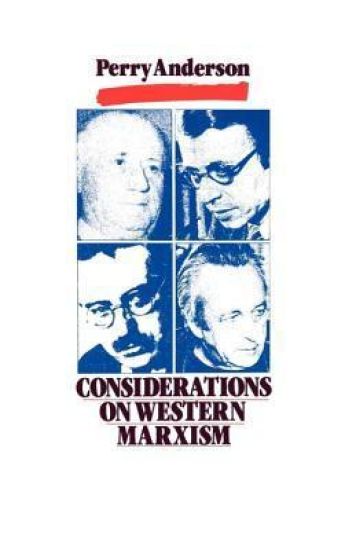
Considerations on Western Marxism

Considerations on Western Marxism

Perry Anderson

Verso Books
1976
nidottu
This synoptic essay considers the nature and evolution of the Marxist theory that developed in Western Europe, after the defeat of the proletarian rebellions in the West and the isolation of the Russian Revolution in the East in the early 1920s. It focuses particularly on the work of Lukács, Korsch and Gramsci; Adorno, Marcuse and Benjamin; Sartre and Althusser; and Della Volpe and Colletti, together with other figures within Western Marxism from 1920 to 1975. The theoretical production of each of these thinkers is related simultaneously to the practical fate of working-class struggles and to the cultural mutations of bourgeois thought in their time. The philosophical antecedents of the various school within this tradition - Lukácsian, Gramscian, Frankfurt, Sartrean, Althusserian and Della Volpean - are compared, and the specific innovations of their respective systems surveyed. The structural unity of 'Western Marxism', beyond the diversity of its individual thinkers, is then assessed, in a balance-sheet that contrasts its heritage with the tradition of 'classical' Marxism that preceded it, and with the commanding problems which will confront any historical materialism to succeed it.
Arguments Within English Marxism

Arguments Within English Marxism

Perry Anderson

Verso Books
1980
nidottu
The characteristic form taken by English Marxism since the war has been the study of history. No writer exemplifies its achievements better than Edward Thompson, whose Making of the English Working Class is probably the most influential single work of historical scholarship by a socialist today. An editor of The New Reasoner in 1957-59, a founder of the New Left in 1960, now an eloquent champion of civil rights, Thompson has most recently aroused widespread interest with the appearance of his Poverty of Theory, which combines philosophical and political polemic with Louis Althusser, and powerful advocacy of the historian's craft. Arguments Within English Marxism is an assessment of its central theses that relates them to Thompson's major historical writings themselves. Thus the role of human agency-the part of the conscious choice and active will-in history is discussed through consideration of its treatment in The Making of the English Working Class. The problems of base and superstructure in historical materialism, and of affiliation to values in the past, are reviewed in the light of Whigs and Hunters. The claims of utopian imagination are illustrated from the findings of William Morris. Questions of socialist strategy are broached in part through the articles now collected in Writing by Candlelight. Exploring at once differences and convergences between New Left Review and one of its founders, the essay concludes by suggesting the virtues of diversity within a common socialist culture.
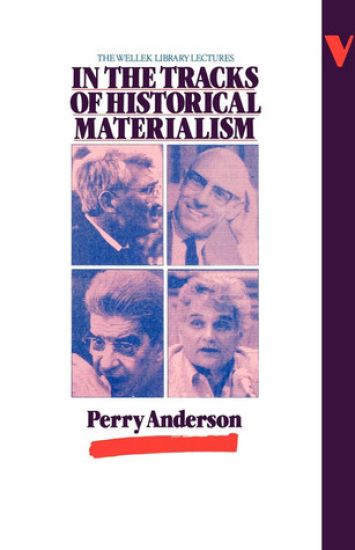
In the Tracks of Historical Materialism
What have been the major changes in the intellectual landscape of the left since the mid seventies? Have they on balance represented an emancipation or a retreat for socialist culture as a whole? In the Tracks of Historical Materialism looks at some of the paradoxes in the evolution of Marxist thought in this period. It starts by considering the remarkable and variegated growth of historical materialism in the Anglo-American world, spreading across a broad field from history to economics, politics to literature, sociology to philosophy. By contrast, the same years have seen a drastic recession of Marxist influences in the Latin cultures where it was traditionally strong-France or Italy. Its main theoretical challengers there proved to be successive forms of structuralism and post-structuralism. The common coordinates of these-tracing the outer bounds of the work of Levi-Strauss or Lacan, Foucault or Derrida-are surveyed and criticized, in the light of the inherent limitations of the language model from which they derived. In Germany, on the other hand, the theoretical scene has been largely dominated by the accumulating work of Habermas, with its roots in the Frankfurt School. Yet Habermas's philosophy also reveals unexpected affinities with the trend of prevalent Parisian concerns, in its unifying emphasis on communication-while at the same time diverging from them in the constancy of its political commitments. The historical background of international class struggles against which these variant fates of Marxism in the west were played out is then explored, with special attention to the interconnection between the destinies of Maoism and Eurocommunism. What, finally, is the nature of the relationship between Marxism as a theory and socialism as a goal? A conclusion reviews the wider issues posed for the labour movement by the rise of the peace movement and the women's movement, and suggests a range of priorities for the further development of Marxist thought in the eighties.
Passages from Antiquity to Feudalism

Passages from Antiquity to Feudalism

Perry Anderson

Verso Books
2013
nidottu
Passages from Antiquity to Feudalism is a sustained exercise in historical sociology that shows how the slave-based societies of Ancient Greece and Rome eventually became the feudal societies of the Middle Ages. In the course of this study, Anderson vindicates and refines the explanatory power of historical materialism, while casting a fascinating light on the Ancient world, the Germanic invasions, nomadic society, and the different routes taken to feudalism in Northern, Mediterranean, Eastern and Western Europe.Through this work and its companion volume, Lineages of the Absolutist State, Anderson presents a Marxist history of Western political development that takes readers from the first stirrings of political consciousness in the classical world to the rise of absolutist monarchies in Europe and the birth of the modern epoch.
Lineages of the Absolutist State

Lineages of the Absolutist State

Perry Anderson

Verso Books
2013
nidottu
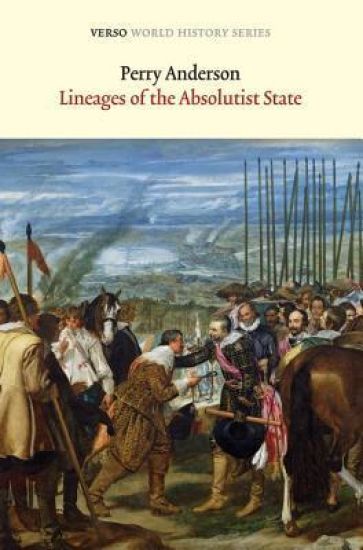
Forty years after its original publication, Lineages of the Absolutist State remains an exemplary achievement in comparative history. Picking up from where its companion volume, Passages from Antiquity to Feudalism, left off, Lineages traces the development of Absolutist states in the early modern period from their roots in European feudalism, and assesses their various trajectories. Why didn't Italy develop into an Absolutist state in the same, indigenous way as the other dominant Western countries, namely Spain, France and England? On the other hand, how did Eastern European countries develop into Absolutist states similar to those of the West, when their social conditions diverged so drastically? Reflecting on examples in Islamic and East Asian history, as well as the Ottoman Empire, Anderson concludes by elucidating the particular role of European development within universal history.
The Indian Ideology

The Indian Ideology

Perry Anderson

Verso Books
2013
nidottu
Today, the Indian state claims to possess a harmonious territorial unity, to embody the values of a stable political democracy, and to adhere to a steadfast religious impartiality. Even many of those critical of the inequalities of Indian society still underwrite such claims. But does the "idea of India" correspond to the realities of the Union?The Indian Ideology suggests that the roots of the republic's current ills go very deep, historically. They lie in the way the struggle for independence culminated in the transfer of power from British rule to Congress in a divided subcontinent, not least in the roles played by Gandhi, as the great architect of the movement, and Nehru, as his appointed successor, in the catastrophe of partition. Only an honest reckoning with that disaster, Perry Anderson argues, offers an understanding of what was has gone wrong since independence.Revisiting a century's history, and sifting the uncomfortable realities from the ideology, Anderson offers an alternative way to look at the story of the nation, and the nature of a state that is less in conflict with caste than built upon it.
American Foreign Policy and Its Thinkers
Since the birth of the nation, impulses of empire have been close to the heart of the United States. How these urges interact with the way the country understands itself, and the nature of the divergent interests at work in the unfolding of American foreign policy, is a subject much debated and still obscure. In a fresh look at the topic, Anderson charts the intertwined historical development of America's imperial reach and its role as the general guarantor of capital.The internal tensions that have arisen are traced from the closing stages of the Second World War through the Cold War to the War on Terror. Despite the defeat and elimination of the USSR, the planetary structures for warfare and surveillance have not been retracted but extended. Anderson ends with a survey of the repertoire of US grand strategy, as its leading thinkers-Brzezinski, Mead, Kagan, Fukuyama, Mandelbaum, Ikenberry, Art and others-grapple with the tasks and predicaments of the American imperium today.
The H-Word

The H-Word

Perry Anderson

Verso Books
2022
nidottu
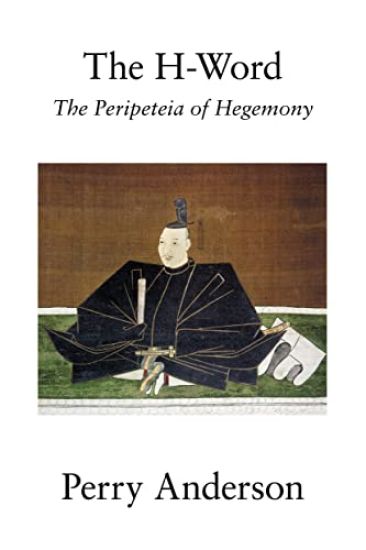
Few terms are so widely used in the literature of international relations and political science, with so little agreement about their exact meaning, as hegemony.In the first full historical study of its fortunes as a concept, Perry Anderson traces its emergence in Ancient Greece and its rediscovery during the upheavals of 1848-1849 in Germany. He then follows its checkered career in revolutionary Russia, fascist Italy, Cold War America, Gaullist France, Thatcher's Britain, post-colonial India, feudal Japan, Maoist China, eventually arriving at twenty-first-century US geopolitics and Germany's place within an expanded European Union. The result is a surprising and fascinating expedition into global intellectual history.
The Antinomies of Antonio Gramsci

The Antinomies of Antonio Gramsci

Perry Anderson

Verso Books
2020
nidottu
An explosive analysis of the central strategic concepts in Gramsci's thought, as revelatory today as on first publication in New Left Review in 1976. This landmark essay has been the subject of keen debate across four decades for its disentangling of the hesitations and contradictions in Gramsci's highly original usage of such key dichotomies as East and West, domination and direction, hegemony and dictatorship, state and civil society, war of position and war of movement. In a critical tribute to the international richness of Gramsci's work, Anderson shows how deeply embedded these notions were in the revolutionary debates in Tsarist Russia and Wilhemine Germany, in which arguments criss-crossed between Plekhanov, Lenin, Kautsky, Luxemburg, Lukács and Trotsky, with contemporary echoes in Brecht and Benjamin. A preface considers the objections this account of Gramsci provoked, as well as a memorable intervention by the late Eric Hobsbawm.
The Indian Ideology

The Indian Ideology

Perry Anderson

Verso Books
2021
nidottu
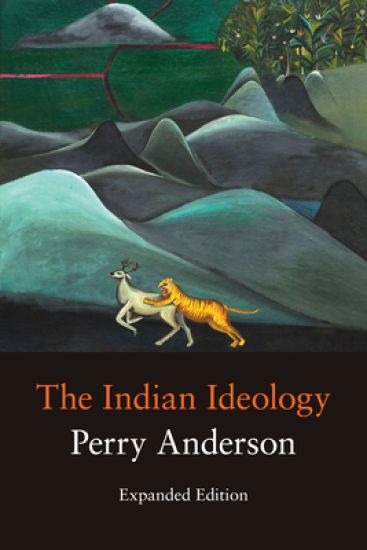
The historiography of modern India is largely a pageant of presumed virtues: harmonious territorial unity, religious impartiality, the miraculous survival of electoral norms in the world's most populous democracy. Even critics of injustices within Indian society still underwrite such claims. But how well does the 'Idea of India' correspond to the realities of the Union?In an iconoclastic intervention, Marxist historian Perry Anderson provides an unforgettable reading of the Subcontinent's passage through Independence and the catastrophe of Partition, the idiosyncratic and corrosive vanities of Gandhi and Nehru, and the close interrelationship of Indian democracy and caste inequality. The Indian Ideology caused uproar on first publication in 2012, not least for breaking with euphemisms for Delhi's occupation of Kashmir. This new, expanded edition includes the author's reply to his critics, an interview with the late Praful Bidwai of the Indian weekly Outlook, and a postscript on India under the rule of Narendra Modi. Anderson considers whether his regime is as much of a break with the practices and thought processes of Congress rule as is generally supposed.
Brazil Apart

Brazil Apart

Perry Anderson

Verso Books
2019
sidottu
What does Brazil's lurch to the hard right under Jair Bolsonaro portend for Latin America's most populous society, and how has it come about? Perry Anderson, foremost observer of the Brazilian scene in the English-speaking world, offers a matchless account of the country's recent political upheavals: after the dashed hopes of the Cardoso years, the soaring popularity of Luiz Inácio Lula da Silva; the parliamentary coup d'état against his successor, Dilma; and the sweeping election victory of Bolsonaro, backed by the Armed Forces and a youthful new right. Always something of a world unto itself, under the Workers' Party, Brazil had bucked the global trend towards a tighter neoliberalism. With its lodestar, Lula, now behind bars, a weighing up of the PT's legacy, and of the contrasting Bolsonaro regime, is urgently needed.
Different Speeds, Same Furies

Different Speeds, Same Furies

Perry Anderson

Verso Books
2022
sidottu
There are few writers about whom opinions diverge so widely as Anthony Powell, whose Dance to the Music of Time sequence is one of the most ambitious literary constructions in the English language. In Different Speeds, Same Furies, Perry Anderson measures Powell's achievement against Marcel Proust's celebrated In Search of Lost Time.The literature on Dance is a drop in the ocean compared to that on Proust. Yet in construction of plot and depiction of character, Anderson ranks Powell above him. How much do particular advantages of this kind matter, and why is Powell an odd man out in English letters? At once so similar and dissimilar, the intricate retrospectives of the two novelists on bohemia and Society, upbringing and mortality, relationships and personality, invite interrelated judgements. The closing chapters of Different Speeds, Same Furies reach beyond their handlings of time to chart the historical novel from Waverley to Underworld, and the breakthrough in epistolatory fiction of Montesquieu's Persian Letters, held together by what its author described as 'a secret chain which remains, as it were, invisible'.
Disputing Disaster

Disputing Disaster

Perry Anderson

Verso Books
2024
sidottu
In Disputing Disaster, Perry Anderson picks out from the highly charged historiography on the First World War one leading historian from each of the major powers that survived the conflagration: Fritz Fischer, famous historian of German war guilt; Pierre Renouvin, a disabled serviceman and preeminent authority on the conflict in France; Luigi Albertini, the Italian newspaper tycoon who, unique among scholars of the Great War, played a part in pitching his country into it; Paul W. Schroeder, the American expert on the system of Europe - an interstate relations and its breakdown in 1914; Keith Wilson, the one radical deviant from a patriotic consensus about Britain's role in the outbreak of the fighting; and, from Australia (summoned into the war as a dominion), Christopher Clark, acclaimed author of The Sleepwalkers.Disputing Disaster offers a compelling analysis of the major competing versions of the genesis of the Great War; fresh light on the political background of its leading historians; and a novel synthesis of the determining pressures that brought the conflict to pass.Perry Anderson is emeritus in History at UCLA, and an editor at New Left Review. Recent work: Different Speeds, Same Furies, a comparative study of Anthony Powell and Marcel Proust.
Ever Closer Union?

Ever Closer Union?

Perry Anderson

Verso Books
2021
sidottu
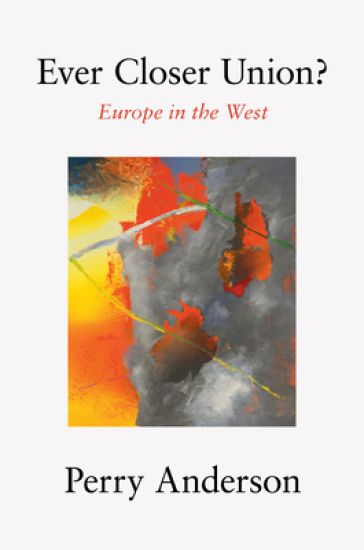
The European Union is a political order of peculiar stamp and continental scope, its polity of 446 million the third largest on the planet, though with famously little purchase on the conduct of its representatives. Sixty years after the founding treaty, what sort of structure has crystallised, and does the promise of ever closer union still obtain?Against the self-image of the bloc, Perry Anderson poses the historical record of its assembly. He traces the wider arc of European history, from First World War to Eurozone crisis, the hegemony of Versailles to that of Maastricht, and casts the work of the EU's leading contemporary analysts - both independent critics and court philosophers - in older traditions of political thought. Are there likenesses to the age of Metternich, lessons in statecraft from that of Machiavelli? An excursus on the UK's jarring departure from the Union considers the responses it has met with inside the country's intelligentsia, from the contrite to the incandescent. How do Brussels and Westminster compare as constitutional forms? Differently put, which could be said to be worse?
Spectrum

Spectrum

Perry Anderson

Verso Books
2007
nidottu
The focus of Spectrum is the range of contemporary ideas that runs from conservative to liberal to radical conceptions of state and society, rarely considered in the same optic. It looks at the theories of major minds of the twentieth-century Right, including Carl Schmitt, Leo Strauss and Friedrich von Hayek; liberal philosophers such as John Rawls, Jurgen Habermas and Norberto Bobbio; and significant figures in the culture of the Left: the historians Edward Thompson, Robert Brenner and Eric Hobsbawm; the classicist Sebastiano Timpanaro; the sociologist Goran Therborn; the novelist Gabriel Garcia Marquez. The book concludes with some comparative observations on the two leading intellectual periodicals of the UK and USA, the London Review of Books and New York Review of Books; and a piece of family history.
The New Old World

The New Old World

Perry Anderson

Verso Books
2011
nidottu
The New Old World looks at the history of the European Union, the core continental countries within it, and the issue of its further expansion into Asia. It opens with a consideration of the origins and outcomes of European integration since the Second World War, and how today's EU has been theorized across a range of contemporary disciplines. It then moves to more detailed accounts of political and cultural developments in the three principal states of the original Common Market-France, Germany and Italy. A third section explores the interrelated histories of Cyprus and Turkey that pose a leading geopolitical challenge to the Community. The book ends by tracing ideas of European unity from the Enlightenment to the present, and their bearing on the future of the Union. The New Old World offers a critical portrait of a continent now increasingly hailed as a moral and political example to the world at large.
The Origins of Postmodernity

The Origins of Postmodernity

Perry Anderson

Verso Books
1998
nidottu
Where does the idea of the postmodern come from? Who first conceived, and who developed it? How have its meanings changed? What purposes do they serve? These are the questions addressed in The Origins of Postmodernity. The answers take us from Lima to Angkor, to Paris and Munich, to China and the stars. At the center of the story is the figure of Fredric Jameson, theorist supreme of postmodernism. What happens to art, time, politics, in the age of the spectacle? What has ended, and what has begun?
Red to Black

Red to Black

Perry Anderson

Perry Anderson
2019
sidottu
Everywhere you look, businesses are closing their doors - both recent startups and long-standing establishments. No matter which statistics you read, it seems that the odds are against success for small-to-medium- sized businesses. Is closing the doors inevitable once the balance sheet reads red so many months in a row? Perry M. Anderson replies with a resounding No This book offers hope and help to distressed business owners and managers in need of an immediate turn-around solution. Perry understands that it is not "just a business." Instead, it is the livelihoods that real families depend on. Appreciative of the urgency with which complex and high-impact decisions must be made, he delineates those tasks that must be done now in order to stave off the creditors, and the steps to undertake next in bringing the company back from the brink. In compassionate yet no-nonsense terms, Mr. Anderson shines a light through the shadow of bankruptcy onto the landscape of business turnaround.