Kirjojen hintavertailu. Mukana 11 244 527 kirjaa ja 12 kauppaa.

Kirjahaku

Etsi kirjoja tekijän nimen, kirjan nimen tai ISBN:n perusteella.

4 kirjaa tekijältä Perry Bush

Peace, Progress and the Professor

Peace, Progress and the Professor

Perry Bush

Herald Press (VA)
2015
pokkari
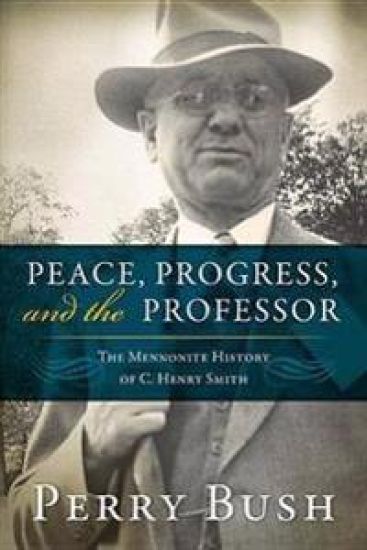
What does it mean to be Mennonite in the modern world? And what is the witness of a peace church that is always at risk of splintering? C. Henry Smith--son of an Amish family, erudite historian, urbane bank president, and pioneer of Mennonite scholarship--sought answers to these questions in the middle of the 20th century, and his answers reverberate through the church to this day.In this engaging narrative biography, historian Perry Bush chronicles Smith's childhood in an Illinois farming community, his youthful turn toward intellectual inquiry, and his confidence that Anabaptist faith and life offer gifts to the wider world. By recounting the story of one of the foremost Mennonite intellectuals, Bush surveys the storied terrain of 20th-century Mennonite identity in its selective borrowing from wider culture and its tentative embrace of progressive reforms and higher education, and growing conviction that Anabaptism served as a taproot of Western civilization. Bush argues that Smith's body of historical writing furnished a new generation of Mennonites with both an understanding of their shared past and the tools to navigate an ever-shifting present.Volume 49 in the Studies in Anabaptist and Mennonite History Series.
Peace, Progress, and the Professor

Peace, Progress, and the Professor

Perry Bush

Herald Press (VA)
2015
sidottu
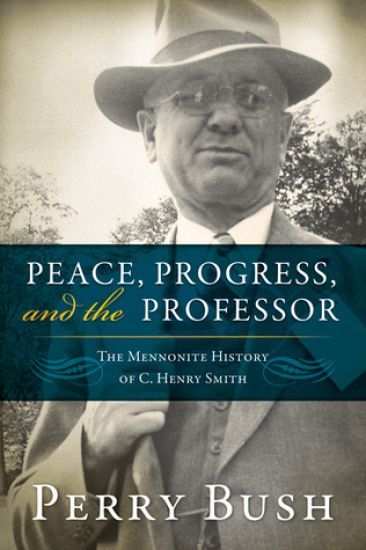
What does it mean to be Mennonite in the modern world? And what is the witness of a peace church that is always at risk of splintering? C. Henry Smith--son of an Amish family, erudite historian, urbane bank president, and pioneer of Mennonite scholarship--sought answers to these questions in the middle of the 20th century, and his answers reverberate through the church to this day. In this engaging narrative biography, historian Perry Bush chronicles Smith's childhood in an Illinois farming community, his youthful turn toward intellectual inquiry, and his confidence that Anabaptist faith and life offer gifts to the wider world. By recounting the story of one of the foremost Mennonite intellectuals, Bush surveys the storied terrain of 20th-century Mennonite identity in its selective borrowing from wider culture and its tentative embrace of progressive reforms and higher education, and growing conviction that Anabaptism served as a taproot of Western civilization. Bush argues that Smith's body of historical writing furnished a new generation of Mennonites with both an understanding of their shared past and the tools to navigate an ever-shifting present. Key points: - Biography of one of the premier Mennonite intellectuals in the 20th century - Volume 49 in the Studies in Anabaptist and Mennonite History Series. 464 Pages.
Rust Belt Resistance

Rust Belt Resistance

Perry Bush

Kent State University Press
2012
sidottu
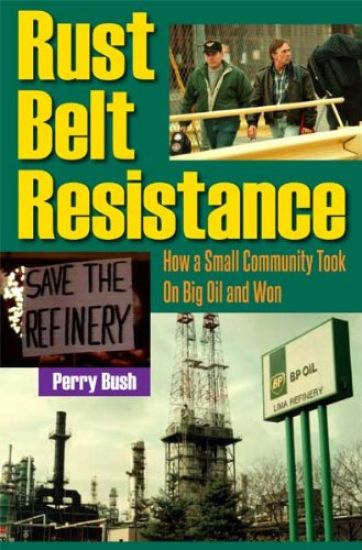
Since the 1970s, urban communities across the country have had to face the wrenching process of economic restructuring. As the media announce the latest plant closings and politicians slam each other for outsourcing jobs, events are too often framed with a kind of economic determinism that denies agency to individual communities. To what degree can industrial cities in such an era still imagine themselves as authors of their own economic fates? In Rust Belt Resistance, author Perry Bush explores this question by focusing on the small midwestern city of Lima, Ohio. When British Petroleum (BP) announced late in 1996 that it would close and demolish its refinery there—which at the time employed 500 people with a $31.5 million payroll—economic desperation loomed. Lima's story, however, deviated from the usual sad narrative of other Midwest plant closures and began to assume a drama of its own.Led by an unlikely cast of characters—an uncommonly stubborn set of civic leaders, a conservative local newspaper publisher, and the city's determined and progressive mayor—Lima refused to take its place quietly on the industrial scrap heap. Instead of collapsing in despair, the refinery's workers continued to function as a model of industrial efficiency and hard work, partly in a determined effort to build profitability and preserve their jobs and also because hard work was the essence and tradition of this blue-collar town.In a story replete with a number of dramatic twists and turns, Bush describes how this collection of individuals led a resistant multinational corporation to a financial deal it could not refuse, located an acceptable buyer for the refinery, and saved not only a sizable share of the city's financial foundation but also the community's identity and self-respect. Rust Belt Resistance is a valuable instructional lesson for business and community leaders, scholars, and anyone interested in the continuing viability of American industrial cities.
Rust Belt Resistance

Rust Belt Resistance

Perry Bush

Kent State University Press
2013
nidottu
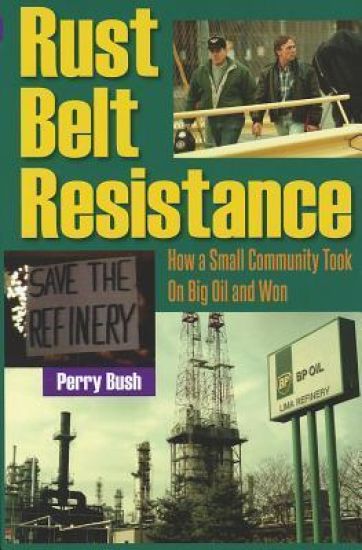
Since the 1970s, urban communities across the country have had to face the wrenching process of economic restructuring. As the media announce the latest plant closings and politicians slam each other for outsourcing jobs, events are too often framed with a kind of economic determinism that denies agency to individual communities. To what degree can industrial cities in such an era still imagine themselves as authors of their own economic fates? In Rust Belt Resistance, author Perry Bush explores this question by focusing on the small midwestern city of Lima, Ohio. When British Petroleum (BP) announced late in 1996 that it would close and demolish its refinery there—which at the time employed 500 people with a $31.5 million payroll—economic desperation loomed. Lima's story, however, deviated from the usual sad narrative of other Midwest plant closures and began to assume a drama of its own.Led by an unlikely cast of characters—an uncommonly stubborn set of civic leaders, a conservative local newspaper publisher, and the city's determined and progressive mayor—Lima refused to take its place quietly on the industrial scrap heap. Instead of collapsing in despair, the refinery's workers continued to function as a model of industrial efficiency and hard work, partly in a determined effort to build profitability and preserve their jobs and also because hard work was the essence and tradition of this blue-collar town.In a story replete with a number of dramatic twists and turns, Bush describes how this collection of individuals led a resistant multinational corporation to a financial deal it could not refuse, located an acceptable buyer for the refinery, and saved not only a sizable share of the city's financial foundation but also the community's identity and self-respect. Rust Belt Resistance is a valuable instructional lesson for business and community leaders, scholars, and anyone interested in the continuing viability of American industrial cities.