Kirjojen hintavertailu. Mukana 11 507 730 kirjaa ja 12 kauppaa.

Kirjahaku

Etsi kirjoja tekijän nimen, kirjan nimen tai ISBN:n perusteella.

12 kirjaa tekijältä Peter Baxter

Gandhi, Smuts and Race in the British Empire

Gandhi, Smuts and Race in the British Empire

Peter Baxter

PEN SWORD BOOKS LTD
2025
nidottu
Towards the end of 1906, a meeting took place between two emerging giants of the age, Mohandas K. Gandhi and General Jan Christian Smuts. United under the same empire, but separated by distance and culture, Smuts was born in the Cape Colony, and Gandhi in Porbandar, a duchy of the Indian province of Gujarat. Both, however, went on to study law in Britain, and while developing a great admiration for the institutions of empire, each man also suffered his own particular crisis of faith. From their widely dispersed origins, Gandhi and Smuts collided over the issue of race and equality in a turbulent province of the empire, each attempting to hold the British to their stated ideals. This insightful book explores attitudes to race, and belonging, in an age when the English speaking peoples straddled the globe, and sought to impose on all of their subject races, basking under the radiance of Britannia, a common ideal of parity, equal opportunity and free movement.
After the Lost Franklin Expedition

After the Lost Franklin Expedition

Peter Baxter

Pen Sword History
2020
nidottu
The fate of the lost Franklin Expedition of 1847 is an enigma that has tantalised generations of historians, archaeologists and adventurers. The expedition was lost without a trace and all 129 men died in what is arguably the worst disaster in Britain's history of polar exploration. In the aftermath of the crew's disappearance, Lady Jane Franklin, Sir John's widow, maintained a crusade to secure her husband's reputation, imperiled alongside him and his crew in the frozen wastes of the Artic. Lady Franklin was an uncommon woman for her age, a socially and politically astute figure who ravaged anyone who she viewed as a threat to her husband's legacy. Meanwhile John Rae, an explorer and employee of the Hudson Bay Company, recovered deeply disturbing information from the Expedition. His shocking conclusions embroiled him in a bitter dispute with Lady Franklin which led to the ruin of his reputation and career. Against the background of Victorian society and the rise of the explorer celebrity, we learn of Lady Franklin's formidable grit to honour her husband's legacy; of John Rae being discredited and his eventual ruin, despite later being proven right. It is a fascinating assessment of the aftermath of the Franklin Expedition and its legacy.
Rhodesia: A Complete History 1890-1980

Rhodesia: A Complete History 1890-1980

Peter Baxter

Independently Published
2018
nidottu
Before there was Zimbabwe, there was Rhodesia, a British colony founded by the great capital imperialist Cecil John Rhodes, and administered by the British South Africa Company. Rhodesia was the last British territory in Africa, and the most difficult to divest. This is the story of a gifted land, bitterly contested as the final imperial chapter in Africa. Through war and peace, following the careers of some of the great African leaders of the modern age, this was the last, painful transition from colonial to liberated Africa.A story intricately told and meticulously researched. For all enthusiasts of African and British Imperial history, this book is a must read
Can Anyone Hear Me?

Can Anyone Hear Me?

Peter Baxter

Icon Books Ltd
2013
pokkari
For 25 years Peter Baxter toured the world for the BBC, producing and commentating on Test Match Special from India and Pakistan to New Zealand and the West Indies.Drawing extensively on his tour diaries, and with a cast including Henry Blofeld, Jonathan Agnew and the late Christopher Martin-Jenkins, Baxter vividly takes us behind the scenes of TMS on tour - from the threat of arrest in Zimbabwe to commentating from the ramparts of a fort in Sri Lanka.With summaries of some of the most memorable foreign Tests, this funny and revealing book is the ideal companion to an afternoon in the pavilion.'The stories are told with avuncular warmth and no little charm.' Rob Smyth, The Cricketer
France in Centrafrique

France in Centrafrique

Peter Baxter

Helion Company
2019
nidottu
France in Centrafrique explores the early colonial and post-colonial history of French Equatorial Africa with a particular emphasis on the role of the Central African Republic in the Second World War and the Free French Movement. One of the key figures to emerge from this period, and a man who would shape the modern destiny of the Central African Republic, was Jean-Bédel Bokassa. Bokassa served alongside the Free French under General Charles de Gaulle and later in the metropolitan French military as an NCO in Indo-China. The narrative traces his ascent from these humble beginnings to his position as one of the region’s most notorious dictators, exploring both his excesses of violence and personal aggrandizement and the role played by France and the wide-reaching Foccart intelligence network in his rise and fall. Baxter examines the past and present relationship of France with her erstwhile African colonial possessions, giving substance to the cause and effect of the many French interventions and the play of various individual personalities, both French and African, and how this has affected the current complexion of the region and its ongoing relationship with France. The book traces the overt and covert French military actions in the region, the rise of internal violence and insecurity and the increasing involvement of the international community in the series of coups and counter-coups that characterized the 1990s and the new century. Featured are Operation Barracuda, Operations Almandin I, II and II, Operation Boali and the various regional, international and European regional interventions.
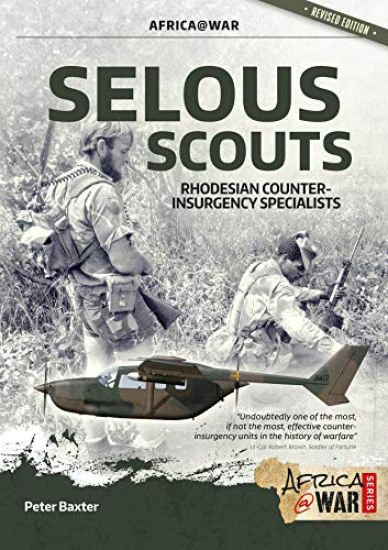
Selous Scouts

Selous Scouts

Peter Baxter

Helion Company
2019
nidottu
Formed in 1973 by the legendary Lieutenant-Colonel Ron Reid-Daly at the behest of Rhodesian military supremo General Peter Walls, the Selous Scouts were to write their name into the annals of military history as one of the finest counterinsurgency units of all time, through their innovative pseudo-guerrilla tactics, brilliant reconnaissance operations into Zambia and Botswana and daring flying-column raids into Mozambique. Feared and hated by the liberation movements ZIPRA and ZANLA, the Scouts wreaked untold havoc and destruction on their Soviet- and Chinese-backed enemies, accounting for 68% of guerrilla casualties within Rhodesia alone during the bitter bush war of the 1970s. Uniquely ahead of its time, the regiment - a brotherhood of men that traversed cultural and racial barriers; their Shona motto was 'Pamwe Chete' (together only) - was to produce the type of soldier that earned for the unit one Grand Cross of Valour, nine Silver Crosses and 22 Bronze Crosses of Rhodesia.
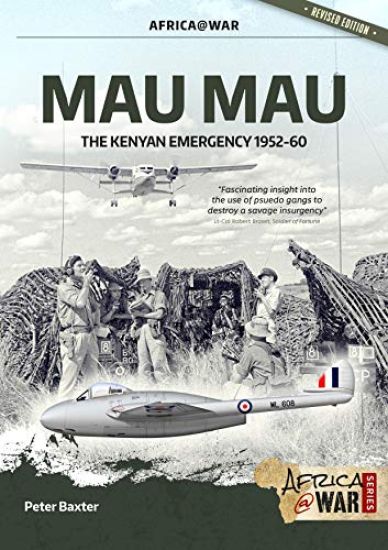
Mau Mau

Mau Mau

Peter Baxter

Helion Company
2019
nidottu
The Second World War forever altered the complexion of the British Empire. From Cyprus to Malaya, from Borneo to Suez, the dominoes began to fall within a decade of peace in Europe. Africa in the late 1940s and 1950s was energized by the grant of independence to India, and the emergence of a credible indigenous intellectual and political caste that was poised to inherit control from the waning European imperial powers. The British on the whole managed to disengage from Africa with a minimum of ill feeling and violence, conceding power in the Gold Coast, Nigeria and Sierra Leone under an orderly constitutional process, and engaging only in the suppression of civil disturbances in Nyasaland and Northern Rhodesia as the practicalities of a political handover were negotiated. In Kenya, however, matters were different. A vociferous local settler lobby had accrued significant economic and political authority under a local legislature, coupled with the fact that much familial pressure could be brought to bear in Whitehall by British settlers of wealth and influence, most of whom were utterly irreconciled to the notion of any kind of political handover. Mau Mau was less than a liberation movement, but much more than a mere civil disturbance. Its historic importance is based primarily on the fact that the Mau Mau campaign was one of the first violent confrontations in sub-Saharan Africa to take place over the question of the self-determination of the masses. It also epitomized the quandary suffered by the white settler communities of Africa who had been promised utopia in an earlier century, only to be confronted in a post-war world by the completely unexpected reality of black political aspiration. This book journeys through the birth of British East Africa as a settled territory of the Empire, and the inevitable politics of confrontation that emerged from the unequal distribution of resources and power. It covers the emergence and growth of Mau Mau, and the strategies applied by the British to confront and nullify what was in reality a tactically inexpert, but nonetheless powerfully symbolic black expression of political violence. That Mau Mau set the tone for Kenyan independence somewhat blurred the clean line of victory and defeat. The revolt was suppressed and peace restored, but events in the colony were nevertheless swept along by the greater movement of Africa toward independences, resulting in the eventual establishment of majority rule in Kenya in 1964.
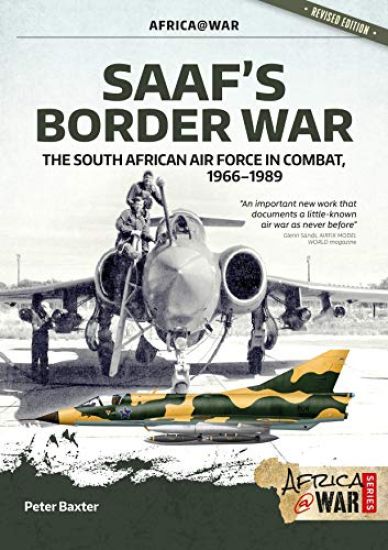
Saaf'S Border War

Saaf'S Border War

Peter Baxter

Helion Company
2019
nidottu
South African Mirages and Cuban MiG-21s dogfighting over Cuito Cuanavale, the largest tank battle on African soil since El Alamein; Puma troopships shot out of the skies by Strela missiles and RPG-7 rockets; Alouette III gunships hovering menacingly above Koevoet tracker-combat teams as they close in for the kill; Hercules and Transall transports disgorging their loads of Parabats over Cassinga; suicidal helicopter hot-extractions of Recce operators deep in enemy territory; and a lone Alouette pilot who disobeyed orders and under intense ground fire evacuated a critically wounded soldier … such is the story of the South African Air Force, the SAAF, over the 23-year period 1966-1989, the period of conflict that became known as the 'Border War'. Set against the backdrop of the Cold War, the SAAF was effectively South Africa's first line of defence against Soviet expansionism in southern Africa. That the Soviets, through their surrogates - the Cuban military, Angola's FAPLA and Namibia's SWAPO - sought a communist regime in South Africa is indisputable, as too was the SAAF's skill, quality, determination and capability to defeat the best Soviet air defences of the time. This account covers all the major operations that the SAAF was involved in, from Operation Blouwildebees, the opening salvo of the conflict at Omgulumbashe, South West Africa in 1966 to the final curtain, Operation Merlyn, the so-called April Fool's Day 'war' of 1989 when the SAAF and Koevoet, almost alone, frustrated SWAPO's last throw of the dice with its illegal invasion of South West Africa. In this account, highlighting such operations as Reindeer, Bootlace/Uric, Sceptic, Protea, Daisy, Askari, Moduler, Hooper and Packer, among many, as well as the ongoing methodological operations like Lunar, Maanskyn, Donkermaan and Butterfly, Baxter examines and brings to life the squadrons and aviators that fought in both counter-insurgency and conventional warfare roles. Besides an extensive selection of rare photographs, the book features a comprehensive section on camouflage and markings and 11 pages of colour aircraft profiles and insignia by noted SAAF authority William Marshall, making this title especially useful for modelers.
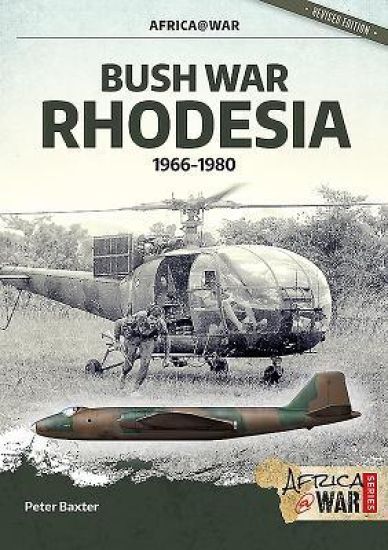
Bush War Rhodesia

Bush War Rhodesia

Peter Baxter

Helion Company
2019
nidottu
It has been over four decades since the Union Jack was lowered on the colony of Rhodesia, but the bitter and divisive civil war that preceded it has continued to endure as a textbook counter-insurgency campaign fought between a mobile, motivated and highly trained Rhodesian security establishment and two constituted liberations movements motivated, resourced and inspired by the ideals of communist revolution in the third world. A complicated historical process of occupation and colonization set the tone as early as the late 1890s for what would at some point be an inevitable struggle for domination of this small, landlocked nation set in the southern tropics of Africa. The story of the Rhodesian War, or the Zimbabwean Liberation Struggle, is not only an epic of superb military achievement, and revolutionary zeal and fervour, but is the tale of the incompatibility of the races in southern Africa, a clash of politics and ideals and, perhaps more importantly, the ongoing ramifications of the past upon the present, and the social and political scars that a war of such emotional underpinnings as the Rhodesian conflict has had on the modern psyche of Zimbabwe. The Rhodesian War was fought with finely tuned intelligence-gathering and -analysis techniques combined with a fluid and mobile armed response. The practitioners of both have justifiably been celebrated in countless histories, memoirs and campaign analyses, but what has never been attempted has been a concise, balanced and explanatory overview of the war, the military mechanisms and the social and political foundations that defined the crisis. This book does all of that. The Rhodesian War is explained in digestible detail and in a manner that will allow enthusiasts of the elements of that struggle - the iconic exploits of the Rhodesian Light Infantry, the SAS, the Selous Scouts, the Rhodesian African Rifles, the Rhodesia Regiment, among other well-known fighting units - to embrace the wider picture in order to place the various episodes in context.
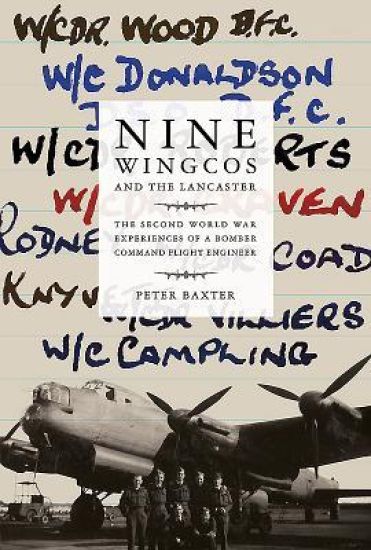
Nine Wingcos and the Lancaster

Nine Wingcos and the Lancaster

Peter Baxter

Fighting High Ltd
2018
sidottu
Bomber Command flight engineer Peter Baxter completed thirty-four operations during the Second World War, and following his first tour with No. 12 Squadron he became the Engineer Leader for the new formed No. 153 Squadron. During his 400 hours in the air, half of which were at night, he flew with a succession of pilots including nine Wing Commanders.After passing the entrance examination in November 1937, Peter entered the Royal Air Force Technical Apprentices School at Halton, near Aylesbury, Buckinghamshire, and over the next few years Peter learnt his trade at RAF stations Halton, Cosford, and Penhros. In 1942 the opportunity arose for Peter to become aircrew, with the RAF’s new four-engine heavy bombers requiring a designated airman, the flight engineer, to take care of the aircraft's various mechanical, hydraulic, electrical and fuel systems. Peter takes up such duties, flying the iconic Avro Lancaster, when Bomber Command is about to enter one of the most intense air campaigns of the war, the 1943 Battle of the Ruhr.In 'Nine Wingcos and the Lancaster' the author describes in remarkable detail not only his RAF experiences but also the environment in which he lived, the friendships made, and the rigours of firstly working on aircraft in all conditions as groundcrew, and then as an airman struggling to fly, fight and survive amidst the attrition of the air battle over Germany. Illustrated with previously unpublished photographs Peter Baxter’s account is also a must for all technical enthusiasts, with comprehensive sections on the mechanics of the Avro Lancaster and how it is flown.
Biafra

Biafra

Peter Baxter

Helion Company
2019
nidottu
Nigeria was a unique concept in the formation of modern Africa. It began life as a highly lucrative if climatically challenging holding of the Royal Niger Company, a British Chartered Company under the control of Victorian capitalist Sir George Taubman Goldie. It was handed over to indigenous rule in 1960 with the best of intentions and a profound hope on the part of the British Crown that it would become the poster child of successful political transition in Africa. It did not. One of the signal failures of imperial strategists at the turn of the 19th century was to take little if any account of the traditional demographics of the territories and societies that were subdivided, and often joined together, into spheres of foreign influence, later evolving into colonies, and finally into nation states. Many of the signature crises in post-colonial Africa have owed their origins to this very phenomenon: incompatible and mutually antagonistic tribal and ethnic groupings forced to cohabit within the indivisible precincts of political geography. Congo, Rwanda/Burundi, Sudan and many others have suffered ongoing attrition within their borders as historic enmities surge and boil in restless and ongoing violence. Such was the case with Nigeria in the post-independence period. The traditions and practices of the Islamic north and the Christian/Animist south, and even within the multiplicity of ethnic division in the south itself, proved to be impossible to reconcile. The result was an immediate centrifuge away from the centre, complicated by the vast infusion of oil revenues and the inevitable explosion of corruption that followed. All of this created the alchemy of civil war and genocide, which erupted into violence in 1967 as the eastern region of Nigeria attempted to secede. The war that followed shocked the conscience of the world, and revealed for the first time the true depth of incompatibility of the four partners in the Nigerian federation. This book traces the early history of Nigeria from inception to civil war, and the complex events that defined the conflict in Biafra, revealing how and why this awful event played out, and the scars that it has since left on the psyche of the disunited federation that has continued to exist in the aftermath.