Kirjojen hintavertailu. Mukana 11 699 587 kirjaa ja 12 kauppaa.

Kirjahaku

Etsi kirjoja tekijän nimen, kirjan nimen tai ISBN:n perusteella.

15 kirjaa tekijältä Peter Brock

Pacifism in Europe to 1914

Pacifism in Europe to 1914

Peter Brock

Princeton University Press
2015
pokkari
In a companion volume to Pacifism in the United States, Peter Brock surveys the history of the pacifist movement in Europe from the beginning of the Christian era to the First World War. His detailed narrative is directed to the activities--and the beliefs that motivated them--of these sects in particular: the Czech Brethren of the late Middle Ages; the radical Anabaptists of the Protestant Reformation; their less militant offshoot, the Mennonites; the Quakers of Cromwell's England; and the Tolstoyans of nineteenth-century Russia. Mr. Brock concludes his account with a working definition of normative pacifism, a typology of pacifism, and a discussion of the factors present in the genesis and decay of pacifist groups. Originally published in 1972. The Princeton Legacy Library uses the latest print-on-demand technology to again make available previously out-of-print books from the distinguished backlist of Princeton University Press. These editions preserve the original texts of these important books while presenting them in durable paperback and hardcover editions. The goal of the Princeton Legacy Library is to vastly increase access to the rich scholarly heritage found in the thousands of books published by Princeton University Press since its founding in 1905.

Pioneers of a Peaceable Kingdom

Pioneers of a Peaceable Kingdom

Peter Brock

Princeton University Press
2015
pokkari
Extracted from Pacifism in the United States, this work focuses on the significant contribution of the Quakers to the history of pacifism in the United States. Originally published in 1971. The Princeton Legacy Library uses the latest print-on-demand technology to again make available previously out-of-print books from the distinguished backlist of Princeton University Press. These editions preserve the original texts of these important books while presenting them in durable paperback and hardcover editions. The goal of the Princeton Legacy Library is to vastly increase access to the rich scholarly heritage found in the thousands of books published by Princeton University Press since its founding in 1905.

Radical Pacifists in Antebellum America

Radical Pacifists in Antebellum America

Peter Brock

Princeton University Press
2015
pokkari
Selected portions from Pacifism in the United States: From the Colonial Era to the First World War Originally published in 1968. The Princeton Legacy Library uses the latest print-on-demand technology to again make available previously out-of-print books from the distinguished backlist of Princeton University Press. These editions preserve the original texts of these important books while presenting them in durable paperback and hardcover editions. The goal of the Princeton Legacy Library is to vastly increase access to the rich scholarly heritage found in the thousands of books published by Princeton University Press since its founding in 1905.

Pacifism in the United States

Pacifism in the United States

Peter Brock

Princeton University Press
2015
pokkari
Called "a pioneer work of the first importance" by Staughton Lynd, this book traces the history of pacifism in America from colonial times to the start of World War I. The author describes how the immigrant peace sects-Quaker, Mennonite, and Dunker -faced the challenges of a hostile environment. The peace societies that sprang up after 1815 form the subject of the next section, with particular attention focused upon the American Peace Society and Garrison's New England Non-Resistance Society. A series of chapters on the reactions of these sects and societies to the Civil War, the neglect of pacifism in the postwar period, and the beginnings of a renewal in the years before the outbreak of war in Europe bring the book to a close. The emphasis on the institutional aspects of the movement is balanced throughout by a rich mine of accounts about the experiences of individual pacifists. Originally published in 1968. The Princeton Legacy Library uses the latest print-on-demand technology to again make available previously out-of-print books from the distinguished backlist of Princeton University Press. These editions preserve the original texts of these important books while presenting them in durable paperback and hardcover editions. The goal of the Princeton Legacy Library is to vastly increase access to the rich scholarly heritage found in the thousands of books published by Princeton University Press since its founding in 1905.

Pacifism in Europe to 1914

Pacifism in Europe to 1914

Peter Brock

Princeton University Press
2016
sidottu
In a companion volume to Pacifism in the United States, Peter Brock surveys the history of the pacifist movement in Europe from the beginning of the Christian era to the First World War. His detailed narrative is directed to the activities--and the beliefs that motivated them--of these sects in particular: the Czech Brethren of the late Middle Ages; the radical Anabaptists of the Protestant Reformation; their less militant offshoot, the Mennonites; the Quakers of Cromwell's England; and the Tolstoyans of nineteenth-century Russia. Mr. Brock concludes his account with a working definition of normative pacifism, a typology of pacifism, and a discussion of the factors present in the genesis and decay of pacifist groups. Originally published in 1972. The Princeton Legacy Library uses the latest print-on-demand technology to again make available previously out-of-print books from the distinguished backlist of Princeton University Press. These editions preserve the original texts of these important books while presenting them in durable paperback and hardcover editions. The goal of the Princeton Legacy Library is to vastly increase access to the rich scholarly heritage found in the thousands of books published by Princeton University Press since its founding in 1905.

Pioneers of a Peaceable Kingdom

Pioneers of a Peaceable Kingdom

Peter Brock

Princeton University Press
2016
sidottu
Extracted from Pacifism in the United States, this work focuses on the significant contribution of the Quakers to the history of pacifism in the United States. Originally published in 1971. The Princeton Legacy Library uses the latest print-on-demand technology to again make available previously out-of-print books from the distinguished backlist of Princeton University Press. These editions preserve the original texts of these important books while presenting them in durable paperback and hardcover editions. The goal of the Princeton Legacy Library is to vastly increase access to the rich scholarly heritage found in the thousands of books published by Princeton University Press since its founding in 1905.

Radical Pacifists in Antebellum America

Radical Pacifists in Antebellum America

Peter Brock

Princeton University Press
2016
sidottu
Selected portions from Pacifism in the United States: From the Colonial Era to the First World War Originally published in 1968. The Princeton Legacy Library uses the latest print-on-demand technology to again make available previously out-of-print books from the distinguished backlist of Princeton University Press. These editions preserve the original texts of these important books while presenting them in durable paperback and hardcover editions. The goal of the Princeton Legacy Library is to vastly increase access to the rich scholarly heritage found in the thousands of books published by Princeton University Press since its founding in 1905.

Pacifism in the United States

Pacifism in the United States

Peter Brock

Princeton University Press
2016
sidottu
Called "a pioneer work of the first importance" by Staughton Lynd, this book traces the history of pacifism in America from colonial times to the start of World War I. The author describes how the immigrant peace sects-Quaker, Mennonite, and Dunker -faced the challenges of a hostile environment. The peace societies that sprang up after 1815 form the subject of the next section, with particular attention focused upon the American Peace Society and Garrison's New England Non-Resistance Society. A series of chapters on the reactions of these sects and societies to the Civil War, the neglect of pacifism in the postwar period, and the beginnings of a renewal in the years before the outbreak of war in Europe bring the book to a close. The emphasis on the institutional aspects of the movement is balanced throughout by a rich mine of accounts about the experiences of individual pacifists. Originally published in 1968. The Princeton Legacy Library uses the latest print-on-demand technology to again make available previously out-of-print books from the distinguished backlist of Princeton University Press. These editions preserve the original texts of these important books while presenting them in durable paperback and hardcover editions. The goal of the Princeton Legacy Library is to vastly increase access to the rich scholarly heritage found in the thousands of books published by Princeton University Press since its founding in 1905.
Against the Draft

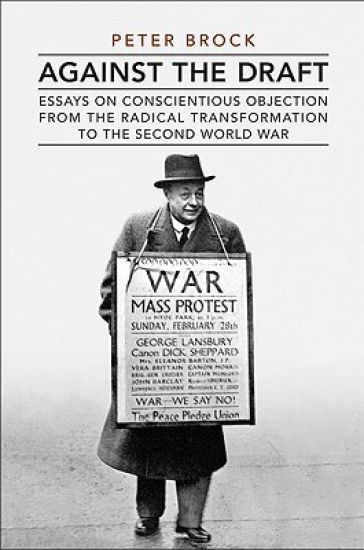
Against the Draft

Peter Brock

University of Toronto Press
2006
sidottu
Around the world and for hundreds of years, men and women have refused to be drafted into bearing arms for their nations' wars. These conscientious objectors to the draft are the subject of Peter Brock's latest collection, Against the Draft. Brock, the world's leading historian on pacifism, has assembled twenty-five of his essays on conscientious objection to the draft from the beginning of the Radical Reformation in 1525 to the end of the Second World War. Included in the collection are essays on little known facets of the anti-draft movement including the Anabaptist-Mennonite tradition of military exemption that started with the outset of the Radical Reformation in 1525 and has continued, with variations, until the present. Further articles deal with the Quakers in a number of countries, Civil-war America, Leo Tolstoy (who became a convinced pacifist in the later part of his life), British conscientious objectors in the Non-Combatant Corps, the emergence of conscientious objection in Japan, and the fate of conscientious objectors in the psychiatric clinics of Germany and in interwar Poland. Essays on the Central European Nazerenes and on Jehovah's Witnesses in Nazi Germany highlight the exceptionally harsh treatment meted out to conscientious objectors belonging to these two sects, and their steadfast resistance to the state's demand to bear arms. Against the Draft makes an important contribution to the growing study of pacifism and conscientious objection, and represents a key work in the career of the field's foremost scholar.
Polish Revolutionary Populism

Polish Revolutionary Populism

Peter Brock

University of Toronto Press
1977
pokkari
Polish populism, which advocated agrarian socialism by either revolutionary or reformist means, emerged first among the émigrés who had left Poland after the Russians defeated the nationalist uprising of 1830. In exile they came into contact with the ideas of French ‘Utopian’ socialists such as Babeuf, Saint-Simon, Fourier, and Cabet, and they attempted to adapt these ideas to the very different conditions prevailing in their east European homeland. Thus this version of populism preceded in time, and probably influenced, the emergence of the ideas of the better-known Russian narodniks. Polish Revolutionary Populism describes the activities and conflicting ideologies of the various organizations, abroad and in partitioned Poland, which were struggling for national independence and for agrarian and social reform. Like the author’s recent work, The Slovak National Awakening, this book deals with the emerging national aspirations characteristic of central and eastern Europe at the time and with the variety of political and social theories that made debate so acrimonious.
The Slovak National Awakening

The Slovak National Awakening

Peter Brock

University of Toronto Press
1976
pokkari
The Slovaks lived under Hungarian rule for centuries, with no clear sense of political separateness, preserving Slovak as their spoken language, but using Czech as their written language. In the last decades of the 18th and the first half of the 19th centuries, the efforts made by clerical intellectuals to develop a language more closely attuned to Slovak needs led to the rise of Slovak nationalism. The Slovak National Awakening describes the three major stages in the development of national consciousness. In the 1780s Catholic intellectuals began to write in the vernacular; a Catholic priest, Bernolàk, produced a Slovak grammar and dictionary and an influential treatise in defence of Slovak as a language separate from Czech. However, while Slovak ethnic distinctness was being asserted, the sense of belonging to the Hungarian nation was not questioned. The next steps were taken by the Protestant intelligentsia, who had been pro-Czech since the Reformation. Influenced by German concepts of linguistic nationalism, they began to assert Slovak cultural and linguistic separateness, but still within the political framework of the Hungarian State. The third stage in the Slovak Awakening came in the mid-1840s when a group of young Protestant intellectuals, led by L’udovít Štúr, rejected their predecessors’ ‘Czechoslovakism’ and advocated a Slovak language and a Slovak nationality. In 1851, the Catholic Bernolákites and the Protestant Štúrites were able to agree on the language that became the basis of modern Slovak. This study of the relation between language and nationalism will appeal to specialists in European history and will be of interest for the light it throws on modern separatists and anti-imperialist movements.