Kirjojen hintavertailu. Mukana 12 445 968 kirjaa ja 12 kauppaa.

Kirjahaku

Etsi kirjoja tekijän nimen, kirjan nimen tai ISBN:n perusteella.

47 kirjaa tekijältä Peter Charles Hoffer

"Cry Liberty"

"Cry Liberty"

Peter Charles Hoffer

Oxford University Press Inc
2010
nidottu
The story of slavery in the colonial New World is, in part, one of rebellion. In Jamaica, Hispaniola, Dutch Surinam and elsewhere, massive uprisings threatened European rule. But not in British North America. Between the founding of Jamestown in 1607 and the start of the American Revolution in 1775, the colonies experienced only one notable revolt, on South Carolina's Stono River in 1739, and it lasted a single day. Yet, writes Peter Charles Hoffer, as brief as this event was, historians have misunderstood it--and have thus overlooked its deeper significance. In "Cry Liberty," Hoffer provides a deeply researched and finely nuanced narrative of the Stono River conflict, offering uncomfortable insights into American slavery. In particular, he draws on new sources to reexamine this one dramatic day. According to conventional wisdom, recently imported African slaves-warriors in spirit and training-learned of an impending war between England and Spain. Seeking freedom from Spanish authorities, the argument runs, they launched a well-planned uprising in order to escape to Florida.But Hoffer has mined legislative and legal records, land surveys, and first-hand accounts to identify precisely where the fighting began, trace the paths taken by rebels and militia, and offer a new explanation of its causes. Far from a noble, well-crafted revolt, he reveals, the slaves were simply breaking into a store to take what they thought was their due, and chance events put them on a path no participant had originally intended. The truth is a far less heroic, but far more of a human tragedy. Richly researched, crisply told, and unflinchingly honest, this book uncovers the grim truth about the violent wages of slavery and sheds light on why North America had so few slave rebellions.
Benjamin Franklin Explains the Stamp ACT Protests to Parliament, 1766
Benjamin Franklin Explains the Stamp Act Protests to Parliament, 1766 brings together a unique collection of primary source documents, organized and arranged as a dialogue, to examine the issues surrounding the Stamp Act. The selections--at the center of which is Benjamin Franklin's examination in Parliament on February 13, 1766--are meant to be read as a continuous dialogue among leading colonists in America and politicians in England. While the individual documents were separated in time and space, here they are reconstituted as part of a consistent whole--a trans-Atlantic conversation about the nature of the empire, the rights of the colonists, and the powers of Parliament at a critical moment in American and British history. Some liberty has been taken in their editing in order to emphasize this conversational quality. A chronology preceding the documents indicates the sequence of their production, and a bibliographical essay at the end of the documents directs students to useful secondary sources.
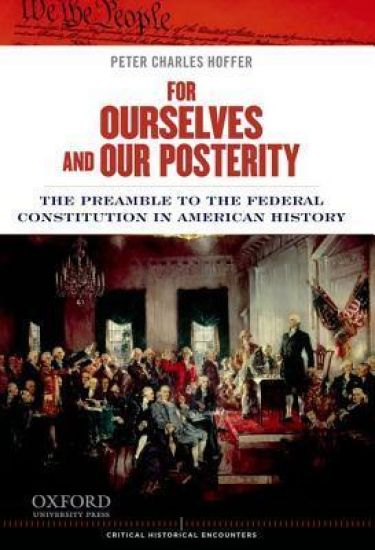
For Ourselves and Our Posterity: The Preamble to the Federal Constitution in American History
In For Ourselves and Our Posterity: The Preamble to the Federal Constitution in American History, author Peter Charles Hoffer offers a sweeping, dramatic narration of a crucial moment in Early American history. Over the course of five days in September 1787, five men serving on an ad hoc "Committee of Style and Arrangement" edited the draft of the federal Constitution at the Constitutional Convention, profoundly recasting the wording of the Preamble. In so doing, the committee changed a federation into a Union and laid out an ambitious program for national governance many years ahead of its time. The Preamble and all that it came to represent was the unique achievement of a remarkable group of men at a momentous turning point in American history. Providing a clear exposition of constitutional issues, For Ourselves and Our Posterity features individual portraits of the leading framers at the heart of this dramatic event.
The Search for Justice

The Search for Justice

Peter Charles Hoffer

University of Chicago Press
2019
sidottu
The civil rights era was a time of pervasive change in American political and social life. Among the decisive forces driving change were lawyers, who wielded the power of law to resolve competing concepts of order and equality and, in the end, to hold out the promise of a new and better nation.The Search for Justice is a look the role of the lawyers throughout the period, focusing on one of the central issues of the time: school segregation. The most notable participants to address this issue were the public interest lawyers of the NAACP's Legal Defense Fund, whose counselors brought lawsuits and carried out appeals in state and federal courts over the course of twenty years. But also playing a part in the story were members of the bar who defended Jim Crow laws explicitly or implicitly and, in some cases, also served in state or federal government; lawyers who sat on state and federal benches and heard civil rights cases; and, finally, law professors who analyzed the reasoning of the courts in classrooms and public forums removed from the fray. With rich, copiously researched detail, Hoffer takes readers through the interactions of these groups, setting their activities not only in the context of the civil rights movement but also of their full political and legal legacies, including the growth of corporate private legal practice after World War II and the expansion of the role of law professors in public discourse, particularly with the New Deal. Seeing the civil rights era through the lens of law enables us to understand for the first time the many ways in which lawyers affected the course and outcome of the movement.
The Search for Justice

The Search for Justice

Peter Charles Hoffer

University of Chicago Press
2019
pokkari
The civil rights era was a time of pervasive change in American political and social life. Among the decisive forces driving change were lawyers, who wielded the power of law to resolve competing concepts of order and equality and, in the end, to hold out the promise of a new and better nation. The Search for Justice is a look the role of the lawyers throughout the period, focusing on one of the central issues of the time: school segregation. The most notable participants to address this issue were the public interest lawyers of the NAACP's Legal Defense Fund, whose counselors brought lawsuits and carried out appeals in state and federal courts over the course of twenty years. But also playing a part in the story were members of the bar who defended Jim Crow laws explicitly or implicitly and, in some cases, also served in state or federal government; lawyers who sat on state and federal benches and heard civil rights cases; and, finally, law professors who analyzed the reasoning of the courts in classrooms and public forums removed from the fray. With rich, copiously researched detail, Hoffer takes readers through the interactions of these groups, setting their activities not only in the context of the civil rights movement but also of their full political and legal legacies, including the growth of corporate private legal practice after World War II and the expansion of the role of law professors in public discourse, particularly with the New Deal. Seeing the civil rights era through the lens of law enables us to understand for the first time the many ways in which lawyers affected the course and outcome of the movement.
Zombie History

Zombie History

Peter Charles Hoffer

The University of Michigan Press
2020
nidottu
Fake history is not a harmless mistake of fact or interpretation. It is a mistake that conceals prejudice; a mistake that discriminates against certain kinds of people; a mistake held despite a preponderance of evidence; a mistake that harms us. Fake history is like the Zombies we see in mass media, for the fake fact, like the fictional Zombie, lives by turning real events and people into monstrous perversions of fact and interpretation. Its pervasiveness reveals that prejudice remains its chief appeal to those who believe it. Its effect is insidious, because we cannot or will not destroy those mischievous lies. Zombie history is almost impossible to kill. Some Zombie history was and is political, a genre of what Hannah Arendt called “organizational lying” about the past. Its makers designed the Zombie to create a basis in the false past for particular discriminatory policies. Other history Zombies are cultural. They encapsulate and empower prejudice and stereotyping. Still other popular history Zombies do not look disfigured, but like Zombies walk among us without our realizing how devastating their impact can be. Zombie History argues that, whatever their purpose, whatever the venue in which they appear, history Zombies undermine the very foundations of disinterested study of the past.
Zombie History

Zombie History

Peter Charles Hoffer

The University of Michigan Press
2020
sidottu
Fake history is not a harmless mistake of fact or interpretation. It is a mistake that conceals prejudice; a mistake that discriminates against certain kinds of people; a mistake held despite a preponderance of evidence; a mistake that harms us. Fake history is like the Zombies we see in mass media, for the fake fact, like the fictional Zombie, lives by turning real events and people into monstrous perversions of fact and interpretation. Its pervasiveness reveals that prejudice remains its chief appeal to those who believe it. Its effect is insidious, because we cannot or will not destroy those mischievous lies. Zombie history is almost impossible to kill. Some Zombie history was and is political, a genre of what Hannah Arendt called “organizational lying” about the past. Its makers designed the Zombie to create a basis in the false past for particular discriminatory policies. Other history Zombies are cultural. They encapsulate and empower prejudice and stereotyping. Still other popular history Zombies do not look disfigured, but like Zombies walk among us without our realizing how devastating their impact can be. Zombie History argues that, whatever their purpose, whatever the venue in which they appear, history Zombies undermine the very foundations of disinterested study of the past.
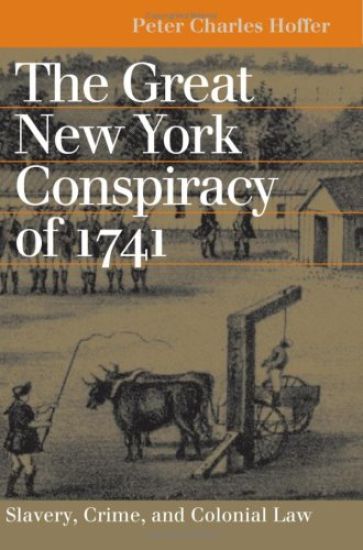
The Great New York Conspiracy of 1741

The Great New York Conspiracy of 1741

Peter Charles Hoffer

University Press of Kansas
2004
sidottu
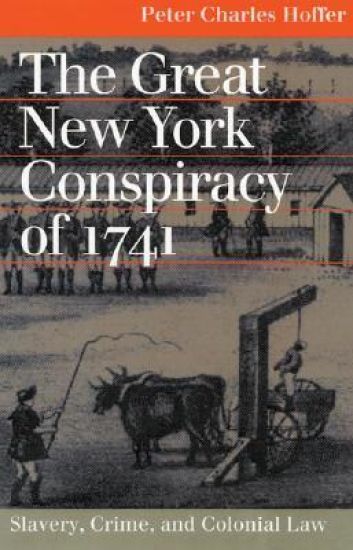
Three and a half decades before the city of New York witnessed the first great battle waged by the new United States of America for its independence, rumors of a massive conspiracy among the city's slaves spread panic throughout the colony. On the testimony of frightened bondsmen and a handful of whites, over seventy slaves were convicted and a third of these were executed. The suspected conspiracy in New York prompted one of the most extensive slave trials in colonial history and some of the most grisly punishments ever meted out to individuals. Peter Hoffer now retells the dramatic story of those landmark trials, setting the events in their legal and historical contexts and offering a revealing glimpse of slavery in colonial cities and of the way that the law defined and policed the institution. Among other things, Hoffer reveals how conspiracy became a central feature of the law of slavery at the same time as it reflected the white belief that slaves were always conspiring against their masters. He draws on uniquely revealing firsthand accounts of the trials to both retell a gripping story and open a window on colonial American justice. He leads readers through a chain of events involving robbery and arson that culminated in the trials of a group of white men suspected of inciting the slaves to revolt. The episode, so vital to our understanding of a time when slavery was an entrenched institution and the law made even the angry muttering of slaves into a criminal act, has much to tell us about current affairs as well. African slaves in colonial times were viewed by authorities and citizens much as some foreigners are today: inherently dangerous, easily identifiable, and constantly conspiring. Peter Charles Hoffer is Distinguished Professor of History at the University of Georgia and coeditor of the series Landmark Law Cases and American Society. Among his other books are The Salem Witchcraft Trials: A Legal History (see page 48). The Law's Conscience: Constitutionalism in America, and Roe v. Wade: The Abortion Rights Controversy in American History, coauthored with N. E. H. Hull (see page 36).
The Great New York Conspiracy of 1741

The Great New York Conspiracy of 1741

Peter Charles Hoffer

University Press of Kansas
2003
nidottu
Almost 35 years before New York saw the first great battle waged by the new United States of America for its independence, rumours of a slave conspiracy spread in the city, leading to the conviction and execution of over 70 slaves. This text retells the dramatic story of these landmark trials.
The Treason Trials of Aaron Burr

The Treason Trials of Aaron Burr

Peter Charles Hoffer

University Press of Kansas
2008
sidottu
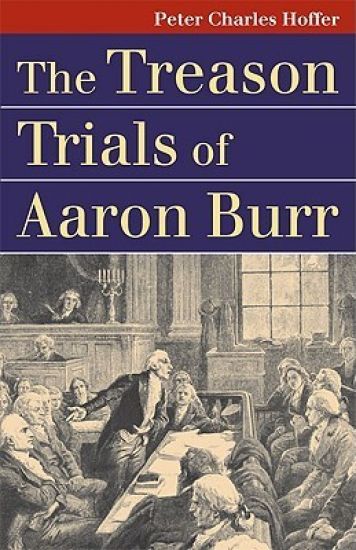
Aaron Burr was an enigma even in his own day. Founding father and vice president, he engaged in a duel with Alexander Hamilton resulting in a murder indictment that effectively ended his legal career. And when he turned his attention to entrepreneurial activities on the frontier he was suspected of empire building - and worse.Burr was finally arrested as a threat to national security, under suspicion of fomenting insurrection against the young republic, and then held without bail for months. His trial, witnessing the unfortunate intrusion of partisan politics and personal animosity into the legal process, revolved around a highly contentious debate over the constitutional meaning of treason.In the first book dedicated to this important case, Peter Charles Hoffer unveils a cast of characters ensnared by politics and law at the highest levels of government, including President Thomas Jefferson - one of Burr's bitterest enemies - and Chief Justice John Marshall, no fan of either Burr or Jefferson. Hoffer recounts how Jefferson's prosecutors argued that the mere act of discussing an ""overt Act of War"" - the constitution's definition of treason - was tantamount to committing the act. Marshall, however, ruled that without the overt act, no treasonable action had occurred and neither discussion nor conspiracy could be prosecuted. Subsequent attempts to convict Burr on violations of the Neutrality Act failed as well.A fascinating excursion into the early American past, Hoffer's narrative makes it clear why the high court's ultimate finding was so foundational that it has been cited as precedent 383 times. Along the way, Hoffer expertly unravels the tale's major themes: attempts to redefine treason in times of crisis, efforts to bend the law to political goals, the admissibility of evidence, the vulnerability of habeas corpus, and the reach of executive privilege. He also proposes an original and provocative explanation for Burr's bizarre conduct that will provide historians with new food for thought.Deftly linking politics to law, Hoffer's highly readable study resonates with current events and shows us why the issues debated two centuries ago still matter today.
The Treason Trials of Aaron Burr

The Treason Trials of Aaron Burr

Peter Charles Hoffer

University Press of Kansas
2008
nidottu
Aaron Burr was an enigma even in his own day. Founding father and vice president, he engaged in a duel with Alexander Hamilton resulting in a murder indictment that effectively ended his legal career. And when he turned his attention to entrepreneurial activities on the frontier he was suspected of empire building - and worse.Burr was finally arrested as a threat to national security, under suspicion of fomenting insurrection against the young republic, and then held without bail for months. His trial, witnessing the unfortunate intrusion of partisan politics and personal animosity into the legal process, revolved around a highly contentious debate over the constitutional meaning of treason.In the first book dedicated to this important case, Peter Charles Hoffer unveils a cast of characters ensnared by politics and law at the highest levels of government, including President Thomas Jefferson - one of Burr's bitterest enemies - and Chief Justice John Marshall, no fan of either Burr or Jefferson. Hoffer recounts how Jefferson's prosecutors argued that the mere act of discussing an ""overt Act of War"" - the constitution's definition of treason - was tantamount to committing the act. Marshall, however, ruled that without the overt act, no treasonable action had occurred and neither discussion nor conspiracy could be prosecuted. Subsequent attempts to convict Burr on violations of the Neutrality Act failed as well.A fascinating excursion into the early American past, Hoffer's narrative makes it clear why the high court's ultimate finding was so foundational that it has been cited as precedent 383 times. Along the way, Hoffer expertly unravels the tale's major themes: attempts to redefine treason in times of crisis, efforts to bend the law to political goals, the admissibility of evidence, the vulnerability of habeas corpus, and the reach of executive privilege. He also proposes an original and provocative explanation for Burr's bizarre conduct that will provide historians with new food for thought.Deftly linking politics to law, Hoffer's highly readable study resonates with current events and shows us why the issues debated two centuries ago still matter today.
A Nation of Laws

A Nation of Laws

Peter Charles Hoffer

University Press of Kansas
2010
sidottu
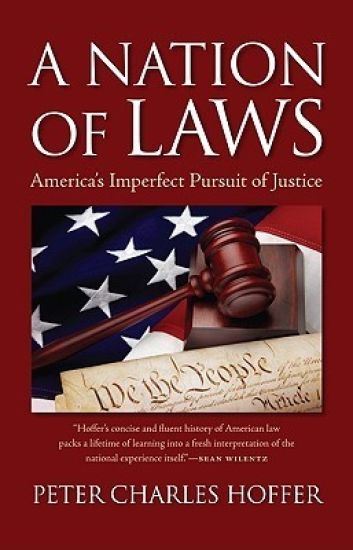
America's founders extolled a nation of laws, for they knew that only a fairly enforced legal system could protect liberty and property against corruption and tyranny. Nearly two and a half centuries later, that system remains the ultimate safeguard for us all. With concise but penetrating and provocative insights, the eminent Peter Charles Hoffer recaptures the spirit of this grand enterprise while never losing sight of its human face. The distillation of four decades of stellar writing, Hoffer's book is a wise and illuminating meditation on the key concepts, history, evolution, and importance of American law. He brings the law to life through brief narratives and portraits drawn from the pages of our nation's history. He takes his readers on a tumultuous journey from the Salem witchcraft trials through the divisive debates over slavery; the long struggles for equality and civil rights; the moral and culture wars over abortion, gay rights, and the teaching of evolution; and, recent controversies concerning the rule of law in wartime. In a very compact space, Hoffer has a great deal to say about the role of law, lawmakers, law cases, lawyers, litigants, judges, law professors, and public opinion in creating and recreating the fabric that weaves all of these elements together. He pays particular attention to the criminal trial by looking at the legal proceedings against slave liberator John Brown, feminist Susan B. Anthony, and teacher of evolution John Scopes. He also explores what happens when the law is stretched to the breaking point by revisiting such events as the Stono Slave Rebellion, the Seneca Falls women's rights convention, and FDR's paradigm-shifting New Deal speech. Throughout, Hoffer carefully weighs the promise and vitality of our laws against its flaws and historical failures, for our legal system has not reflected a strong linear progress from inequality and privilege toward perfected liberty and dignity for all. His crystal clear vision of our legal history reminds us of the ambiguities and contradictions, quarrels and confrontations, that mirror the struggles within American history itself and reinforce the central role of law in American life.
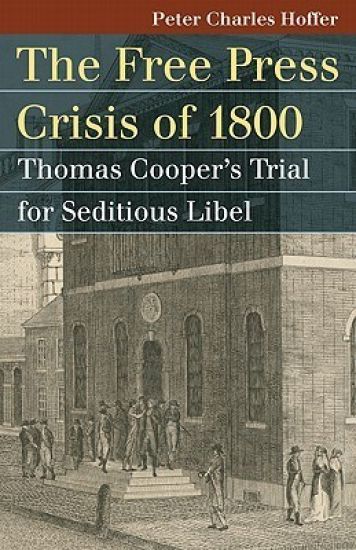
The Free Press Crisis of 1800

The Free Press Crisis of 1800

Peter Charles Hoffer

University Press of Kansas
2011
sidottu
The far-reaching Sedition Act of 1798 was introduced by Federalists to suppress Republican support of French revolutionaries and imposed fines and imprisonment “if any person shall write, print, utter or publish . . . scandalous and malicious writing or writings against the government of the United States.” Such a broadly and loosely defined offense challenged the freedom of the American press and gave the government the power to drag offending newspaper editors into court. The trial of Thomas Cooper in particular became an important showcase for debating the dangers and limits of the new law, one with great implications for both the new republic and federal constitutional law. Cooper’s trial has now been rescued from long neglect and illuminated by Peter Charles Hoffer, one our nation’s preeminent legal historians. While most modern students of the Sedition Act regard it as an extreme measure motivated by partisan malice, Hoffer offers a much more nuanced view that weighs all the arguments and fairly considers the position of each side in historical and legal context. Hoffer sets the stage by revisiting both the much better known 1735 trial of Peter Zenger and the subsequent fashioning of the First Amendment during the first meeting of the U.S. Congress. He then describes the rise of political factions in the early republic, congressional debate over the Sedition Act, and Thomas Jefferson’s and James Madison’s Kentucky and Virginia Resolves. After a close reading of Cooper’s allegedly seditious writings, Hoffer brings the trial record to life, capturing prosecution and defense strategies, including Cooper’s attempt to subpoena President Adams and Federalist trial judge Samuel Chase’s management of the prosecution from the bench. Long after the Federalists had departed the scene, echoes of the free-press crisis continued to roil American politics—reappearing in the debates over antislavery petitions, the suppression of dissent during the Civil War and two world wars, and most recently in the trials of suspected terrorists. Hoffer’s book is an authoritative review of this landmark case and a vital touchstone for anyone concerned about the role of government and the place of dissent in times of national emergency.
The Free Press Crisis of 1800

The Free Press Crisis of 1800

Peter Charles Hoffer

University Press of Kansas
2011
nidottu
The far-reaching Sedition Act of 1798 was introduced by Federalists to suppress Republican support of French revolutionaries and imposed fines and imprisonment “if any person shall write, print, utter or publish . . . scandalous and malicious writing or writings against the government of the United States.” Such a broadly and loosely defined offense challenged the freedom of the American press and gave the government the power to drag offending newspaper editors into court. The trial of Thomas Cooper in particular became an important showcase for debating the dangers and limits of the new law, one with great implications for both the new republic and federal constitutional law. Cooper’s trial has now been rescued from long neglect and illuminated by Peter Charles Hoffer, one our nation’s preeminent legal historians. While most modern students of the Sedition Act regard it as an extreme measure motivated by partisan malice, Hoffer offers a much more nuanced view that weighs all the arguments and fairly considers the position of each side in historical and legal context. Hoffer sets the stage by revisiting both the much better known 1735 trial of Peter Zenger and the subsequent fashioning of the First Amendment during the first meeting of the U.S. Congress. He then describes the rise of political factions in the early republic, congressional debate over the Sedition Act, and Thomas Jefferson’s and James Madison’s Kentucky and Virginia Resolves. After a close reading of Cooper’s allegedly seditious writings, Hoffer brings the trial record to life, capturing prosecution and defense strategies, including Cooper’s attempt to subpoena President Adams and Federalist trial judge Samuel Chase’s management of the prosecution from the bench. Long after the Federalists had departed the scene, echoes of the free-press crisis continued to roil American politics—reappearing in the debates over antislavery petitions, the suppression of dissent during the Civil War and two world wars, and most recently in the trials of suspected terrorists. Hoffer’s book is an authoritative review of this landmark case and a vital touchstone for anyone concerned about the role of government and the place of dissent in times of national emergency.
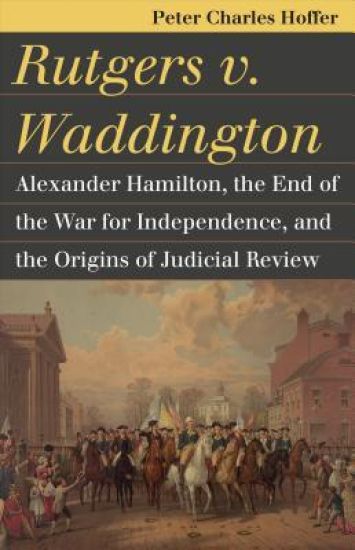
Rutgers v. Waddington

Rutgers v. Waddington

Peter Charles Hoffer

University Press of Kansas
2016
sidottu
Once the dust of the Revolution settled, the problem of reconciling the erstwhile warring factions arose, and as is often the case in the aftermath of violent revolutions, the matter made its way intothe legal arena. Rutgers v. Waddington was such a case. Through this little-known but remarkable dispute over back rent for aburned-down brewery, Peter Charles Hoffer recounts a tale of political and constitutional intrigue involving some of the most important actors in America’s transition from a confederation of states under the Articles of Confederation to a national republic under the US Constitution.At the end of the Revolution, the widow Rutgers and her sons returned to the brewery they’d abandoned when the British had occupied New York. They demanded rent from Waddington, the loyalist who hadrented the facility under the British occupation.Under a punitive New York state law, the loyalist Waddington was liable. But the peace treaty’s provisions protecting loyalists’property rights said otherwise. Appearing for the defendants was war veteran, future Federalist, and first secretary of the treasury,Alexander Hamilton. And, as always, lurking in the background was the estimable Aaron Burr. As Hoffer details Hamilton’s arguments for the supremacy of treaty law over state law, the significance of Rutgers v. Waddington in the development of a strongcentral government emerges clearly—as does the role of the courts in bridging the young nation’s divisions in the Revolution’swake. Rutgers v. Waddington illustrates a foundational moment in American history. As such, it is an encapsulation of a societyriven by war, buffeted by revolutionary change attempting to piece together the true meaning of, in John Adams’s formulation,“rule by law, and not by men.”
Rutgers v. Waddington

Rutgers v. Waddington

Peter Charles Hoffer

University Press of Kansas
2016
nidottu
Once the dust of the Revolution settled, the problem of reconciling the erstwhile warring factions arose, and as is often the case in the aftermath of violent revolutions, the matter made its way intothe legal arena. Rutgers v. Waddington was such a case. Through this little-known but remarkable dispute over back rent for aburned-down brewery, Peter Charles Hoffer recounts a tale of political and constitutional intrigue involving some of the most important actors in America’s transition from a confederation of states under the Articles of Confederation to a national republic under the US Constitution.At the end of the Revolution, the widow Rutgers and her sons returned to the brewery they’d abandoned when the British had occupied New York. They demanded rent from Waddington, the loyalist who hadrented the facility under the British occupation.Under a punitive New York state law, the loyalist Waddington was liable. But the peace treaty’s provisions protecting loyalists’property rights said otherwise. Appearing for the defendants was war veteran, future Federalist, and first secretary of the treasury,Alexander Hamilton. And, as always, lurking in the background was the estimable Aaron Burr. As Hoffer details Hamilton’s arguments for the supremacy of treaty law over state law, the significance of Rutgers v. Waddington in the development of a strongcentral government emerges clearly—as does the role of the courts in bridging the young nation’s divisions in the Revolution’swake. Rutgers v. Waddington illustrates a foundational moment in American history. As such, it is an encapsulation of a societyriven by war, buffeted by revolutionary change attempting to piece together the true meaning of, in John Adams’s formulation,“rule by law, and not by men.”
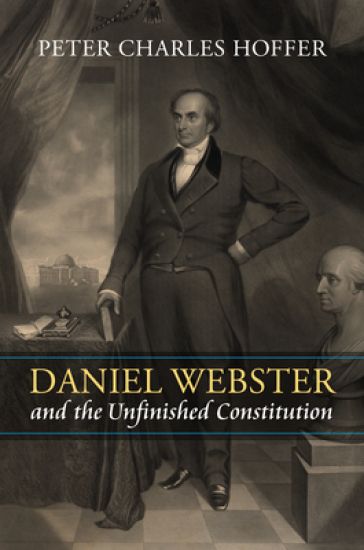
Daniel Webster and the Unfinished Constitution

Daniel Webster and the Unfinished Constitution

Peter Charles Hoffer

University Press of Kansas
2021
sidottu
Daniel Webster and the Unfinished Constitution reveals Webster as the foremost constitutional lawyer of his day. Peter Charles Hoffer builds a persuasive case that Webster was more than a skilled practitioner who rose rapidly from his hardscrabble New Hampshire origins. Hoffer thoroughly documents the ways in which Webster was an innovative jurist. While Chief Justice John Marshall gets credit for much of our early constitutional jurisprudence, in fact in a series of key cases Marshall simply borrowed Webster's oral and written arguments.For Webster, Marshall, and many lawyers and jurists of their day, professions of adherence to the Constitution were universal. Yet they knew that the Constitution could not be fixed in time; its text needed to be read in light of the rapidly transforming early republic and antebellum eras or it would become irrelevant. As Chief Justice Marshall explained in Bank of the United States v. Deveaux (1809): 'A constitution, from its nature, deals in generals, not in detail. Its framers cannot perceive minute distinctions which arise in the progress of the nation, and therefore confine it to the establishment of broad and general principles.' But were these 'broad and general principles' themselves fixed? For Webster there were landmarks: the Contract Clause and the Commerce Clause. While others were exploring and surveying the Northwest Territory and the Louisiana Purchase, Webster set out to map the spaces in the constitutional and legal landscape that were unmarked.Peter Charles Hoffer provides an insightful and timely study of how Webster's analysis of three key constitutional issues is relevant to today's constitutional conflicts: the relationship between law and politics, between public policy and private rights, and between the federal government and the states, all of which remain contentious in our constitutional jurisprudence and crucial to our constitutional order.
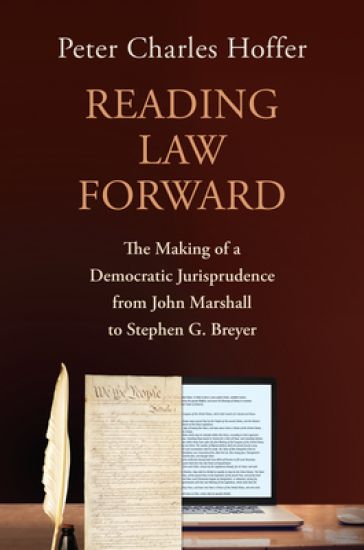
Reading Law Forward

Reading Law Forward

Peter Charles Hoffer

UNIVERSITY PRESS OF KANSAS
2023
sidottu
In the current legal climate where “everyone is an originalist,” conventional wisdom suggests that judges merely find law, rather than make it. Orthodox common-law jurisprudence makes fidelity to the past the central goal and criterion. By contrast, the alternative approach, “reading the law forward”—what some call judicial pragmatism or consequentialism—is viewed as heretical. Rather than mount a theoretical defense of a forward-thinking jurisprudence, legal historian Peter Charles Hoffer offers an empirical study of how this approach to constitutional interpretation actually leads to better law. Reading Law Forward looks at seven judges who exemplify this alternative jurisprudence: John Marshall, Joseph Story, Lemuel Shaw, Louis D. Brandeis, Benjamin Cardozo, William O. Douglas, and Stephen G. Breyer.“In the hands of America’s leading judges, a jurisprudence of reading law forward enabled courts to respond to the challenges of changing conditions. It kept law fresh. It promoted and still promotes the growth of a democratic society,” Hoffer convincingly argues.
The Devil's Disciples

The Devil's Disciples

Peter Charles Hoffer

Johns Hopkins University Press
1998
pokkari
Approaching the subject as a legal and social historian, Peter Charles Hoffer offers a fresh look at the Salem outbreak based on recent studies of panic rumors, teen hysteria, child abuse, and intrafamily relations. He brings to life a set of conversations -- in taverns and courtrooms, at home and work -- which took place among suspected witches, accusers, witnesses, and spectators. The accusations, denials, and confessions of this legal story eventually resurrect the tangled internal tensions that lay at the bottom of the Salem witch hunts.
Sensory Worlds in Early America

Sensory Worlds in Early America

Peter Charles Hoffer

Johns Hopkins University Press
2003
sidottu
Over the past half-century, historians have greatly enriched our understanding of America's past, broadening their fields of inquiry from such traditional topics as politics and war to include the agency of class, race, ethnicity, and gender and to focus on the lives of ordinary men and women. We now know that homes and workplaces form a part of our history as important as battlefields and the corridors of power. Only recently, however, have historians begun to examine the fundamentals of lived experience and how people perceive the world through the five senses. In this ambitious work, Peter Charles Hoffer presents a "sensory history" of early North America, offering a bold new understanding of the role that sight, sound, smell, taste, and touch played in shaping the lives of Europeans, Indians, and Africans in the New World. Reconstructing the most ephemeral aspects of America's colonial past-the choking stench of black powder, the cacophony of unfamiliar languages, the taste of fresh water and new foods, the first sight of strange peoples and foreign landscapes, the rough texture of homespun, the clumsy weight of a hoe-Hoffer explores the impact of sensuous experiences on human thought and action. He traces the effect sensation and perception had on the cause and course of events conventionally attributed to deeper cultural and material circumstances. Hoffer revisits select key events, encounters, and writings from America's colonial past to uncover the sensory elements in each and decipher the ways in which sensual data were mediated by prevailing and often conflicting cultural norms. Among the episodes he reexamines are the first meetings of Europeans and Native Americans; belief in and encounters with the supernatural; the experience of slavery and slave revolts; the physical and emotional fervor of the Great Awakening; and the feelings that prompted the Revolution. Imaginatively conceived, deeply informed, and elegantly written, Sensory Worlds of Early America convincingly establishes sensory experience as a legitimate object of historical inquiry and vividly brings America's colonial era to life.