Kirjojen hintavertailu. Mukana 12 435 076 kirjaa ja 12 kauppaa.

Kirjahaku

Etsi kirjoja tekijän nimen, kirjan nimen tai ISBN:n perusteella.

7 kirjaa tekijältä Peter E. Earl

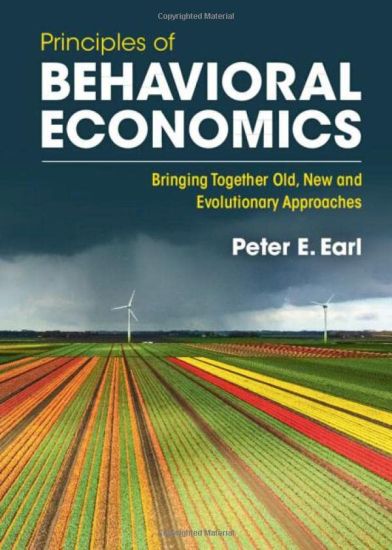
Principles of Behavioral Economics

Principles of Behavioral Economics

Peter E. Earl

Cambridge University Press
2022
pokkari
This book is unique among modern contributions to behavioral economics in presenting a grand synthesis between the kind of behavioral economics popularized by Richard Thaler, earlier approaches such as those of the 1978 Nobel Laureate Herbert Simon, evolutionary psychology, and evolutionary economics from Veblen and Marshall through to neo-Schumpeterian thinking. The synthesis employs a complex adaptive systems approach to how people think, the lifestyles they build, and how new production technologies and products are gradually adopted and produce changes. Using a huge range of examples, it takes behavioral economics from its recent focus on 'nudging' consumers, to the behavior of firms and other organizations, the challenges of achieving structural change and transitioning to environmentally sustainable lifestyles, and instability of the financial system. This book will be of great interest to academics and graduate students who seek a broader view of what behavioral economics is and what it might become.
Principles of Behavioral Economics

Principles of Behavioral Economics

Peter E. Earl

Cambridge University Press
2022
sidottu
This book is unique among modern contributions to behavioral economics in presenting a grand synthesis between the kind of behavioral economics popularized by Richard Thaler, earlier approaches such as those of the 1978 Nobel Laureate Herbert Simon, evolutionary psychology, and evolutionary economics from Veblen and Marshall through to neo-Schumpeterian thinking. The synthesis employs a complex adaptive systems approach to how people think, the lifestyles they build, and how new production technologies and products are gradually adopted and produce changes. Using a huge range of examples, it takes behavioral economics from its recent focus on 'nudging' consumers, to the behavior of firms and other organizations, the challenges of achieving structural change and transitioning to environmentally sustainable lifestyles, and instability of the financial system. This book will be of great interest to academics and graduate students who seek a broader view of what behavioral economics is and what it might become.
Information, Opportunism and Economic Coordination

Information, Opportunism and Economic Coordination

Peter E. Earl

Edward Elgar Publishing Ltd
2002
sidottu
This book is an integrated collection of a dozen of Peter Earl's lively and thought-provoking essays, carefully edited and updated. Theoretical topics include the prediction of corporate behaviour, the economic foundations of marketing and shopping mall design, pricing strategy and its relationship with the existence of second-hand markets, and the microfoundations of macroeconomics. Case studies include cooperation in the car industry, managerialist reforms in New Zealand and the university sector, structural change in the advertising industry and the place of G.B. Richardson and G.L.S. Shackle in the literature of economics.Information, Opportunism and Economic Coordination will be of particular interest to historians of economic thought, business economists, behavioural economists and Post Keynesians.
Monetary Scenarios

Monetary Scenarios

Peter E. Earl

Edward Elgar Publishing Ltd
1989
sidottu
Monetary Scenarios is an original synthesis of post Keynesian macroeconomic and monetary theory with the new microeconomics of the behavioural, transaction cost and public choice theorists. These theoretical ideas are integrated with recent historical and institutional material from the United Kingdom, the United States and Australasia.
Microeconomics for Business and Marketing

Microeconomics for Business and Marketing

Peter E. Earl

Edward Elgar Publishing Ltd
1995
sidottu
Microeconomics for Business and Marketing is an innovative new text for intermediate-level students of microeconomics which offers a series of alternative approaches to economic analysis."And now for something completely different". So starts the preface to Peter Earl's new book. And he is right. He has put together a superbly interesting, intellectually challenging book. It is a book that covers not only the basics of intermediate microeconomics, but also relates microeconomics both to real world business decisions and to the literature wherein the ideas developed. An intermediate micro student who masters this book will be a well trained student.Earl's book will be useful not only to intermediate students, but, perhaps even more so, to graduate students and to faculty teaching intermediate micro and managerial economics. It gives microeconomics both an intellectual context and institutional context for microeconomics. It also contains a wealth of real world examples and discussions of how microeconomic reasoning applies to business. The wealth of essays and problems in the book will be challenging to everyone.This textbook is especially relevant to students of business and commerce since it emphasises practical problem solving and helps readers develop skills in choosing appropriate theoretical 'tools' to deal with particular types of 'real world' problems. While other microeconomics texts focus on mainstream technical set pieces, this book explores, compares and contrasts the tools of both mainstream microeconomic analysis and the behavioural/new institutionalist approaches associated with recent Nobel Laureates Herbert Simon and Ronald Coase. This wider theoretical coverage enables a broader range of practical topics to be addressed, including policy implications of consumer decision processes, and the economics of corporate strategy.Key features of this book include:Worked essays and case study questions within the chapters, as well as post-mortem' reports on examination questions that have been set to classes using this material. Overview chapters on theories of decision-making and consumer choice and theories of business behaviour. Extensive coverage of the economics of uncertainty, including scenario planning, bargaining and competitive games. Emphasizes and analyses on the significance of technological change, and the variety of methods used to organize modern business activities, such as franchising, joint ventures and multinational enterprises.Microeconomics for Business and Marketing is a wide-ranging, innovative textbook which will stimulate students and teachers alike. It will be of particular relevance to students of marketing, commerce and business strategy. Specifically designed with today's larger class sizes in mind, the book encourages students to question and to develop both analytical and written skills, as well as to use economics as a tool for problem solving.
Microeconomics for Business and Marketing

Microeconomics for Business and Marketing

Peter E. Earl

Edward Elgar Publishing Ltd
1995
nidottu
Microeconomics for Business and Marketing is an innovative new text for intermediate-level students of microeconomics which offers a series of alternative approaches to economic analysis."And now for something completely different". So starts the preface to Peter Earl's new book. And he is right. He has put together a superbly interesting, intellectually challenging book. It is a book that covers not only the basics of intermediate microeconomics, but also relates microeconomics both to real world business decisions and to the literature wherein the ideas developed. An intermediate micro student who masters this book will be a well trained student.Earl's book will be useful not only to intermediate students, but, perhaps even more so, to graduate students and to faculty teaching intermediate micro and managerial economics. It gives microeconomics both an intellectual context and institutional context for microeconomics. It also contains a wealth of real world examples and discussions of how microeconomic reasoning applies to business. The wealth of essays and problems in the book will be challenging to everyone.This textbook is especially relevant to students of business and commerce since it emphasises practical problem solving and helps readers develop skills in choosing appropriate theoretical 'tools' to deal with particular types of 'real world' problems. While other microeconomics texts focus on mainstream technical set pieces, this book explores, compares and contrasts the tools of both mainstream microeconomic analysis and the behavioural/new institutionalist approaches associated with recent Nobel Laureates Herbert Simon and Ronald Coase. This wider theoretical coverage enables a broader range of practical topics to be addressed, including policy implications of consumer decision processes, and the economics of corporate strategy.Key features of this book include:Worked essays and case study questions within the chapters, as well as post-mortem' reports on examination questions that have been set to classes using this material. Overview chapters on theories of decision-making and consumer choice and theories of business behaviour. Extensive coverage of the economics of uncertainty, including scenario planning, bargaining and competitive games. Emphasizes and analyses on the significance of technological change, and the variety of methods used to organize modern business activities, such as franchising, joint ventures and multinational enterprises.Microeconomics for Business and Marketing is a wide-ranging, innovative textbook which will stimulate students and teachers alike. It will be of particular relevance to students of marketing, commerce and business strategy. Specifically designed with today's larger class sizes in mind, the book encourages students to question and to develop both analytical and written skills, as well as to use economics as a tool for problem solving.
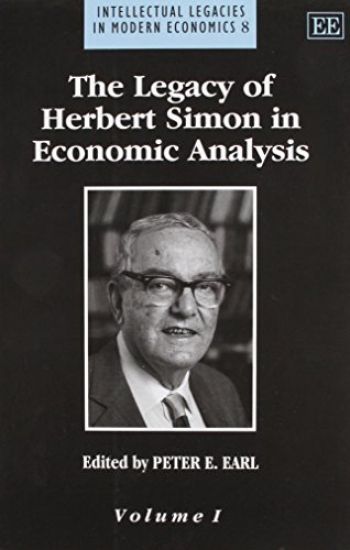
The Legacy of Herbert Simon in Economic Analysis

The Legacy of Herbert Simon in Economic Analysis

Peter E. Earl

Edward Elgar Publishing Ltd
2001
sidottu
Herbert A. Simon has been a leading contributor to cognitive psychology, computer science, public administration, philosophy and statistics, and is the winner of the 1978 Nobel Memorial Prize in economics. As this collection demonstrates, his impact on economics has been felt in areas as diverse as the theory of the firm and economic organization, consumer behaviour, law and economics, and environmental economics. Central to his work is the notion of bounded rationality - the mismatch between human decision-making capacities and the scale of the decision problems that people face, which results in satisficing rather than optimizing behaviour - and his belief that economic research should start from the study of actual behaviour rather than being based on convenient but unrealistic assumptions. Peter Earl's choice of articles shows both the kind of economics that emerges when Simon's philosophy is followed comprehensively, and what happens when neo-classical economists partially adopt his ideas.