Kirjojen hintavertailu. Mukana 11 244 527 kirjaa ja 12 kauppaa.

Kirjahaku

Etsi kirjoja tekijän nimen, kirjan nimen tai ISBN:n perusteella.

6 kirjaa tekijältä Peter E. Gordon

A Precarious Happiness

A Precarious Happiness

Peter E. Gordon

THE UNIVERSITY OF CHICAGO PRESS
2024
sidottu
A strikingly original account of Theodor Adorno’s work as a critique animated by happiness. "Gordon’s confidently gripping and persistently subtle interpretation brings a new tone to the debate about Adorno’s negativism."—Jürgen Habermas Theodor Adorno is often portrayed as a totalizing negativist, a scowling contrarian who looked upon modern society with despair. Peter E. Gordon thinks we have this wrong: if Adorno is uncompromising in his critique, it is because he sees in modernity an unfulfilled possibility of human flourishing. In a damaged world, Gordon argues, all happiness is likewise damaged but not wholly absent. Through a comprehensive rereading of Adorno’s work, A Precarious Happiness recovers Adorno’s commitment to traces of happiness—fragments of the good amid the bad. Ultimately, Gordon argues that social criticism, while exposing falsehoods, must also cast a vision for an unrealized better world.
Walter Benjamin

Walter Benjamin

Peter E. Gordon

YALE UNIVERSITY PRESS
2026
sidottu
An accessible and authoritative biography of Walter Benjamin that guides the reader through the complexity of his intellectual legacy and the turbulence of his time Walter Benjamin (1892–1940) is widely considered one of the most creative cultural critics of the twentieth century. Esteemed for his literary acumen and capacious imagination, he developed a unique style of criticism—his friend Hannah Arendt called it pearl-diving—that sought out fragments of redemption in the ruins of bourgeois civilization. Award-winning author Peter E. Gordon tells Benjamin’s story in a vivid and poetic style, inviting the reader to look beyond the image of Benjamin as a tragic figure of German-Jewish history and portraying him as a complex personality of unique and multifaceted gifts. Tracing Benjamin’s life from his Berlin childhood to his Parisian exile, through the romanticism of the youth movements and the conflicts over modernism and Marxism, Gordon brings Benjamin to life.
Continental Divide

Continental Divide

Peter E. Gordon

Harvard University Press
2012
nidottu
In the spring of 1929, Martin Heidegger and Ernst Cassirer met for a public conversation in Davos, Switzerland. They were arguably the most important thinkers in Europe, and their exchange touched upon the most urgent questions in the history of philosophy: What is human finitude? What is objectivity? What is culture? What is truth? Over the last eighty years the Davos encounter has acquired an allegorical significance, as if it marked an ultimate and irreparable rupture in twentieth-century Continental thought. Here, in a reconstruction at once historical and philosophical, Peter Gordon reexamines the conversation, its origins and its aftermath, resuscitating an event that has become entombed in its own mythology. Through a close and painstaking analysis, Gordon dissects the exchange itself to reveal that it was at core a philosophical disagreement over what it means to be human. But Gordon also shows how the life and work of these two philosophers remained closely intertwined. Their disagreement can be understood only if we appreciate their common point of departure as thinkers of the German interwar crisis, an era of rebellion that touched all of the major philosophical movements of the day—life-philosophy, philosophical anthropology, neo-Kantianism, phenomenology, and existentialism. As Gordon explains, the Davos debate would continue to both inspire and provoke well after the two men had gone their separate ways. It remains, even today, a touchstone of philosophical memory.This clear, riveting book will be of great interest not only to philosophers and to historians of philosophy but also to anyone interested in the great intellectual ferment of Europe’s interwar years.
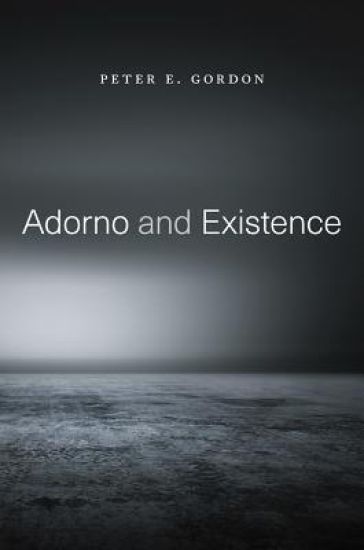
Adorno and Existence

Adorno and Existence

Peter E. Gordon

Harvard University Press
2018
nidottu
From the beginning to the end of his career, the philosopher Theodor W. Adorno sustained an uneasy but enduring bond with existentialism. His attitude overall was that of unsparing criticism, verging on polemic. In Kierkegaard he saw an early paragon for the late flowering of bourgeois solipsism; in Heidegger, an impresario for a “jargon of authenticity” cloaking its idealism in an aura of pseudo-concreteness and neo-romantic kitsch. Even in the straitened rationalism of Husserl’s phenomenology Adorno saw a vain attempt to break free from the prison-house of consciousness.“Gordon, in a detailed, sensitive, fair-minded way, leads the reader through Adorno’s various, usually quite vigorous, rhetorically pointed attacks on both transcendental and existential phenomenology from 1930 on…[A] singularly illuminating study.”—Robert Pippin, Critical Inquiry“Gordon’s book offers a significant contribution to our understanding of Adorno’s thought. He writes with expertise, authority, and compendious scholarship, moving with confidence across the thinkers he examines…After this book, it will not be possible to explain Adorno’s philosophical development without serious consideration of [Gordon’s] reactions to them.”—Richard Westerman, Symposium
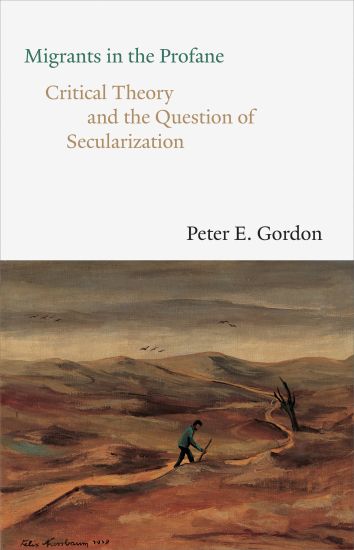
Migrants in the Profane

Migrants in the Profane

Peter E. Gordon

Yale University Press
2021
sidottu
A beautifully written exploration of religion’s role in a secular, modern politics, by an accomplished scholar of critical theory “Rich in historical background, illuminating in its comparative perspective, yet focused on the question of secularization and the normative resources of modernity—a joy to read.”—Maeve Cooke, University College Dublin “Gordon writes with a controlled power, elegance, simplicity, and clarity that is a rare pleasure.”—Max Pensky, Binghamton University Migrants in the Profane takes its title from an intriguing remark by Theodor W. Adorno, in which he summarized the meaning of Walter Benjamin’s image of a celebrated mechanical chess-playing Turk and its hidden religious animus: “Nothing of theological content will persist without being transformed; every content will have to put itself to the test of migrating in the realm of the secular, the profane.” In this masterful book, Peter Gordon reflects on Adorno’s statement and asks an urgent question: Can religion offer any normative resources for modern political life, or does the appeal to religious concepts stand in conflict with the idea of modern politics as a domain free from religion’s influence? In answering this question, he explores the work of three of the Frankfurt School’s most esteemed thinkers: Walter Benjamin, Max Horkheimer, and Theodor W. Adorno. His illuminating analysis offers a highly original account of the intertwined histories of religion and secular modernity.