Kirjojen hintavertailu. Mukana 11 244 527 kirjaa ja 12 kauppaa.

Kirjahaku

Etsi kirjoja tekijän nimen, kirjan nimen tai ISBN:n perusteella.

16 kirjaa tekijältä Peter FitzSimons

The Battle of Long Tan

The Battle of Long Tan

Peter FitzSimons

HACHETTE AUSTRALIA
2024
pokkari
From the bestselling author of Kokoda and Gallipoli comes the epic story of Australia's deadliest Vietnam War battle.4.31 pm: Enemy [on] left flank. Could be serious.5.01 pm: Enemy ... penetrating both flanks and to north and south.5.02: Running short of ammo. Require drop through trees.It was the afternoon of 18 August 1966, hot, humid with grey monsoonal skies. D Company, 6RAR were four kilometres east of their Nui Dat base, on patrol in a rubber plantation not far from the abandoned village of Long Tan. A day after their base had suffered a mortar strike, they were looking for Viet Cong soldiers. Then - just when they were least expecting - they found them. Under withering fire, some Diggers perished, some were grievously wounded, the rest fought on, as they remained under sustained attack.For hours these men fought for their lives against the enemy onslaught. The skies opened and the rain fell as ferocious mortar and automatic fire pinned them down. Snipers shot at close quarters from the trees that surrounded them. The Aussie, Kiwi and Yankee artillery batteries knew it was up to them but, outnumbered and running out of ammunition they fired, loaded, fired as Viet Cong and North Vietnamese Army forces just kept coming. And coming.Their only hope was if Armoured Personnel Carriers (APCs) could reach them before they were wiped out. The APCs did their best but low cloud and thunderstorms meant air support was stalled. A daring helicopter resupply mission was suggested but who would want to fly that? The odds against this small force were monumental...By far the deadliest battle for Australian forces in Vietnam, the Battle of Long Tan has a proud place in the annals of Australian military history - and every ANZAC who fought there could hold his head high.Peter FitzSimons, Australia's greatest storyteller, tells the real story of this classic battle. He reveals the horror, the bravery, the wins and the losses that faced our soldiers. He brings to life the personal stories of the men who fought, the events leading up to that memorable battle and the long war that followed, and the political decisions made in the halls of power that sealed their fates. The Battle of Long Tan is an engrossing and powerful history that shows the costs of war never end.
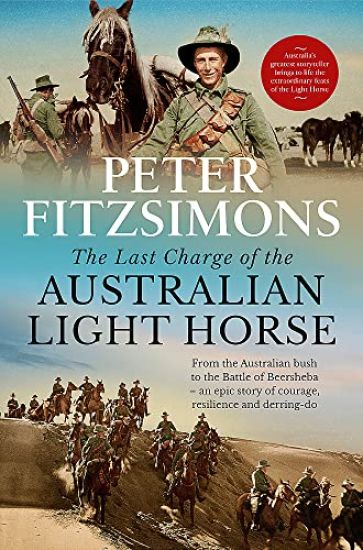
The Last Charge of the Australian Light Horse

The Last Charge of the Australian Light Horse

Peter FitzSimons

HACHETTE AUSTRALIA
2023
sidottu
On 31st October 1917, as the day's light faded, the Australian Light Horse charged against their enemy. Eight hundred men and horses galloped four miles across open country, towards the artillery, rifles and machine guns of the Turks occupying the seemingly unassailable town of Beersheba. What happened in the next hour changed the course of history.This brave battle and the extraordinary adventures that led to it are brought vividly to life by Australia's greatest storyteller, Peter FitzSimons. It is an epic tale of farm boys, drovers, bank clerks, dentists, poets and scoundrels transported to fight a war half a world away, and is full of incredible characters: from Major Banjo Paterson to Lawrence of Arabia; the brilliant writer Trooper Ion Idriess and the humble General Harry Chauvel; the tearaway Test fast bowler 'Tibby' Cotter and the infamous warhorse, Bill the Bastard. All have their part to play in the enthralling, sprawling drama of the Australian Light Horse.Theirs was a war fought in an ancient land with modern weapons; where the men of the Light Horse were trained in sight of the pyramids, drank in the brothels of Cairo and fought through lands known to them only as names from the Bible.The Last Charge of the Australian Light Horse traces the hard path of the Light Horse from the bleakest of starts - being deprived of their horses and fighting at Gallipoli in the tragic Battle of the Nek - to triumph and glory in the desert. Revealing the feats of the Australians who built the legend, it is a brilliantly told tale of courage, resilience and derring-do from Australia's favourite storyteller.
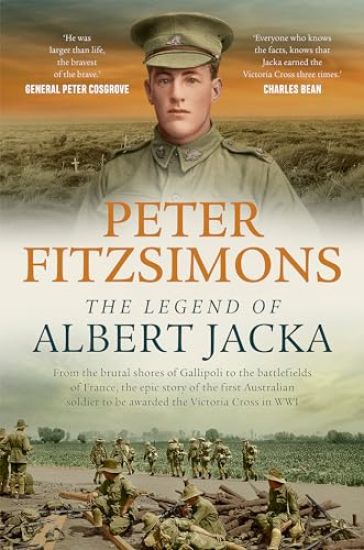
The Legend of Albert Jacka

The Legend of Albert Jacka

Peter FitzSimons

HACHETTE AUSTRALIA
2024
sidottu
Our heroes can come from the most ordinary of places. As a shy lad growing up in country Victoria, no one in the district had any idea the man Albert Jacka would become.Albert 'Bert' Jacka was 21 when Britain declared war on Germany in August 1914. Bert soon enlisted in the Australian Imperial Force and the young private was assigned to 14th Battalion D Company. By the time they shipped out to Egypt he'd been made a Lance Corporal.On 26 April 1915, 14th Battalion landed at Gallipoli under the command of Brigadier General Monash's 4th Infantry Brigade. It was here, on 20 May, that Lance Corporal Albert Jacka proved he was 'the bravest of the brave'. The Turks were gaining ground with a full-scale frontal attack and as his comrades lay dead or dying in the trenches around him, Jacka single-handedly held off the enemy onslaught. The Turks retreated.Jacka's extraordinary efforts saw him awarded the Victoria Cross, the first for an Australian soldier in World War I. He was a national hero, but Jacka's wartime exploits had only just begun: moving on to France, he battled the Germans at Pozières, earning a Military Cross for what historian Charles Bean called 'the most dramatic and effective act of individual audacity in the history of the AIF'. Then at Bullecourt, his efforts would again turn the tide against the enemy. There would be more accolades and adventures before a sniper's bullet and then gassing at Villers-Bretonneux sent Bert home.The Legend of Albert Jacka is an unforgettable story of the bravery and sacrifice of one extraordinary soldier that takes us from the shores of Gallipoli to the battlefields of France, all brought to vivid life by Australia's greatest storyteller, Peter FitzSimons.
The Legend of Albert Jacka

The Legend of Albert Jacka

Peter FitzSimons

HACHETTE AUSTRALIA
2024
pokkari
Our heroes can come from the most ordinary of places. As a shy lad growing up in country Victoria, no one in the district had any idea the man Albert Jacka would become.Albert 'Bert' Jacka was 21 when Britain declared war on Germany in August 1914. Bert soon enlisted in the Australian Imperial Force and the young private was assigned to 14th Battalion D Company. By the time they shipped out to Egypt he'd been made a Lance Corporal.On 26 April 1915, 14th Battalion landed at Gallipoli under the command of Brigadier General Monash's 4th Infantry Brigade. It was here, on 20 May, that Lance Corporal Albert Jacka proved he was 'the bravest of the brave'. The Turks were gaining ground with a full-scale frontal attack and as his comrades lay dead or dying in the trenches around him, Jacka single-handedly held off the enemy onslaught. The Turks retreated.Jacka's extraordinary efforts saw him awarded the Victoria Cross, the first for an Australian soldier in World War I. He was a national hero, but Jacka's wartime exploits had only just begun: moving on to France, he battled the Germans at Pozières, earning a Military Cross for what historian Charles Bean called 'the most dramatic and effective act of individual audacity in the history of the AIF'. Then at Bullecourt, his efforts would again turn the tide against the enemy. There would be more accolades and adventures before a sniper's bullet and then gassing at Villers-Bretonneux sent Bert home.The Legend of Albert Jacka is an unforgettable story of the bravery and sacrifice of one extraordinary soldier that takes us from the shores of Gallipoli to the battlefields of France, all brought to vivid life by Australia's greatest storyteller, Peter FitzSimons.
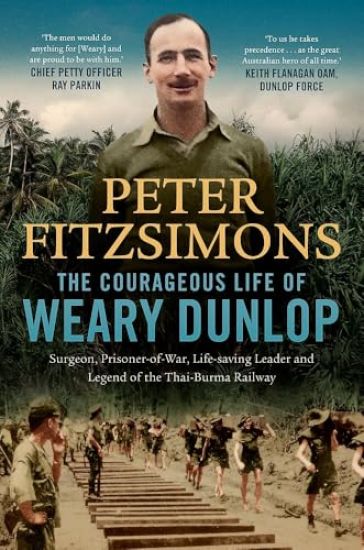
The Courageous Life of Weary Dunlop

The Courageous Life of Weary Dunlop

Peter FitzSimons

HACHETTE AUSTRALIA
2025
pokkari
The extraordinary story of the heroic doctor whose courage and leadership were a lifeline for thousands of Australian prisoners-of-war on the infamous Thai-Burma Railway of World War II - brilliantly told by Australia's favourite storyteller, Peter FitzSimons In September 1939, young Australian surgeon Edward 'Weary' Dunlop was working in London when the dogs of war were unleashed. Signing up, he was commissioned a captain in the Australian Army Medical Corps (AAMC) and sent to the Middle East, serving in Palestine, Greece, Crete, Egypt and Tobruk. As the European war dragged on, an emboldened Japanese force captured Singapore and marched closer to Australian shores. Weary and over 3000 others sailed back to Java to fight this new enemy. At the No. 1 Allied General Hospital in Bandoeng, the Japanese were ready to murder the bedridden when Weary put his body in front of the bayonets. From that moment his leadership, ingenuity and selflessness became legend as Allied prisoners-of-war were sent to Singapore, Thailand and finally faced the hell of working as slave labour on the infamous Thai-Burma Railway. In the POW camps, tropical diseases, malnutrition, and the brutal work regime imposed by their Japanese captors meant the death toll was horrific. And yet, with little to no medical supplies, under extreme physical pressure, Weary Dunlop took risks and beatings to defy the Japanese and keep his men alive in circumstances that tested the limits of human endurance. Weary was a gentle giant of a man. A boxer and former Wallaby, he could have been an elite sportsman but chose a different path - one that led him from rural Victoria to training as a pharmacist and then to medical school. World War II was the fire that fuelled this remarkable hero. His courageous leadership and calm endurance became beacons of hope to the POWs under his command. His name has become synonymous with courage, compassion and resilience. Now, Weary Dunlop's heroic and inspiring story has been brought to life by Australia's greatest storyteller, Peter FitzSimons.
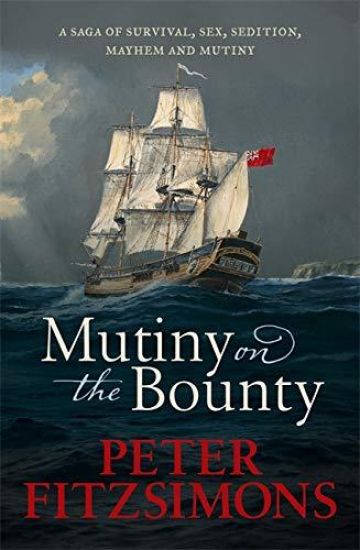
Mutiny on the Bounty

Mutiny on the Bounty

Peter FitzSimons

Constable
2019
pokkari
The mutiny on HMS Bounty, in the South Pacific on 28 April 1789, is one of history's great epics - and in the hands of Peter FitzSimons it comes to life as never before.Commissioned by the Royal Navy to collect breadfruit plants from Tahiti and take them to the West Indies, the Bounty's crew found themselves in a tropical paradise. Five months later, they did not want to leave. Under the leadership of Fletcher Christian most of the crew mutinied soon after sailing from Tahiti, setting Captain William Bligh and 18 loyal crewmen adrift in a small open boat. In one of history's great feats of seamanship, Bligh navigated this tiny vessel for 3618 nautical miles to Timor.Fletcher Christian and the mutineers sailed back to Tahiti, where most remained and were later tried for mutiny. But Christian, along with eight fellow mutineers and some Tahitian men and women, sailed off into the unknown, eventually discovering the isolated Pitcairn Island - at the time not even marked on British maps - and settling there.This astonishing story is historical adventure at its very best, encompassing the mutiny, Bligh's monumental achievement in navigating to safety, and Fletcher Christian and the mutineers' own epic journey from the sensual paradise of Tahiti to the outpost of Pitcairn Island. The mutineers' descendants live on Pitcairn to this day, amid swirling stories and rumours of past sexual transgressions and present-day repercussions. Mutiny on the Bounty is a sprawling, dramatic tale of intrigue, bravery and sheer boldness, told with the accuracy of historical detail and total command of story that are Peter FitzSimons' trademarks.
Burke and Wills

Burke and Wills

Peter FitzSimons

Constable
2019
isokokoinen pokkari
'They have left here today!' he calls to the others. When King puts his hand down above the ashes of the fire, it is to find it still hot. There is even a tiny flame flickering from the end of one log. They must have left just hours ago.'MELBOURNE, 20 AUGUST 1860. In an ambitious quest to be the first Europeans to cross the harsh Australian continent, the Victorian Exploring Expedition sets off, farewelled by 15,000 cheering well-wishers. Led by Robert O'Hara Burke, a brave man totally lacking in the bush skills necessary for his task; surveyor and meteorologist William Wills; and 17 others, the expedition took 20 tons of equipment carried on six wagons, 23 horses and 26camels.Almost immediately plagued by disputes and sackings, the expeditioners battled the extremes of the Australian landscape and weather: its deserts, the boggy mangrove swamps of the Gulf, the searing heat and flooding rains. Food ran short and, unable to live off the land, the men nevertheless mostly spurned the offers of help from the local Indigenous people.In desperation, leaving the rest of the party at the expedition's depot on Coopers Creek, Burke, Wills and John King made a dash for the Gulf in December 1860. Bad luck and bad management would see them miss by just hours a rendezvous back at Coopers Creek, leaving them stranded in the wilderness with practically no supplies. Only King survived to tell the tale.Yet, despite their tragic fates, the names of Burke and Wills have become synonymous with perseverance and bravery in the face of overwhelming odds. They live on in Australia's history - and their story remains immediate and compelling.
Monash's Masterpiece

Monash's Masterpiece

Peter FitzSimons

Constable
2019
isokokoinen pokkari
The Battle of Le Hamel on 4 July 1918 was an Allied triumph, and strategically very important in the closing stages of WW1. A largely Australian force commanded by the brilliant John Monash, fought what has described as the first modern battle - where infantry, tanks, artillery and planes operated together, as a coordinated force.Monash planned every detail meticulously - with nothing left to chance: integrated use of planes, wireless (and even carrier pigeons!)was the basis, and it went on from there, down to the details.Infantry, artillery, tanks and planes worked together of the battlefront, with relatively few losses. In the words of Monash: 'A perfect modern battle plan is like nothing so much as a score for an orchestral composition, where the various arms and units are the instruments, and the tasks they perform are their respective musical phrases.'
James Cook

James Cook

Peter FitzSimons

Constable
2020
pokkari
Captain James Cook is one of the most recognisable in Australian history - an almost mythic figure who is often discussed, celebrated, reviled and debated. But who was the real James Cook?The name Captain James Cook is one of the most recognisable in Australian history - an almost mythic figure who is often discussed, celebrated, reviled and debated.But who was the real James Cook?This Yorkshire farm boy would go on to become the foremost mariner, navigator and cartographer of his era, and to personally map a third of the globe. His great voyages of discovery were incredible feats of seamanship and navigation. Leading a crew of men into uncharted territories, Cook would face the best and worst of humanity as he took himself and his crew to the edge of the known world - and beyond.With his masterful storytelling talent, Peter FitzSimons brings James Cook to life. Focusing on his most iconic expedition, the voyage of the Endeavour, where Cook first set foot on Australian and New Zealand soil, FitzSimons contrasts Cook against another figure who looms large in Australasian history: Joseph Banks, the aristocratic botanist. As they left England, Banks, a rich, famous playboy, was everything that Cook was not. The voyage tested Cook's character and would help define his legacy.Now, 240 years after James Cook's death, FitzSimons reveals what kind of man James was at heart. His strengths, his weaknesses, his passions and pursuits, failures and successes.JAMES COOK reveals the man behind the myth.
Breaker Morant

Breaker Morant

Peter FitzSimons

Constable
2021
pokkari
The epic story of the Boer War and Harry 'Breaker' Morant: drover, horseman, bush poet - murderer or hero?Most people have heard of the Boer War and of Harry 'Breaker' Morant, a figure who rivals Ned Kelly as an archetypal Australian folk hero. But Morant was a complicated man. Born in England and immigrating to Queensland in 1883, he established a reputation as a rider, polo player and poet who submitted ballads to The Bulletin and counted Banjo Paterson as a friend. Travelling on his wits and the goodwill of others, Morant was quick to act when appeals were made for horsemen to serve in the war in South Africa. He joined up, first with the South Australian Mounted Rifles and then with a South African irregular unit, the Bushveldt Carbineers.The adventure would not go as Breaker planned. In October 1901 Lieutenant Harry Morant and two other Australians, Lieutenants Peter Handcock and George Witton, were arrested for the murder of Boer prisoners. Morant and Handcock were court-martialled and executed in February 1902 as the Boer War was in its closing stages, but the debate over their convictions continues to this day.With his masterful command of story, Peter FitzSimons takes us to the harsh landscape of southern Africa and into the bloody action of war against an unpredictable force using modern commando tactics. The truths FitzSimons uncovers about 'the Breaker' and the part he played in the Boer War are astonishing - and finally we will know if the Breaker was a hero, a cad, a scapegoat or a criminal.
Tobruk 75th Anniversary Edition

Tobruk 75th Anniversary Edition

Peter FitzSimons

HarperCollins Publishers (Australia) Pty Ltd
2016
nidottu
The definitive account of when Australia's famed Rats of Tobruk they took on General Erwin Rommel, The Desert Fox. The classic story of 1941's Battle of Tobruk, in which more than 15,000 Australian troops - backed by British artillery - fought in excruciating desert heat through eight long months, against Rommel's formidable Afrika Korps. During the dark heart of World War II, when Hitler turned his attention to conquering North Africa, a distracted and far-flung Allied force could not give its all to the defence of Libya. So the job was left to the roughest, toughest bunch that could be mustered: the Australian Imperial Force. The AIF's defence of the harbour city of Tobruk against the Afrika Korps' armoured division is not only the stuff of Australian legend, it is one of the great battles of all time, as against the might of General Rommel and his Panzers, the Australians relied on one factor in particular to give them the necessary strength against the enemy: mateship. Drawing on extensive source material - including diaries and letters, many never published before - this extraordinary book, written in Peter FitzSimons' highly readable style, is the definitive account of this remarkable chapter in Australia's history.