Kirjojen hintavertailu. Mukana 11 699 587 kirjaa ja 12 kauppaa.

Kirjahaku

Etsi kirjoja tekijän nimen, kirjan nimen tai ISBN:n perusteella.

7 kirjaa tekijältä Peter Groenewegen

Eighteenth Century Economics

Eighteenth Century Economics

Peter Groenewegen

Routledge
2002
sidottu
Peter Groenewegen is one of the world's foremost scholars of eighteenth century economics - the era that saw the effective 'mainstreaming' of the discipline in the work of Smith, Turgot and Quesnay. This collection of essays amounts to the definitive guide to eighteenth century economics and is a must for any economist's bookshelves.Eighteenth Century Economics represents four decades of Peter Groenewegen's research of that period. Presented in chronological order, the essays read not only as an authoritative summary of that period, but also as a guide to the evolution of Groenewegen's writings down the years. There can be no doubt that this book is truly indispensable to any serious economist and will prove a valuable resource for students of the history of economic thought.
Minor Marshallians and Alfred Marshall

Minor Marshallians and Alfred Marshall

Peter Groenewegen

Routledge
2011
sidottu
Alfred Marshall, Professor of Economics at Cambridge University (1885-1908), produced a distinguished a distinguished crop of students, many of them leaders in the economics profession in subsequent generations. Pigou, Keynes and Denis Robertson are undoubtedly the most famous of these Marshall ‘pupils’ but there were many more, even if more minor forces in the development of early twentieth century economics. This book intends to examine the major work of ten of these ‘minor’ Marshallians – Sydney John Chapman (1871-1951), John Harold Clapham (1873-1946), Charles Ryle Fay (1884-1961), Alfred William Flux (1867-1942), Frederick Lavington (1881-1927), Walter Thomas Layton (1884-1966), David Huchinson MacGregor (1827-1953), Joseph Shield Nicholson (1850-1927), Charles Percy Sanger (1871-1930) and Gerald Francis Shove (1888-1947), to name them in alphabetical order.The broad aim of this book is to evaluate the more important contributions of these ‘minor’ Marshallians by selective examination of their major economic work. That evaluation has at least two dimensions. First, it focuses on the significance of the author’s individual contributions to the development of twentieth century economic thought. Secondly, it attempts to assess the Marshallian credentials of these contributions in order to indicate how Marshallian in their economics these ‘pupils’ of Marshall’s economics teaching actually stayed.
Eighteenth Century Economics

Eighteenth Century Economics

Peter Groenewegen

Routledge
2015
nidottu
Peter Groenewegen is one of the world's foremost scholars of eighteenth century economics - the era that saw the effective 'mainstreaming' of the discipline in the work of Smith, Turgot and Quesnay. This collection of essays amounts to the definitive guide to eighteenth century economics and is a must for any economist's bookshelves.Eighteenth Century Economics represents four decades of Peter Groenewegen's research of that period. Presented in chronological order, the essays read not only as an authoritative summary of that period, but also as a guide to the evolution of Groenewegen's writings down the years. There can be no doubt that this book is truly indispensable to any serious economist and will prove a valuable resource for students of the history of economic thought.
Minor Marshallians and Alfred Marshall

Minor Marshallians and Alfred Marshall

Peter Groenewegen

Routledge
2015
nidottu
Alfred Marshall, Professor of Economics at Cambridge University (1885-1908), produced a distinguished a distinguished crop of students, many of them leaders in the economics profession in subsequent generations. Pigou, Keynes and Denis Robertson are undoubtedly the most famous of these Marshall ‘pupils’ but there were many more, even if more minor forces in the development of early twentieth century economics. This book intends to examine the major work of ten of these ‘minor’ Marshallians – Sydney John Chapman (1871-1951), John Harold Clapham (1873-1946), Charles Ryle Fay (1884-1961), Alfred William Flux (1867-1942), Frederick Lavington (1881-1927), Walter Thomas Layton (1884-1966), David Huchinson MacGregor (1827-1953), Joseph Shield Nicholson (1850-1927), Charles Percy Sanger (1871-1930) and Gerald Francis Shove (1888-1947), to name them in alphabetical order.The broad aim of this book is to evaluate the more important contributions of these ‘minor’ Marshallians by selective examination of their major economic work. That evaluation has at least two dimensions. First, it focuses on the significance of the author’s individual contributions to the development of twentieth century economic thought. Secondly, it attempts to assess the Marshallian credentials of these contributions in order to indicate how Marshallian in their economics these ‘pupils’ of Marshall’s economics teaching actually stayed.
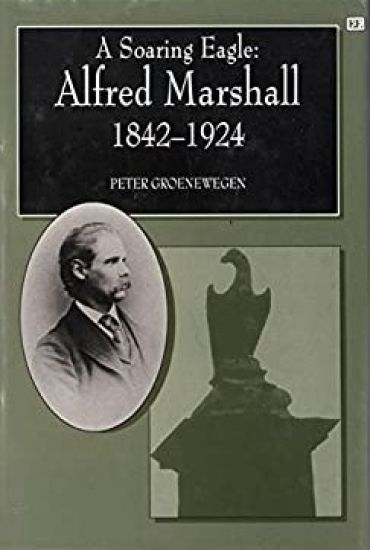
A SOARING EAGLE: Alfred Marshall 1842–1924

A SOARING EAGLE: Alfred Marshall 1842–1924

Peter Groenewegen

Edward Elgar Publishing Ltd
1995
sidottu
Theorist, practitioner, educator and arguably the father of professional economics, Alfred Marshall's life and career have long required a full scale biography to put his work into context and reveal the extent of his influence.Peter Groenewegen's outstanding new book places the major features of Marshall's life and work within the rich institutional setting of late nineteenth and early twentieth century Britain. This biography sheds new light on Marshall's decision to study economics - after dropping mathematics, philosophy and psychology in turn - and the background to his important books, including the Principles of Economics, as well as his government advice over three decades. More than just the life of a major economist, it also deals with economics and mathematics education at Cambridge, contemporary controversies over socialism, imperialism, free trade, eugenics, religious belief, social welfare and the women's movement.As the first biography of Alfred Marshall, A Soaring Eagle contributes to the history of economics, the social sciences and education while also offering a series of insights into Victorian and Edwardian society.
A SOARING EAGLE: Alfred Marshall 1842–1924

A SOARING EAGLE: Alfred Marshall 1842–1924

Peter Groenewegen

Edward Elgar Publishing Ltd
1998
nidottu
Theorist, practitioner, educator and arguably the father of professional economics, Alfred Marshall's life and career have long required a full scale biography to put his work into context and reveal the extent of his influence.Peter Groenewegen's outstanding new book places the major features of Marshall's life and work within the rich institutional setting of late nineteenth and early twentieth century Britain. This biography sheds new light on Marshall's decision to study economics - after dropping mathematics, philosophy and psychology in turn - and the background to his important books, including the Principles of Economics, as well as his government advice over three decades. More than just the life of a major economist, it also deals with economics and mathematics education at Cambridge, contemporary controversies over socialism, imperialism, free trade, eugenics, religious belief, social welfare and the women's movement.As the first biography of Alfred Marshall, A Soaring Eagle contributes to the history of economics, the social sciences and education while also offering a series of insights into Victorian and Edwardian society.
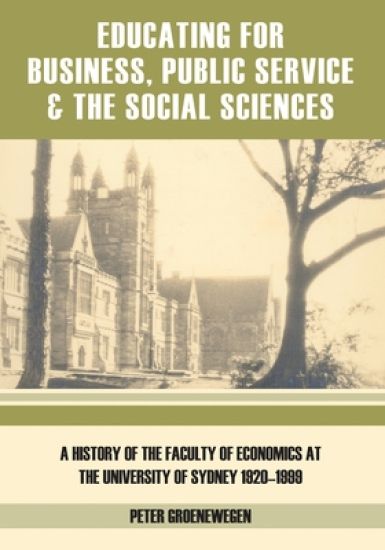
Educating for Business, Public Service and the Social Sciences
Tertiary economics and business education started early in Australia but was not organised on a faculty basis until the 20th century. Commerce and business teaching at Sydney University began in 1906, and from 1920 was taught in the Faculty of Economics, together with public administration and accounting. Its progress for the next 80 years is chronicled in this comprehensive history of the Faculty of Economics.The book presents a broad overview of staff, students and courses of study during Depression, war, postwar reconstruction, student unrest and successful moves to add further Business studies. A prelude surveys the 19th-century beginnings and the epilogue presents the varied education opportunities offered for the 21st century by the Faculty of Economics and Business.