Kirjojen hintavertailu. Mukana 11 717 486 kirjaa ja 12 kauppaa.

Kirjahaku

Etsi kirjoja tekijän nimen, kirjan nimen tai ISBN:n perusteella.

7 kirjaa tekijältä Peter H. Russell

Constitutional Odyssey

Constitutional Odyssey

Peter H. Russell

University of Toronto Press
2004
pokkari
Constitutional Odyssey is an account of the politics of making and changing Canada's constitution from Confederation to the present day. Peter H. Russell frames his analysis around two contrasting constitutional philosophies – Edmund Burke's conception of the constitution as a set of laws and practices incrementally adapting to changing needs and societal differences, and John Locke's ideal of a Constitution as a single document expressing the will of a sovereign people as to how they are to be governed. The first and second editions of Constitutional Odyssey, published in 1992 and 1993 respectively, received wide-ranging praise for their ability to inform the public debate. This third edition continues in that tradition. Russell adds a new preface, and a new chapter on constitutional politics since the defeat of the Charlottetown Accord in 1993. He also looks at the 1995 Quebec Referendum and its fallout, the federal Clarity Act, Quebec's Self-Determination Act, the Agreement on Internal Trade, the Social Union Framework Agreement and the Council of the Federation, progress in Aboriginal self-determination such as Nunavut and the Nisga'a Agreement, and the movement to reduce the democratic deficit in parliamentary government. Comprehensive and eminently readable, Constitutional Odyssey is as important as ever.
Constitutional Odyssey

Constitutional Odyssey

Peter H. Russell

University of Toronto Press
2004
sidottu
Constitutional Odyssey is an account of the politics of making and changing Canada's constitution from Confederation to the present day. Peter H. Russell frames his analysis around two contrasting constitutional philosophies – Edmund Burke's conception of the constitution as a set of laws and practices incrementally adapting to changing needs and societal differences, and John Locke's ideal of a Constitution as a single document expressing the will of a sovereign people as to how they are to be governed. The first and second editions of Constitutional Odyssey, published in 1992 and 1993 respectively, received wide-ranging praise for their ability to inform the public debate. This third edition continues in that tradition. Russell adds a new preface, and a new chapter on constitutional politics since the defeat of the Charlottetown Accord in 1993. He also looks at the 1995 Quebec Referendum and its fallout, the federal Clarity Act, Quebec's Self-Determination Act, the Agreement on Internal Trade, the Social Union Framework Agreement and the Council of the Federation, progress in Aboriginal self-determination such as Nunavut and the Nisga'a Agreement, and the movement to reduce the democratic deficit in parliamentary government. Comprehensive and eminently readable, Constitutional Odyssey is as important as ever.
Canada's Trial Courts

Canada's Trial Courts

Peter H. Russell

University of Toronto Press
2007
sidottu
One of the most important but least examined aspects of the Canadian judicial system is the dual structure of civil and criminal trial courts. Canada's Trial Courts examines the co-existence, in every province, of superior courts (presided over by federally appointed judges) and 'lower' courts (staffed by provincially appointed judges). Combining both political and legal analysis, this is the first book to provide an in depth study of the evolution and operation of Canada's trial courts. This collection of essays begins with an exploration of the constitutional origins of Canada's integrated court system and the failure of federal and provincial governments to cooperate in its development. Following are discussions of a number of contemporary reform projects in various jurisdictions, including Quebec, Nova Scotia, Alberta, and Nunavut, as well as examinations of competing visions of how Canada's trial courts should be organized in the future. To put the issue in a comparative perspective, the concluding section provides examples of how trial courts have been restructured in the United Kingdom and the state of California. Proposing a range of practical alternatives to the present system, the volume offers a ground-breaking legal analysis that addresses constitutional obstacles to trial court reform, and assesses the political factors that influence reform at the judicial level. Featuring distinguished contributors from a variety of disciplinary backgrounds, Canada's Trial Courts offers a comprehensive and up-to-date examination of an important but neglected issue that ultimately has a profound impact on the quality of justice that Canadians experience.
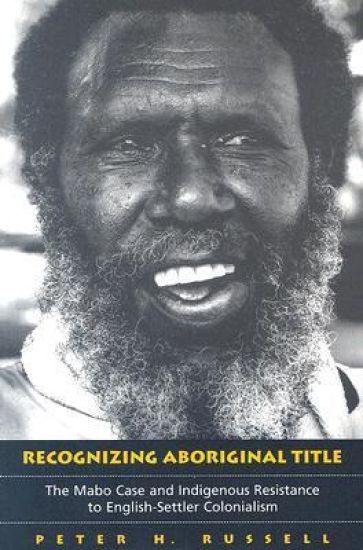
Recognizing Aboriginal Title

Recognizing Aboriginal Title

Peter H. Russell

University of Toronto Press
2006
pokkari
A judicial revolution occurred in 1992 when Australia's highest court discarded a doctrine that had stood for two hundred years, that the country was a terra nullius – a land of no one – when the white man arrived. The proceedings were known as the Mabo Case, named for Eddie Koiki Mabo, the Torres Strait Islander who fought the notion that the Australian Aboriginal people did not have a system of land ownership before European colonization. The case had international repercussions, especially on the four countries in which English-settlers are the dominant population: Australia, Canada, New Zealand, and the United States. In Recognizing Aboriginal Title, Peter H. Russell offers a comprehensive study of the Mabo case, its background, and its consequences, contextualizing it within the international struggle of Indigenous peoples to overcome their colonized status. Russell weaves together an historical narrative of Mabo's life with an account of the legal and ideological premises of European imperialism and their eventual challenge by the global forces of decolonization. He traces the development of Australian law and policy in relation to Aborigines, and provides a detailed examination of the decade of litigation that led to the Mabo case. Mabo died at the age of fifty-six just five months before the case was settled. Although he had been exiled from his land over a dispute when he was a teenager, he was buried there as a hero. Recognizing Aboriginal Title is a work of enormous importance by a legal and constitutional scholar of international renown, written with a passion worthy of its subject – a man who fought hard for his people and won.
Sovereignty

Sovereignty

Peter H. Russell

University of Toronto Press
2021
sidottu
To be effective, sovereignty must be secured through force or consent by those living in a territory, and accepted externally by other sovereign states. To be legitimate, the sovereignty claim must have the consent of its people and accord with international human rights. In Sovereignty: The Biography of a Claim, Peter H. Russell traces the origins of the sovereignty claim to Christian Europe and the attribution of sovereignty to God in the early Middle Ages. Transcending a narrow legal framework, he discusses sovereignty as a political activity including efforts to enshrine sovereignty within international law. Russell does not call for the end of sovereignty but makes readers aware of its limitations. While sovereignty can do good work for small and vulnerable peoples, it cannot be the basis of a global order capable of responding to the major existential threats that threaten our species and our planet. A brisk, often humorous, and personal exploration, Sovereignty: The Biography of a Claim will interest specialists and general readers alike, offering fresh insights on the limitations of sovereignty and the potential of federalism to alleviate these limitations now and in the future.
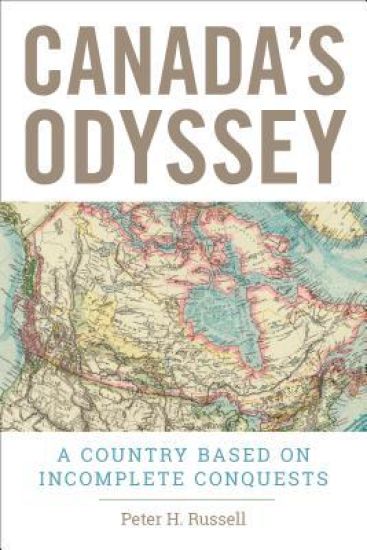
Canada's Odyssey

Canada's Odyssey

Peter H. Russell

University of Toronto Press
2019
pokkari
150 years after Confederation, Canada is known around the world for its social diversity and its commitment to principles of multiculturalism. But the road to contemporary Canada is a winding one, a story of division and conflict as well as union and accommodation. In Canada’s Odyssey, renowned scholar Peter H. Russell provides an expansive, accessible account of Canadian history from the pre-Confederation period to the present day. By focusing on what he calls the "three pillars" of English Canada, French Canada, and Aboriginal Canada, Russell advances an important view of our country as one founded on and informed by "incomplete conquests." It is the very incompleteness of these conquests that have made Canada what it is today, not just a multicultural society but a multinational one. Featuring the scope and vivid characterizations of an epic novel, Canada’s Odyssey is a magisterial work by an astute observer of Canadian politics and history, a perfect book to commemorate the 150th anniversary of Confederation.
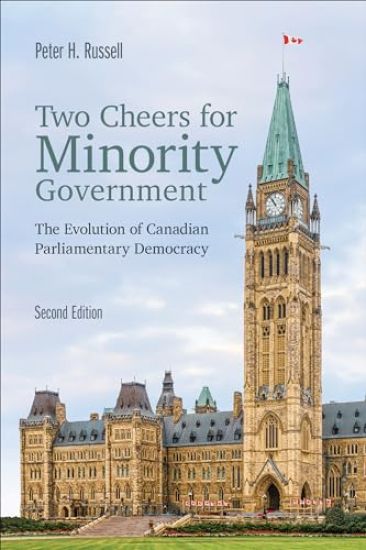
Two Cheers for Minority Government

Two Cheers for Minority Government

Peter H. Russell

UNIVERSITY OF TORONTO PRESS
2024
pokkari
Two Cheers for Minority Government presents a concise, accessible analysis of the prevalence of minority governments in Canada. Using the Canadian case to reflect on the processes and procedures of the parliamentary system, Peter H. Russell explores the tendency for people in parliamentary government to prefer elections which result in one party getting a margin of seats. Russell aims to explain why a minority government is not only a likely outcome of parliamentary elections in Canada but is also, for most, the best possible outcome. He argues that the best result of parliamentary actions is for no party to end up with a majority of seats in the lower house. This makes for government that is more accountable to the people. This new edition reveals how the increasing frequency of parliamentary elections that do not result in majority governments is a positive development for democracy. Ultimately, Two Cheers for Minority Government aims to help both citizens and politicians understand and make the most of the opportunities presented by minority governments.