Kirjojen hintavertailu. Mukana 11 244 527 kirjaa ja 12 kauppaa.

Kirjahaku

Etsi kirjoja tekijän nimen, kirjan nimen tai ISBN:n perusteella.

56 kirjaa tekijältä Peter Johnson

The Amazing Adventures of John Smith, Jr. Aka Houdini
For fans of Jerry Spinelli's Maniac Magee, Gary D. Schmidt's The Wednesday Wars, and Jack Gantos's Joey Pigza Books comes a hilarious and poignant slice-of-life novel from critically acclaimed author and poet Peter Johnson.When an author comes to speak to his class in a rundown area of Providence, Houdini decides to make money by writing his own novel. Houdini chronicles his life as he and his friends start a leaf-raking business, befriend Old Man Jackson (a Vietnam War veteran with a seriously intimidating dog), and get even with the neighborhood bully, Angel. But it's hard to find a way to write about his dad losing his job or his brother, Franklin, who is first reported missing in action in Iraq and then still seems to be missing when he comes home.No matter what, Houdini and his friends rely on one another to figure out how to do the right thing. And Houdini discovers that writing and thinking about his friends and family lets him get to know them in completely new ways.

The Life and Times of Benny Alvarez

The Life and Times of Benny Alvarez

Peter Johnson

Harpercollins
2014
sidottu
This heartfelt story about school, friendship, and family is perfect for readers who can't get enough of such middle grade favorites as Jerry Spinelli and Gary D. Schmidt. From acclaimed author Peter Johnson, The Life and Times of Benny Alvarez is a novel that will make you laugh, cry, and appreciate your family all the more.Everyone thinks Benny Alvarez is Mr. Negativity. According to Benny, he's just realistic about seeing the "other side" of things--when it comes to just about everything. But maybe there's another way to deal with the things Benny can't control--like his ailing grandfather, his wild younger brother, and the know-it-all girls at school. In this poignant novel about acceptance, Benny Alvarez will have to decide . . . is the glass half empty or half full?
Astute Competition

Astute Competition

Peter Johnson

Elsevier Science Ltd
2006
sidottu
This book is embedded in practical tools which proposes a fourth field of economics in addition to macro, micro and industrial organisation economics (IO); namely what may be called the economics of diversity. This book asserts that businesses are as individual as people. All have unique identities, what may be called genomes. As such economic diversity is the norm, rather than the economics of commodities. Contemporary economics deals very effectively with commodities in situations of perfect competition. It also makes some useful insights into imperfect competition and monopoly. The first half of the book expands the conceptual underpinnings of the economics of diversity (ecosystems, business models, advantage, rents and valuation of resources); the second half demonstrates how these methods can be practically applied through tools and techniques to deal with questions of business development, corporate strategy, mergers and acquisitions, and start-ups.
Politics, Innocence, and the Limits of Goodness
First published in 1988. Moral innocence is of enduring interest because it seems to embody our ideals in their purest form. The place of moral innocence in politics is the central theme of Peter Johnson’s subtle and original book. Are there moral dispositions which are not only incompatible with politics but actually endanger it? If it is sometimes necessary to act badly in order to achieve desirable objectives, what moral standpoints would exclude such a course at action? Peter Johnson demonstrates convincingly why philosophical accounts of morality, past and present, are unable to explain moral innocence: its full impact on politics can only be grasped by putting aside traditional theories. Literature provides the key to a deeper understanding of the relationship between politics and morality. Melville’s Billy Budd, Shakespeare’s Henry VI, and Graham Greene’s The Quiet American reveal moral innocence at work in political circumstances of great intensity. Through these and other literary figures, we see at last the specific character of moral innocence and why it is connected with political disaster. This closely reasoned yet deeply passionate book illuminates a problem of great contemporary interest and nowhere more so than in American public life. Original in theme and content, it confronts central issues of concern to the modern mind, not simply to academics, both teachers and taught, but to all those interested in how they might be governed.
Politics, Innocence, and the Limits of Goodness
First published in 1988. Moral innocence is of enduring interest because it seems to embody our ideals in their purest form. The place of moral innocence in politics is the central theme of Peter Johnson’s subtle and original book. Are there moral dispositions which are not only incompatible with politics but actually endanger it? If it is sometimes necessary to act badly in order to achieve desirable objectives, what moral standpoints would exclude such a course at action? Peter Johnson demonstrates convincingly why philosophical accounts of morality, past and present, are unable to explain moral innocence: its full impact on politics can only be grasped by putting aside traditional theories. Literature provides the key to a deeper understanding of the relationship between politics and morality. Melville’s Billy Budd, Shakespeare’s Henry VI, and Graham Greene’s The Quiet American reveal moral innocence at work in political circumstances of great intensity. Through these and other literary figures, we see at last the specific character of moral innocence and why it is connected with political disaster. This closely reasoned yet deeply passionate book illuminates a problem of great contemporary interest and nowhere more so than in American public life. Original in theme and content, it confronts central issues of concern to the modern mind, not simply to academics, both teachers and taught, but to all those interested in how they might be governed.
The Economics of Small Firms

The Economics of Small Firms

Peter Johnson

Routledge
2007
sidottu
Student-friendly and international in scope and relevance, this book provides an accessible introduction to the economics of small business for those with little knowledge of economics. Economics, alongside other disciplines and interacting with them, has some important insights to offer and it is in this context that The Economics of Small Firms examines the formation, survival, growth and financing of small businesses, spatial variations in business formation, the economic role of small businesses, and key policy issues. This informative text is an essential purchase for anybody studying business and management who is eager for an easy-to-use and engaging overview of economics, entrepreneurship and small business.
The Economics of Small Firms

The Economics of Small Firms

Peter Johnson

Routledge
2007
nidottu
Student-friendly and international in scope and relevance, this book provides an accessible introduction to the economics of small business for those with little knowledge of economics. Economics, alongside other disciplines and interacting with them, has some important insights to offer and it is in this context that The Economics of Small Firms examines the formation, survival, growth and financing of small businesses, spatial variations in business formation, the economic role of small businesses, and key policy issues. This informative text is an essential purchase for anybody studying business and management who is eager for an easy-to-use and engaging overview of economics, entrepreneurship and small business.
The Formation and Development of Small Business
This book brings together thirty years of original empirical research on key aspects of the formation and development of small firms from selected articles authored or co-authored by Peter Johnson. Complete with a comprehensive introduction from the author placing the work in relation to the contemporary debates on the subject and providing a cohesive overview, these essays provide an excellent historical context for current research in this area. Many of the studies in this book emphasise the interrelatedness of economic activity and decisions, an emphasis that serves as an important reminder of the complex business environments in which small firms operate. The book is divided into five sections. The first part focuses on the process of business formation. In part two, the role of new firms in regional development is considered. The third section deals with employment issues, whilst part four looks at various aspects of growth and development. Finally, the book concludes with two articles on policy.
Frames of Deceit

Frames of Deceit

Peter Johnson

Cambridge University Press
2007
pokkari
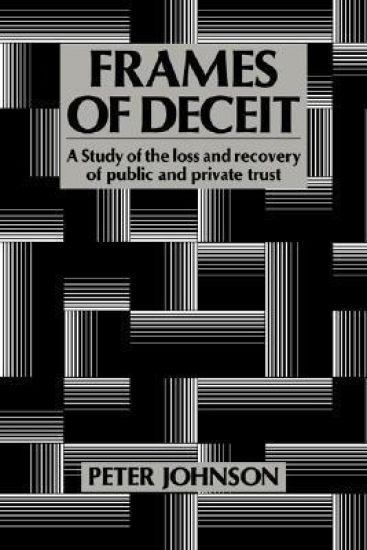
Frames of Deceit is a philosophical investigation of the nature of trust in public and private life. It examines how trust originates, how it is challenged, and how it is recovered when moral and political imperfections collide. In politics, rulers may be called upon to act badly for the sake of a political good, and in private life intimate attachments are formed in which the costs of betrayal are high. This book asks how trust is tested by human goods, moral character and power relations. It explores whether an individual's experience of betrayal differs totally from that of a community when it loses and then seeks to recover a vital public trust. Although this is a work of political philosophy it is distinctive in examining three literary texts - Sophocles' Philoctetes, Shakespeare's Troilus and Cressida, and Zola's Thérése Raquin - in order to deepen our understanding of the place of trust in morality and politics.
Frames of Deceit

Frames of Deceit

Peter Johnson

Cambridge University Press
1992
sidottu
Frames of Deceit is a philosophical investigation of the nature of trust in public and private life. It examines how trust originates, how it is challenged, and how it is recovered when moral and political imperfections collide. In politics, rulers may be called upon to act badly for the sake of a political good, and in private life intimate attachments are formed in which the costs of betrayal are high. This book asks how trust is tested by human goods, moral character and power relations. It explores whether an individual's experience of betrayal differs totally from that of a community when it loses and then seeks to recover a vital public trust. Although this is a work of political philosophy it is distinctive in examining three literary texts - Sophocles' Philoctetes, Shakespeare's Troilus and Cressida, and Zola's Thérése Raquin - in order to deepen our understanding of the place of trust in morality and politics.
Narrow Gauge Lines of the British Isles

Narrow Gauge Lines of the British Isles

Peter Johnson

Ian Allan Publishing
2015
sidottu
Although standard gauge railways - albeit of different gauges - came to dominate the railways of Britain and Ireland, there was also a considerable number of narrow gauge lines constructed throughout the British Isles. Whilst many of these were built almost exclusively for industrial purposes and never saw regular passenger service, a significant number from the Cambeltown & Machrihanish on the Mull of Kintyre, to the Southwold on the Suffolk Coast and the Lynton & Barnstaple in North Devon, carried regular passenger services. Within the British Isles, three areas - Wales, the Isle of Man and Ireland - had the greatest concentration of narrow gauge lines and it was in these areas that the lines survived the longest. In Ireland, lines such as the County Donegal and Londonderry & Lough Swilly survived until the late 1950s and in Wales, a number of the lines survived into the postwar era and were to become amongst the pioneers of the preservation movement.This new book will look in detail at the narrow gauge lines across the British Isles, illustrated with a comprehensive selection of both colour and mono photographs, the latter because a number of the lines featured had closed before the arrival of colour photography. Informative and extended captions illuminate the illustrations and provide a brilliant history of these interesting lines.
Narrow Gauge Railways

Narrow Gauge Railways

Peter Johnson

Shire Publications
2013
nidottu
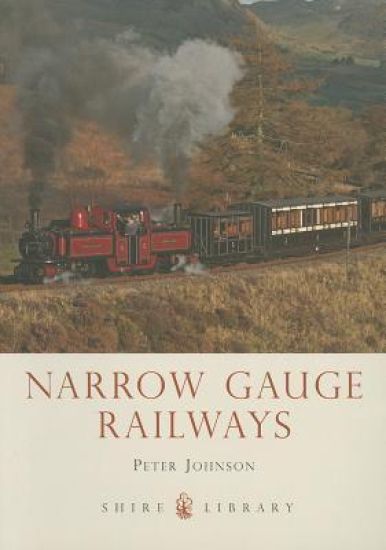
Narrow gauge railways, so well suited to difficult, mountainous terrain, were built in many of the UK’s most scenic locations. Their genesis was in mines and quarries where they replaced man- or horse-pulled wagons, but their adaptability meant that by the 1860s they were also carrying passengers, in some cases over quite considerable distances. Today a good proportion of all the important lines survive in the service of tourists, whose appreciation of the landscape, and the railways themselves, keep these relics of industrial Britain alive in all their variety. Peter Johnson has been researching and writing about narrow gauge lines for many years, and this is the perfect introduction to a rich and appealing corner of British railway history.
New Firms

New Firms

Peter Johnson

CRC Press Inc
2018
sidottu
This book, first published in 1986, is an important contribution to the economic analysis of new firms. It emphasises the importance of analysing the economic inter-relationship between new and established firms. These links are especially relevant in the assessment of the employment effects of formation activity.
New Firms

New Firms

Peter Johnson

CRC Press Inc
2019
nidottu
This book, first published in 1986, is an important contribution to the economic analysis of new firms. It emphasises the importance of analysing the economic inter-relationship between new and established firms. These links are especially relevant in the assessment of the employment effects of formation activity.
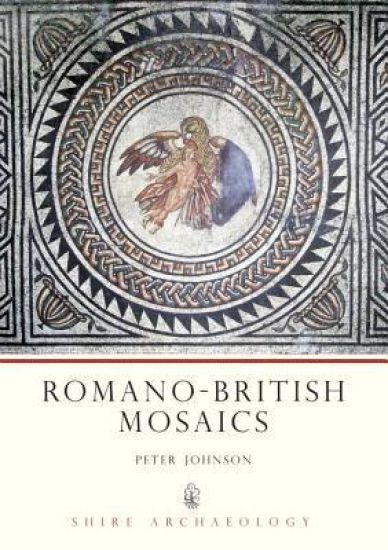
Romano-British Mosaics

Romano-British Mosaics

Peter Johnson

Shire Publications
2002
nidottu
A concise introduction to the floor mosaics of Roman Britain. Romano-British Mosaics first chronicles the history of mosaic discovery in Britain and discusses the changing attitudes towards mosaics, no longer considered merely art objects but social documents. It deals with the different periods of mosaic-laying, from the first-century pavements at Fishbourne, of Italian craftsmanship, to the Hadrianic and Antonine periods, when mosaic was first established in the towns. It traces the apparent collapse of the craft in the third century and the remarkable fourth-century revival, when many villas were decorated with sophisticated mosaics, and it examines the probable techniques of the Roman mosaicist by reference to both literary and archaeological evidence. A chapter deals with the recording, conservation and research of mosaics, and a list of sites where mosaics can be seen includes comments on items of outstanding interest. The book is illustrated throughout with photographs and distribution maps showing the fourth-century schools of mosaic, and supported by a glossary of technical terms.
The Constants of Nature

The Constants of Nature

Peter Johnson

Routledge
2019
sidottu
First published in 1997, this volume constitutes an attempt to resolve certain misunderstandings and ignorance concerning the constants of Nature. Its purpose is to look closely at the philosophical arguments made to support the customary conventional view of measurement, particularly with regard to constants. Peter Johnson argues that historic accounts provide only a partial understanding of the nature of constants, and that the conventionalism that rises relates only to the numerical representations used to quantify the measurement of quantities.
The Constants of Nature

The Constants of Nature

Peter Johnson

Routledge
2020
nidottu
First published in 1997, this volume constitutes an attempt to resolve certain misunderstandings and ignorance concerning the constants of Nature. Its purpose is to look closely at the philosophical arguments made to support the customary conventional view of measurement, particularly with regard to constants. Peter Johnson argues that historic accounts provide only a partial understanding of the nature of constants, and that the conventionalism that rises relates only to the numerical representations used to quantify the measurement of quantities.
The Formation and Development of Small Business
This book brings together thirty years of original empirical research on key aspects of the formation and development of small firms from selected articles authored or co-authored by Peter Johnson. Complete with a comprehensive introduction from the author placing the work in relation to the contemporary debates on the subject and providing a cohesive overview, these essays provide an excellent historical context for current research in this area. Many of the studies in this book emphasise the interrelatedness of economic activity and decisions, an emphasis that serves as an important reminder of the complex business environments in which small firms operate. The book is divided into five sections. The first part focuses on the process of business formation. In part two, the role of new firms in regional development is considered. The third section deals with employment issues, whilst part four looks at various aspects of growth and development. Finally, the book concludes with two articles on policy.