Kirjojen hintavertailu. Mukana 11 699 587 kirjaa ja 12 kauppaa.

Kirjahaku

Etsi kirjoja tekijän nimen, kirjan nimen tai ISBN:n perusteella.

10 kirjaa tekijältä Peter Lorange

New Vision for Management Education

New Vision for Management Education

Peter Lorange

Elsevier Science Ltd
2002
sidottu
Many academic institutions, especially business schools, tend to be managed on an ad hoc basis. Why? Because the leadership may not be fully and formally equipped to lead, and difficult stakeholder-mix issues often limit its ability to govern proactively. This book is meant as a guide for making strategic management a more realistic option for such institutions. It explores the role of the President/CEO/Dean, and offers examples of effective strategic direction setting, including the use of modern technology. This volume features topics such as: a conceptual scheme for setting strategic direction in academic institutions, specifically business schools; a look at key barriers that block strategic change initiatives and how institutions can overcome them; a discussion of the roles of key leaders in the academic institution, including how these roles can be shaped for more effective implementation; a detailed description of management approaches that keep the strategic momentum for academic value creation and change; and an examination of the role of new technology and how this can strengthen the value creation in business schools.
Shipping Company Strategies

Shipping Company Strategies

Peter Lorange

Elsevier Science Ltd
2005
sidottu
This book is about developing implementable strategies for shipping firms. It opens with an initial historical retrospective that highlights cases on A.P. Moller-Maersk and Leif Hoegh and Co. Here the reader is introduced to the global nature of competition in shipping, as well as the volatility of shipping markets. The book then turns to the question of how to play these markets. It looks at commodity based shipping company strategies for the bulk carrier, tanker container-ship and other segments. Here, the focus is on both going long-short, in-out, and maintaining a low cost base. Next is a discussion of operations versus asset play. The book analyzes Marsoft's forecasting methodology, with case studies on The Torvald Klaveness Group, Norden, Frontline and Teekay. The book then takes a close look at the challenge of driving one's strategy towards niches, i.e. on-commodity segments, with a spotlight on how to find a viable business opportunity and develop a defendable strength there. Examples come from I.M. Skaugen, Farstad Shipping, The Torvald Klaveness Group and Leif Hoegh and Co. Since overall corporate-wide portfolio strategies can be important in shipping, particularly if the various elements in the portfolio are relatively unrelated, the next part of the book turns to analytical approaches, citing several examples. Then follows a discussion of key organizational issues, particularly how to create and sustain more effective, predominantly network-based organizations. The penultimate subject is the important role the board of directors can play here. Finally, the role of family firms, and the future of shipping firms, is discussed, again with several rich examples.
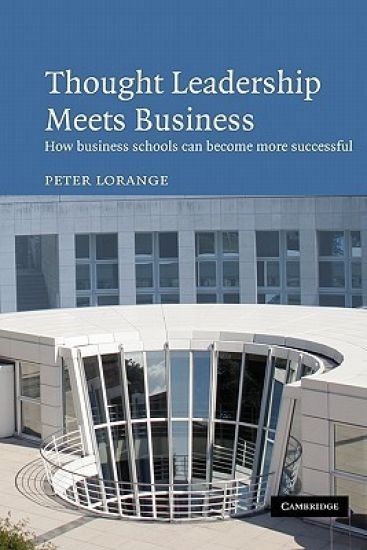
Thought Leadership Meets Business

Thought Leadership Meets Business

Peter Lorange

Cambridge University Press
2010
pokkari
For leading corporations, talent is perhaps the only truly sustainable competitive advantage. In light of this, leading international corporations need to be staffed by the best possible executive talent from around the world. This talent revolution places a burden on business schools to offer highly focused learning, based on practical research. In addition, business schools face fierce competition in this sector, not least from the rapid growth in management education in India and South East Asia. Thought Leadership Meets Business offers significant insights into the factors that have led to the delivery of high-quality executive education at the top-ranking International Institute for Management Development (IMD). Drawing on the experience and wisdom gained by IMD President Peter Lorange over a distinguished career of more than twenty years, this book offers a powerful model for business school success.
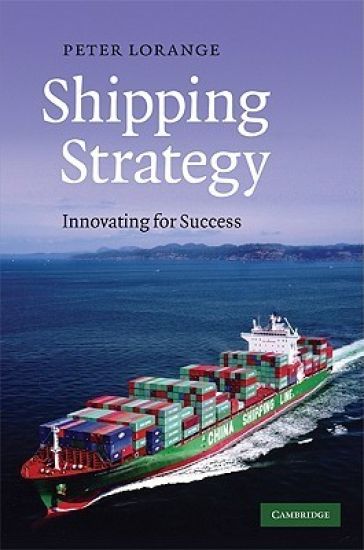
Shipping Strategy

Shipping Strategy

Peter Lorange

Cambridge University Press
2009
sidottu
The shipping industry has an impact on each and every one of us every day. Ships transport the food we eat, the clothes we wear, the cars we drive, the materials used to build our homes, and the fuel that heats them. Yet traditional shipping companies - ones that combine various aspects of shipping under one organizational roof - are on the decline. They are gradually being replaced by new, more specialized companies with more strategic clarity and managerial focus. In Shipping Strategy Peter Lorange draws on his extensive experience in the shipping industry to show how companies can adapt to the fast-moving and volatile world of maritime business by devising strategies for future success, including specialization and innovation.
Thought Leadership Meets Business

Thought Leadership Meets Business

Peter Lorange

Cambridge University Press
2008
sidottu
For leading corporations, talent is perhaps the only truly sustainable competitive advantage. In light of this, leading international corporations need to be staffed by the best possible executive talent from around the world. This talent revolution places a burden on business schools to offer highly focused learning, based on practical research. In addition, business schools face fierce competition in this sector, not least from the rapid growth in management education in India and South East Asia. Thought Leadership Meets Business offers significant insights into the factors that have led to the delivery of high-quality executive education at the top-ranking International Institute for Management Development (IMD). Drawing on the experience and wisdom gained by IMD President Peter Lorange over a distinguished career of more than twenty years, this book offers a powerful model for business school success.
Leading in Turbulent Times

Leading in Turbulent Times

Peter Lorange

Emerald Publishing Limited
2010
nidottu
For much of his business life, Peter Lorange has had three careers running in parallel - as a business academic leading some of the world's most important business schools, as the head of a shipping company and as a board member for several multinational companies. As a result, he has seen leadership from all angles, inside and out. In this book, Peter shares what he has learnt about leadership during turbulent times and, in particular, the key insights that emerged from some of the most challenging moments in his career. Drawing on his own experiences and those of other CEOs interviewed especially for this book, Peter identifies the four leadership characteristics essential in turbulent times, and the three leadership tasks that are critical to an organization under stress. He identifies the type of organization that leaders must create in order to meet the challenges they face today, and explores what it means to be the person sitting where the buck stops. Peter describes how he is bucking the trend and reinventing the business school model at a time when many organizations are keeping their heads down and hoping for the global situation to improve.
Innovations in Shipping

Innovations in Shipping

Peter Lorange

Cambridge University Press
2020
sidottu
Innovations are dramatically changing the traditionally conservative global ocean shipping industry as it works to become more efficient and more sustainable. Academic and former shipping company owner Peter Lorange is best placed to make sense of how to approach and keep ahead of these changes. This book explains what the key innovations are, how to ensure a return on investment, the barriers to innovation and how to overcome them. Drawing on a number of specialist case studies, Lorange outlines the specific analytical and decision-making steps to consider and the actions to take to arrive at a new strategic blueprint for modern shipping companies. This book is invaluable for practising shipping company executives, advanced students of shipping, logistics, port management and maritime economics, and investors deciding whether to invest in a particular shipping firm.
The Business School of the Future

The Business School of the Future

Peter Lorange

Cambridge University Press
2019
sidottu
Facing questions about the status and legitimacy of business schools, many of the world's leading institutions are now experimenting with new business models. In The Business School of the Future, former president of International Institute for Management Development (IMD), Peter Lorange reveals how the era of virtual technology, and the shift away from conservatism in classical academic institutions, heralds the arrival of a new kind of accessible and scalable business school. Drawing on his expansive and expert experience as a professor, leader and founder of academic institutions across the US and Europe, Lorange discusses the pedagogical and bureaucratic aspects of education and includes five case studies of institutes practicing the cutting-edge approaches discussed in the book (CEIBS, IMD, Singapore Management University, IE Madrid and Hult). This guide to designing the business school of the future, incorporating industry innovations, will appeal to business school deans, educators, policymakers and commentators.
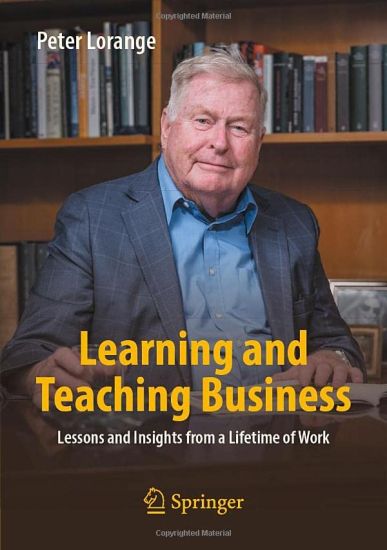
Learning and Teaching Business

Learning and Teaching Business

Peter Lorange

Springer International Publishing AG
2022
nidottu
Businesses constantly look for ways to achieve better performance, and business schools play an important role through their curricula by teaching such methods and helping budding and experienced managers find innovative paths. The author of this book, Prof. Peter Lorange, a well-accomplished expert at business and academic leadership, draws on a set of reflections from his vast experience in both fields to offer core messages which help in improving business education. The author believes that experience-based reflections tend to be both more interesting and more useful than mere chronological, biographical ones, or conceptual reviews of management dimensions without links to practice. The book helps academics, business school management, and even advanced students understand how to bring a practical focus to learning and teaching business via a holistic curriculum. The book also features a special focus on how to integrate family business perspectives to the curriculum.