Kirjojen hintavertailu. Mukana 11 342 296 kirjaa ja 12 kauppaa.

Kirjahaku

Etsi kirjoja tekijän nimen, kirjan nimen tai ISBN:n perusteella.

2 kirjaa tekijältä Peter M. Collins

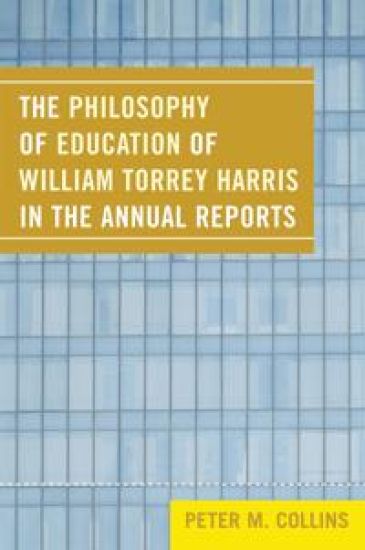
The Philosophy of Education of William Torrey Harris in the Annual Reports
The intertwining careers of William Torrey Harris (1835–1909) converge in twelve of the Annual Reports of the Board of Directors for St. Louis Public Schools. Harris formulated most of the essential features of these twelve reports as the Superintendent of Schools from 1867 to 1869. These particular reports—which have been acclaimed nationally and internationally—are said to be among the most valuable official publications in American educational literature. They are far different from the descriptive documents originally intended by their author. This study demonstrates that Harris provided an authentic philosophy of education, a set of interrelated philosophical principles and their applications to educational problems. The substance of Harris's philosophy of education is focused upon a broadly based philosophical anthropology in relationship primarily to the purposes, curriculum, and teaching methods in intellectual, moral, and religious education.
A Twentieth-Century Collision

A Twentieth-Century Collision

Peter M. Collins

University Press of America
2010
nidottu
A Twentieth-Century Collision explores intellectual culture in the United States during the twentieth century, a topic which cannot be understood without attention to the gradual narrowing of the scope of (academic) philosophy and its diminishing influence. This "narrowing" signifies a growing indifference to, and elimination of, genuinely metaphysical and prescriptively ethical questions, as well as the bifurcation of faith and reason. American Catholic universities, it is contended in this book, can render a seriously-needed contribution to combating the negative effects of this historical development, one of which is the separation of questions concerning the ultimate meaning of life from rational inquiry. This thesis is pursued by 1) reviewing a highly selective—but also highly representative—sample of pertinent mainstream philosophical principles, and 2) comparing them with principles of Pope John Paul II found in three documents in which he elaborates his views on the nature and role of philosophy (and its relationship to theology) in Catholic higher education. This project is not unrelated to recent, persistent criticism that American Catholic universities have forfeited their identity—and thus their unique contribution to American cultural pluralism.