Kirjojen hintavertailu. Mukana 12 016 292 kirjaa ja 12 kauppaa.

Kirjahaku

Etsi kirjoja tekijän nimen, kirjan nimen tai ISBN:n perusteella.

6 kirjaa tekijältä Peter Temin

The Vanishing Middle Class

The Vanishing Middle Class

Peter Temin

MIT Press
2018
pokkari
Why the United States has developed an economy divided between rich and poor and how racism helped bring this about.The United States is becoming a nation of rich and poor, with few families in the middle. In this book, MIT economist Peter Temin offers an illuminating way to look at the vanishing middle class. Temin argues that American history and politics, particularly slavery and its aftermath, play an important part in the widening gap between rich and poor. Temin employs a well-known, simple model of a dual economy to examine the dynamics of the rich/poor divide in America, and outlines ways to work toward greater equality so that America will no longer have one economy for the rich and one for the poor.Many poorer Americans live in conditions resembling those of a developing country-substandard education, dilapidated housing, and few stable employment opportunities. And although almost half of black Americans are poor, most poor people are not black. Conservative white politicians still appeal to the racism of poor white voters to get support for policies that harm low-income people as a whole, casting recipients of social programs as the Other-black, Latino, not like "us." Politicians also use mass incarceration as a tool to keep black and Latino Americans from participating fully in society. Money goes to a vast entrenched prison system rather than to education. In the dual justice system, the rich pay fines and the poor go to jail.
The Jacksonian Economy

The Jacksonian Economy

Peter Temin

WW Norton Co
1969
nidottu
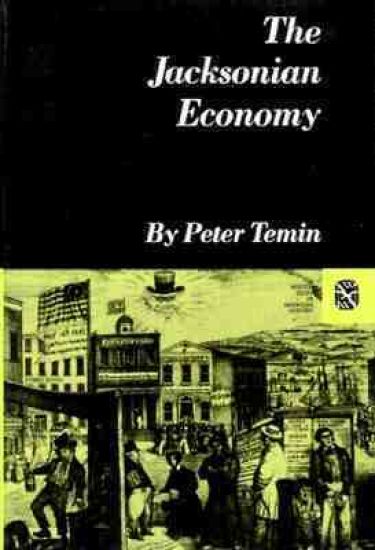
Arthur Schlesinger, Jr., Richard Hofstadter, and other have maintained that Andrew Jackson set off a chain reaction when he vetoed the recharter of the Second Bank of the United States in 1832. This interpretation holds that subsequent removal of deposits from the Bank led to unsound credit expansion and inflation, to unprecedented speculation in public land, to the Panic of 1837, and ultimately to the depression. "Not true," write Professor Temin in this thoroughly researched and documented study which shatters the traditional interpretation of the 1830's. "Jackson's economic policies undoubtedly were not the most enlightened the country has ever seen, but they were by no means disastrous. The inflation and crisis of the 1930's had their origin in events largely beyond Jackson's control and probably would have taken place whether or not he had acted as he did. The economy was not the victim of Jacksonian politics; Jackson's policies were the victims of economic fluctuations."
Engines of Enterprise

Engines of Enterprise

Peter Temin

Harvard University Press
2002
nidottu
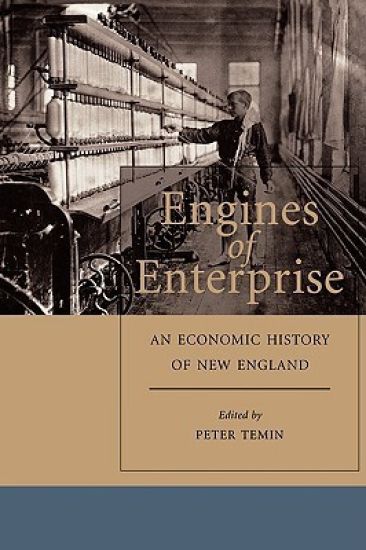
New England's economy has a history as dramatic as any in the world. From an inauspicious beginning--as immigration ground to a halt in the eighteenth century--New England went on to lead the United States in its transformation from an agrarian to an industrial economy. And when the rest of the country caught up in the mid-twentieth century, New England reinvented itself as a leader in the complex economy of the information society.Engines of Enterprise tells this dramatic story in a sequence of narrative essays written by preeminent historians and economists. These essays chart the changing fortunes of entrepreneurs and venturers, businessmen and inventors, and common folk toiling in fields, in factories, and in air-conditioned offices. The authors describe how, short of staple crops, colonial New Englanders turned to the sea and built an empire; and how the region became the earliest home of the textile industry as commercial fortunes underwrote new industries in the nineteenth century. They show us the region as it grew ahead of the rest of the country and as the rest of the United States caught up. And they trace the transformation of New England's products and exports from cotton textiles and machine tools to such intangible goods as education and software. Concluding short essays also put forward surprising but persuasive arguments--for instance, that slavery, while not prominent in colonial New England, was a critical part of the economy; and that the federal government played a crucial role in the development of the region's industrial skills.
The Roman Market Economy

The Roman Market Economy

Peter Temin

Princeton University Press
2017
pokkari
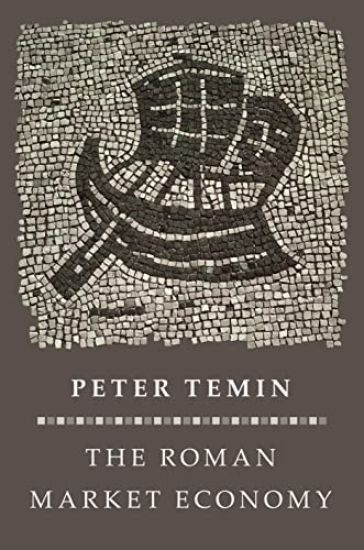
The quality of life for ordinary Roman citizens at the height of the Roman Empire probably was better than that of any other large group of people living before the Industrial Revolution. The Roman Market Economy uses the tools of modern economics to show how trade, markets, and the Pax Romana were critical to ancient Rome's prosperity. Peter Temin, one of the world's foremost economic historians, argues that markets dominated the Roman economy. He traces how the Pax Romana encouraged trade around the Mediterranean, and how Roman law promoted commerce and banking. Temin shows that a reasonably vibrant market for wheat extended throughout the empire, and suggests that the Antonine Plague may have been responsible for turning the stable prices of the early empire into the persistent inflation of the late. He vividly describes how various markets operated in Roman times, from commodities and slaves to the buying and selling of land. Applying modern methods for evaluating economic growth to data culled from historical sources, Temin argues that Roman Italy in the second century was as prosperous as the Dutch Republic in its golden age of the seventeenth century. The Roman Market Economy reveals how economics can help us understand how the Roman Empire could have ruled seventy million people and endured for centuries.
Never Together

Never Together

Peter Temin

Cambridge University Press
2022
sidottu
In November 2020, The New York Times asked fifteen of its columnists to 'explain what the past four years have cost America.' Not one of the columnists focused on President Trump's racism. This book seeks to redress this imbalance and bring Black Americans' role in our economy to the forefront. While all humans were created equal, economic history in the United States tells a different story. Reconstruction lasted for only a decade, and Jim Crow laws replaced it. The Civil Rights Movement lasted through the 1960s, yet decayed under President Nixon. The United States has been declining in the Social Product Index, where it now is the lowest of the G7 and 26th in the world. For health and happiness, Temin argues that we need lasting integration efforts that allow Black Americans equal opportunity. This book convincingly integrates Black and white activities into an inclusive economic history of America.