Kirjojen hintavertailu. Mukana 11 244 527 kirjaa ja 12 kauppaa.

Kirjahaku

Etsi kirjoja tekijän nimen, kirjan nimen tai ISBN:n perusteella.

8 kirjaa tekijältä Phil Bellfy

Three Fires Unity

Three Fires Unity

Phil Bellfy

University of Nebraska Press
2011
sidottu
The Lake Huron area of the Upper Great Lakes region, an area spreading across vast parts of the United States and Canada, has been inhabited by the Anishnaabeg for millennia. Since their first contact with Europeans around 1600, the Anishnaabeg have interacted with-and struggled against-changing and shifting European empires and the emerging nation-states that have replaced them. Through their cultural strength, diplomatic acumen, and a remarkable knack for adapting to change, the Anishnaabeg of the Lake Huron Borderlands have reemerged as a strong and vital people, fully in charge of their destiny in the twenty-first century. Winner of the North American Indian Prose Award, this first comprehensive cross-border history of the Anishnaabeg provides an engaging account of four hundred years of their life in the Lake Huron area, showing how they have been affected by European contact and trade. Three Fires Unity examines how shifting European politics and, later, the imposition of the Canada–United States border running through their homeland, affected them and continue to do so today. In looking at the cultural, social, and political aspects of this borderland contact, Phil Bellfy sheds light on how the Anishnaabeg were able to survive and even thrive over the centuries in this intensely contested region.
Three Fires Unity

Three Fires Unity

Phil Bellfy

University of Nebraska Press
2019
pokkari
The Lake Huron area of the Upper Great Lakes region, an area spreading across vast parts of the United States and Canada, has been inhabited by the Anishnaabeg for millennia. Since their first contact with Europeans around 1600, the Anishnaabeg have interacted with-and struggled against-changing and shifting European empires and the emerging nation-states that have replaced them. Through their cultural strength, diplomatic acumen, and a remarkable knack for adapting to change, the Anishnaabeg of the Lake Huron Borderlands have reemerged as a strong and vital people, fully in charge of their destiny in the twenty-first century. Winner of the North American Indian Prose Award, this first comprehensive cross-border history of the Anishnaabeg provides an engaging account of four hundred years of their life in the Lake Huron area, showing how they have been affected by European contact and trade. Three Fires Unity examines how shifting European politics and, later, the imposition of the Canada–United States border running through their homeland, affected them and continue to do so today. In looking at the cultural, social, and political aspects of this borderland contact, Phil Bellfy sheds light on how the Anishnaabeg were able to survive and even thrive over the centuries in this intensely contested region.
U.P. Colony

U.P. Colony

Phil Bellfy

Ziibi Press
2021
pokkari
In the 1980s, Phil Bellfy pondered the question: Why does Sault, Ontario, appear to be so prosperous, while the "Sault" on the American side has fallen into such a deplorable state? Could the answer be that the "American side" was little more than a "resource colony"-or to use the academic jargon of "Conflict and Change" Sociology-an "Internal Colony." In UP Colony, Bellfy revisits his graduate research to update us the state of the Sault.The ultimate question: why has the U.P.'s vast wealth, nearly unrivaled in the whole of the United States, left the area with poverty nearly unrivaled in the whole of the United States? None of the conventional explanations from "distance to markets," to "too many people," to "disadvantageous production costs," have any credibility. Simply put: "Where did the $1.5 billion earned from copper mining, $1 billion from logging, and nearly $4 billion in iron ore go?" To get to the bottom of these thorny questions, Bellfy looks at the possible economic pressures imposed by "external colonial powers." The pressure-points examined in this book include presence of a complimentary economy, lopsided investment in one sector, monopoly style management, disparity of living standards, a repressive conflict-resolution system, and the progressive growth of inequality over time.In UP Colony, Dr. Bellfy has revisited his MA Thesis and brought this analysis up-to-date in conjunction with the Sault's Semisepticentennial-the 350th anniversary of its French founding in 1668.
U.P. Colony

U.P. Colony

Phil Bellfy

Ziibi Press
2022
sidottu
Winner of 2021 U.P. Notable Books AwardIn the 1980s, Phil Bellfy pondered the question: Why does Sault, Ontario, appear to be so prosperous, while the "Sault" on the American side has fallen into such a deplorable state? Could the answer be that the "American side" was little more than a "resource colony"-or to use the academic jargon of "Conflict and Change" Sociology-an "Internal Colony." In UP Colony, Bellfy revisits his graduate research to update us the state of the Sault.The ultimate question: why has the U.P.'s vast wealth, nearly unrivaled in the whole of the United States, left the area with poverty nearly unrivaled in the whole of the United States? None of the conventional explanations from "distance to markets," to "too many people," to "disadvantageous production costs," have any credibility. Simply put: "Where did the $1.5 billion earned from copper mining, $1 billion from logging, and nearly $4 billion in iron ore go?" To get to the bottom of these thorny questions, Bellfy looks at the possible economic pressures imposed by "external colonial powers." The pressure-points examined in this book include presence of a complimentary economy, lopsided investment in one sector, monopoly style management, disparity of living standards, a repressive conflict-resolution system, and the progressive growth of inequality over time.In UP Colony, Dr. Bellfy has revisited his MA Thesis and brought this analysis up-to-date in conjunction with the Sault's Semisepticentennial-the 350th anniversary of its French founding in 1668.
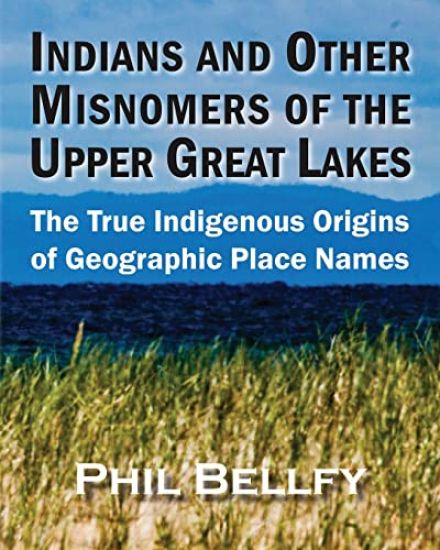
Indians and Other Misnomers of the Upper Great Lakes
No less than 27 out of the 50 states' names in the USA are based in American Indian languages. Additionally, six out of 13 of Canada's provinces and territories have names with indigenous origins, and, of course, Canada itself is derived from an indigenous source. Shakespeare quipped, "What's in a name?" A lot, it turns out, because states like California and Florida reflect their Spanish history; here, in the Great Lakes, that history is indigenous. If you have an understanding of the name of a place, its history may reveal itself. And that history will, most likely, enrich your own life and your place in it.Join us on this journey through Michigan, Pennsylvania, Ontario, Ohio, Indiana, Illinois, Wisconsin, and Minnesota as we alphabetically traverse indigenous place names in each locale. Alternately, you can peruse an alphabetical concordance of every place name. In the appendices, you'll discover details of US and Canadian treaties with indigenous people, and many that are still under dispute today--including the Anishinaabek, Ottawa, Chippewa, Potawatomi, Miami, Kickapoo, Sauk, Sioux, Ojibway, Mississauga, Mohawk, Algonquin, Iroquois, Huron, and related First Nations bands in Ontario."Emeritus Professor Phil Bellfy has used his life-long Indigenous knowledge to produce this imaginative, original work that will be indispensable to any researcher working on Indigenous studies in the Great Lakes watershed. Indians and Other Misnomers of the Upper Great Lakes will be in the forefront of changing the way in which Indigenous knowledge shapes the hitherto colonial narrative of the Great Lakes." David T. McNab, professor emeritus, York University, Toronto, Ontario. "Indians and Other Misnomers of the Upper Great Lakes is a fascinating exploration of the Indigenous origins of many place names bordering the Great Lakes. This book offers readers the opportunity to contemplate their place within the landscape of the Indigenous homelands now claimed by the Canadian and American settler states. It is a must-own companion book for researchers, residents and anyone interested in the places, history and linguistic heritages of the Great Lakes." --Karl Hele, Anishinaabeg and the Davidson Chair in Canadian Studies, Mount Allison University "Words carry meaning and history. In this Indians and Other Misnomers of the Upper Great Lakes, Dr. Phil Bellfy takes us on an etymological journey around the Great Lakes region as he explains the possible origins and meanings of Native American place names. This book helps paint a relational picture of the cultural world of the Anishinaabe Three Fires Confederacy of Ojibway, Odawa, and Potawatomi and how that view has been impacted by settler colonialism." -- Dr. Martin Reinhardt, Anishinaabe Ojibway citizen of the Sault Ste. Marie Tribe of Chippewa Indians; professor of Native American Studies, Northern Michigan University, president of the Michigan Indian Education Council.
Indians and Other Misnomers of the Upper Great Lakes
No less than 27 out of the 50 states' names in the USA are based in American Indian languages. Additionally, six out of 13 of Canada's provinces and territories have names with indigenous origins, and, of course, Canada itself is derived from an indigenous source. Shakespeare quipped, "What's in a name?" A lot, it turns out, because states like California and Florida reflect their Spanish history; here, in the Great Lakes, that history is indigenous. If you have an understanding of the name of a place, its history may reveal itself. And that history will, most likely, enrich your own life and your place in it.Join us on this journey through Michigan, Pennsylvania, Ontario, Ohio, Indiana, Illinois, Wisconsin, and Minnesota as we alphabetically traverse indigenous place names in each locale. Alternately, you can peruse an alphabetical concordance of every place name. In the appendices, you'll discover details of US and Canadian treaties with indigenous people, and many that are still under dispute today--including the Anishinaabek, Ottawa, Chippewa, Potawatomi, Miami, Kickapoo, Sauk, Sioux, Ojibway, Mississauga, Mohawk, Algonquin, Iroquois, Huron, and related First Nations bands in Ontario. "Emeritus Professor Phil Bellfy has used his life-long Indigenous knowledge to produce this imaginative, original work that will be indispensable to any researcher working on Indigenous studies in the Great Lakes watershed. Indians and Other Misnomers of the Upper Great Lakes will be in the forefront of changing the way in which Indigenous knowledge shapes the hitherto colonial narrative of the Great Lakes." David T. McNab, professor emeritus, York University, Toronto, Ontario. "Indians and Other Misnomers of the Upper Great Lakes is a fascinating exploration of the Indigenous origins of many place names bordering the Great Lakes. This book offers readers the opportunity to contemplate their place within the landscape of the Indigenous homelands now claimed by the Canadian and American settler states. It is a must-own companion book for researchers, residents and anyone interested in the places, history and linguistic heritages of the Great Lakes." --Karl Hele, Anishinaabeg and the Davidson Chair in Canadian Studies, Mount Allison University "Words carry meaning and history. In Indians and Other Misnomers of the Upper Great Lakes, Dr. Phil Bellfy takes us on an etymological journey around the Great Lakes region as he explains the possible origins and meanings of Native American place names. This book helps paint a relational picture of the cultural world of the Anishinaabe Three Fires Confederacy of Ojibway, Odawa, and Potawatomi and how that view has been impacted by settler colonialism." -- Dr. Martin Reinhardt, Anishinaabe Ojibway citizen of the Sault Ste. Marie Tribe of Chippewa Indians; professor of Native American Studies, Northern Michigan University, president of the Michigan Indian Education Council.From Ziibi PressLearn more at www.ZiibiPress.com