Kirjojen hintavertailu. Mukana 11 518 949 kirjaa ja 12 kauppaa.

Kirjahaku

Etsi kirjoja tekijän nimen, kirjan nimen tai ISBN:n perusteella.

7 kirjaa tekijältä Philip Booth

Boundless Success with Philip Booth

Boundless Success with Philip Booth

Philip Booth

Success Publishing, LLC
2021
pokkari
In his book, Boundless Success, Booth explains why we should have faith and how it can improve our everyday lives. Using religious faith to guide our decision-making process, we can turn our dreams into reality and live a happy, successful life. Booth shows us that God wants us to succeed, and by following His will and surrounding ourselves with people who support us, we can enrich our lives with love and positivity.About the AuthorPhilip Booth is the proprietor and CEO of 100% Phil Booth. He has been a retailer of home appliances for forty years. His career began after completing his Trade Certificate as a radio and television serviceperson, after which he launched a career in retailing. He has owned and managed two businesses, and his longevity has resulted from leveraging the two top appliance co-operating companies in New Zealand and a strong faith in the goodness of God. He currently belongs to the Appliance Connexion Group Services Ltd, which is associated with the NARTA Group of Australasia. Phil has kept up with current appliance retailing trends by traveling extensively to conferences hosted by various groups and suppliers of appliance brands, CEOs, visits to appliance factories, and listening to motivational guest speakers.
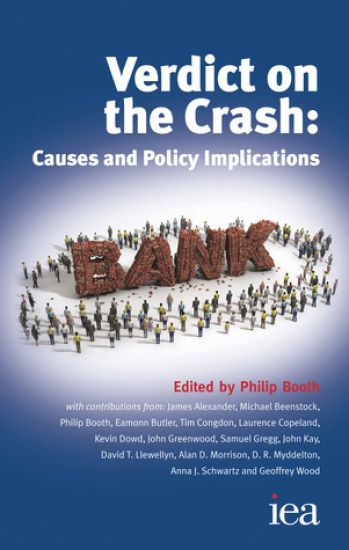
Verdict on the Crash

Verdict on the Crash

Philip Booth

Institute of Economic Affairs
2009
nidottu
This title features contributions from James Alexander, Michael Beenstock, Philip Booth, Eamonn Butler, Tim Congdon, Laurence Copeland, Kevin Dowd, John Greenwood, Samuel Gregg, John Kay, David Llewellyn, Alan Morrison, D. R Myddelton, Anna Schwartz and Geoffrey Wood. This book challenges the myth that the recent banking crisis was caused by insufficient statutory regulation of financial markets. Though it finds that statutory regulation failed, and that market participants took more risks than they should have done, it appears that statutory regulation made matters worse rather than better. Furthermore the fifteen experts who have contributed to this study find that government policy failed in other respects too. As with the boom and bust that led to the Great Depression, loose monetary policy on both sides of the Atlantic helped to promote an asset price bubble and credit boom which, at some stage, was bound to have serious consequences. Rejecting the failed approach of discretionary detailed regulation of the financial system, the authors instead propose specific and incisive regulatory tools that are designed to target, in a non-intrusive way, particular weaknesses in a banking system that is backed by deposit insurance. This study, by some of the most eminent authors in the field, is essential reading for all those who are interested in the policy implications of recent events in financial markets.
Federal Britain

Federal Britain

Philip Booth

Institute of Economic Affairs
2015
nidottu
The UK has the most centralised system of government amongst major economies. This results in poorer services, lower economic growth and higher taxes. We have also developed an approach to devolution that is incoherent and unstable. This short book proposes an entirely new set of constitutional arrangements. It proposes that the UK should develop a federal structure of government with only a small number of functions such as defence and border control being determined at the UK level. All other functions would be the ultimate responsibility of individual nations within the UK, though Wales, Northern Ireland and England could combine together if they wished. The author also proposes further radical decentralisation of government. Local government should become responsible for a much wider range of functions and raise the revenue to finance them. In areas such as health and education, the government role would be diminished further as parents, families and civil society institutions are provided with finance to directly procure their own services. Overall, this is a radical plan to completely change the nature of government in the UK.It would return power to the people and reverse the long trend of centralisation that has happened since World War I.
Carbon Conundrum

Carbon Conundrum

Philip Booth

INSTITUTE OF ECONOMIC AFFAIRS
2022
nidottu
Politicians around the world have signed up to achieving carbon net zero by 2050. And several countries, including the UK and those in the EU, have struck a ‘new green deal’. This puts environmental taxes and subsidies at the heart of energy policy. But it’s created an immensely complex and costly merry-go-round in which even fossil fuels end up being subsidised. This chaotic system, say authors Philip Booth and Carlo Stagnaro, is wide open to regulatory capture – and to an ideologically motivated agenda. It is also less resilient to crises in energy supply, such as the one caused by Russia’s invasion of Ukraine in early 2022. In Carbon Conundrum they illustrate the incoherence, iniquities and inefficiency of this large-scale government intervention. And they warn that ‘climate change is too important a challenge to be approached in this way’. Instead, they argue for a rational ‘polluter pays’ system of taxing energy sources. This, they contend, would give individuals and businesses much more control over how they reduce carbon emissions. And it would stimulate greater levels of carbon reduction – at a much lower economic cost.
Planning by Consent

Planning by Consent

Philip Booth

Spon Press
2003
sidottu
**Please note this is an unedited paperback reprint of the hardback, originally published in 2003**The British system of universal development control celebrated its 50th anniversary in 1997. Remarkably, the system has survived more or less intact but the experience of the 1980s has left large questions unanswered about the relevance and effectiveness of the system. This book traces the history of the development control system in Britain from early modern times to the present day.
Trying to Say It

Trying to Say It

Philip Booth

The University of Michigan Press
1996
nidottu
As one of Robert Frost's last students, Philip Booth has for more than four decades written poems prized for their clarity and depth. As founder of the Syracuse University Creative Writing Program, he has been a crucial influence in the early stages of such individually distinguished poets as Thomas Centolella, Stephen Dunn, Carol Frost, Brooks Haxton, Larry Levis, Jane Mead, Jay Meek, Susan Mitchel, Barbara Moore, and Lucia Perillo. The New York Times Book Review has said that "anyone who cares about poetry knows his work."Gathering together selections from his notebooks, dreamlogs, memoirs, and essays of such poets as Frost, Robert Lowell and George Oppen, Trying to Say It particularly focuses on the ways that the tension between in-formed structures and lineation create poems which--in all senses--move. Employing the Thoreauvian sense of place for which his poetry is known, Booth probes the nature of poetry itself, as well as the poetry of nature--yielding insights that are rooted in the acute observation that catalyzes imagination. Infused with a restless spirit in search of a moving language commensurate with the complexity of being fully alive, the essays collected in Trying to Say It reveal the pulses of a teacher's mind and a poet's heart.Philip Booth is the author of nine books of poetry, and has been honored by Guggenheim, Rockefeller, and National Endowment for the Arts fellowships, the National Institute of Arts and Letters, and the Academy of American Poets.
Planning by Consent

Planning by Consent

Philip Booth

Routledge
2015
nidottu
**Please note this is an unedited paperback reprint of the hardback, originally published in 2003**The British system of universal development control celebrated its 50th anniversary in 1997. Remarkably, the system has survived more or less intact but the experience of the 1980s has left large questions unanswered about the relevance and effectiveness of the system. This book traces the history of the development control system in Britain from early modern times to the present day.