Kirjojen hintavertailu. Mukana 12 595 353 kirjaa ja 12 kauppaa.

Kirjahaku

Etsi kirjoja tekijän nimen, kirjan nimen tai ISBN:n perusteella.

6 kirjaa tekijältä Philip G. Cerny

Rethinking World Politics

Rethinking World Politics

Philip G. Cerny

Oxford University Press Inc
2010
sidottu
Rethinking World Politics is a major intervention into a central debate in international relations: how has globalization transformed world politics? Most work on world politics still presumes the following: in domestic affairs, individual states function as essentially unified entities, and in international affairs, stable nation-states interact with each other. In this scholarship, the state lies at the center; it is what politics is all about. However, Philip Cerny contends that recent experience suggests another process at work: "transnational neopluralism." In the old version of pluralist theory, the state is less a cohesive and unified entity than a varyingly stable amalgam of competing and cross-cutting interest groups that surround and populate it. Cerny explains that contemporary world politics is subject to similar pressures from a wide variety of sub- and supra-national actors, many of which are organized transnationally rather than nationally. In recent years, the ability of transnational governance bodies, NGOs, and transnational firms to shape world politics has steadily grown. Importantly, the rapidly growing transnational linkages among groups and the emergence of increasingly influential, even powerful, cross-border interest and value groups is new. These processes are not replacing nation-states, but they are forging new transnational webs of power. States, he argues, are themselves increasingly trapped in these webs. After mapping out the dynamics behind contemporary world politics, Cerny closes by prognosticating where this might all lead. Sweeping in its scope, Rethinking World Politics is a landmark work of international relations theory that upends much of our received wisdom about how world politics works and offers us new ways to think about the forces shaping the contemporary world.
Rethinking World Politics

Rethinking World Politics

Philip G. Cerny

Oxford University Press Inc
2010
nidottu
Rethinking World Politics is a major intervention into a central debate in international relations: how has globalization transformed world politics? Most work on world politics still presumes the following: in domestic affairs, individual states function as essentially unified entities, and in international affairs, stable nation-states interact with each other. In this scholarship, the state lies at the center; it is what politics is all about. However, Philip Cerny contends that recent experience suggests another process at work: "transnational neopluralism." In the old version of pluralist theory, the state is less a cohesive and unified entity than a varyingly stable amalgam of competing and cross-cutting interest groups that surround and populate it. Cerny explains that contemporary world politics is subject to similar pressures from a wide variety of sub- and supra-national actors, many of which are organized transnationally rather than nationally. In recent years, the ability of transnational governance bodies, NGOs, and transnational firms to shape world politics has steadily grown. Importantly, the rapidly growing transnational linkages among groups and the emergence of increasingly influential, even powerful, cross-border interest and value groups is new. These processes are not replacing nation-states, but they are forging new transnational webs of power. States, he argues, are themselves increasingly trapped in these webs. After mapping out the dynamics behind contemporary world politics, Cerny closes by prognosticating where this might all lead. Sweeping in its scope, Rethinking World Politics is a landmark work of international relations theory that upends much of our received wisdom about how world politics works and offers us new ways to think about the forces shaping the contemporary world.
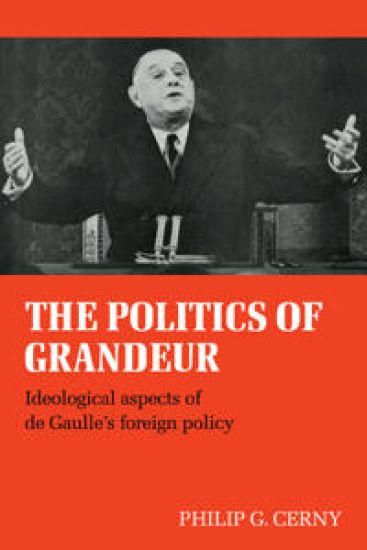
The Politics of Grandeur

The Politics of Grandeur

Philip G. Cerny

Cambridge University Press
2008
pokkari
De Gaulle was the first major Western leader to pursue a foreign policy designed consistently to break the vicious circle of the Cold War and the straitjacket of the nuclear balance of terror between Russia and the United States. At the same time, he sought to establish in France a new set of institutions designed to break another vicious circle: that of the divisive conflicts between French social groups and political parties, which led to weak governments and an ineffective state. This book studies the link between these two aims, both by examining de Gaulle's political aims and style in a political and cultural context, and by looking first at French policy towards the Atlantic alliance, and then at the impact of de Gaulle's foreign policy on domestic politics. As a result, many of the orthodox notions about de Gaulle are questioned.
The Changing Architecture of Politics

The Changing Architecture of Politics

Philip G. Cerny

SAGE Publications Ltd
1990
sidottu
This original analysis of structuration, agency and the state offers an incisive explanation of the changing nature of the state. Cerny argues that the state is not being transcended; the architecture of politics is not moving beyond the nation-state despite the emergence of transnational structures. He points to the movement of many states towards the model of the `competition state', and away from the model of `welfare state', as the major contemporary change in the role of the state. He asserts that new forms of political action will have to evolve if the state itself is to be controlled and used for the pursuit of deeper human values in the 21st century.
The Changing Architecture of Politics

The Changing Architecture of Politics

Philip G. Cerny

SAGE Publications Ltd
1990
nidottu
This original analysis of structuration, agency and the state offers an incisive explanation of the changing nature of the state. Cerny argues that the state is not being transcended; the architecture of politics is not moving beyond the nation-state despite the emergence of transnational structures. He points to the movement of many states towards the model of the `competition state', and away from the model of `welfare state', as the major contemporary change in the role of the state. He asserts that new forms of political action will have to evolve if the state itself is to be controlled and used for the pursuit of deeper human values in the 21st century.
Internalizing Globalization

Internalizing Globalization

Susanne Soederberg; Georg Menz; Philip G. Cerny

Palgrave Macmillan
2005
sidottu
This book explores how a wide range of countries attempt to cope with the challenges of globalization. While the internalization of globalization proceeds in significantly different ways, there is a broad process of convergence taking place around the politics of neoliberalism and a more market-oriented version of capitalism. The book examines how distinct social structures, political cultures, patterns of party and interest group politics, classes, public policies, liberal democratic and authoritarian institutions, and the discourses that frame them, are being reshaped by political actors. Chapters cover national experiences from Europe and North America to Asia and Latin America (Chile, Mexico, and Peru).