Kirjojen hintavertailu. Mukana 12 365 986 kirjaa ja 12 kauppaa.

Kirjahaku

Etsi kirjoja tekijän nimen, kirjan nimen tai ISBN:n perusteella.

13 kirjaa tekijältä Philip J. Davis

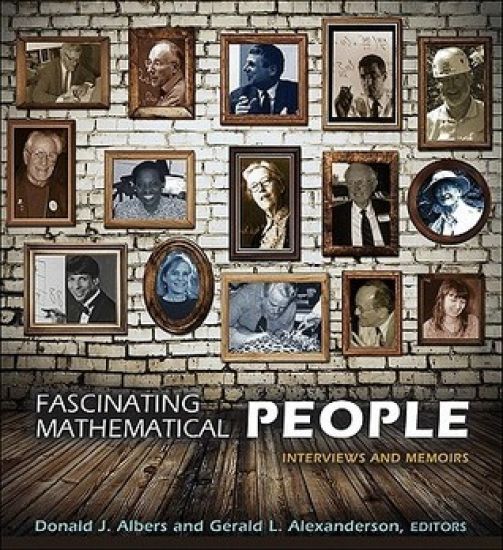
Fascinating Mathematical People

Fascinating Mathematical People

Philip J. Davis

Princeton University Press
2011
sidottu
Fascinating Mathematical People is a collection of informal interviews and memoirs of sixteen prominent members of the mathematical community of the twentieth century, many still active. The candid portraits collected here demonstrate that while these men and women vary widely in terms of their backgrounds, life stories, and worldviews, they all share a deep and abiding sense of wonder about mathematics. Featured here--in their own words--are major research mathematicians whose cutting-edge discoveries have advanced the frontiers of the field, such as Lars Ahlfors, Mary Cartwright, Dusa McDuff, and Atle Selberg. Others are leading mathematicians who have also been highly influential as teachers and mentors, like Tom Apostol and Jean Taylor. Fern Hunt describes what it was like to be among the first black women to earn a PhD in mathematics. Harold Bacon made trips to Alcatraz to help a prisoner learn calculus. Thomas Banchoff, who first became interested in the fourth dimension while reading a Captain Marvel comic, relates his fascinating friendship with Salvador Dali and their shared passion for art, mathematics, and the profound connection between the two. Other mathematical people found here are Leon Bankoff, who was also a Beverly Hills dentist; Arthur Benjamin, a part-time professional magician; and Joseph Gallian, a legendary mentor of future mathematicians, but also a world-renowned expert on the Beatles. This beautifully illustrated collection includes many photographs never before published, concise introductions by the editors to each person, and a foreword by Philip J. Davis.

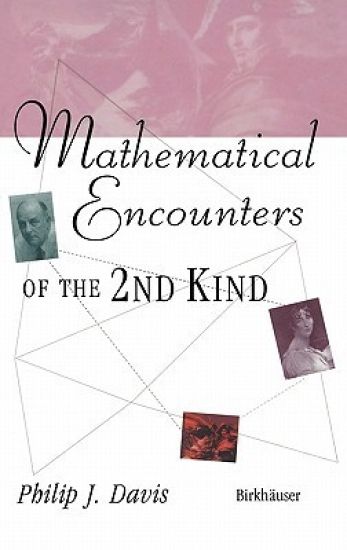
Mathematical Encounters of the Second Kind

Mathematical Encounters of the Second Kind

Philip J. Davis

Birkhauser Boston Inc
1996
sidottu
A number of years ago, Harriet Sheridan, then Dean of Brown University, organized a series oflectures in which individual faculty members described how it came about that they entered their various fields. I was invited to participate in this series and found in the invitation an opportunity to recall events going back to my early teens. The lecture was well received and its reception encouraged me to work up an expanded version. My manuscript lay dormant all these years. In the meanwhile, sufficiently many other mathematical experiences and encounters accumulated to make this little book. My 1981 lecture is the basis of the first piece: "Napoleon's Theorem. " Although there is a connection between the first piece and the second, the four pieces here are essentially independent. The sec­ ond piece, "Carpenter and the Napoleon Ascription," has as its object a full description of a certain type of scholar-storyteller (of whom I have known and admired several). It is a pastiche, contain­ ing a salad bar selection blended together by my own imagination. This piece purports, as a secondary goal, to present a solution to a certain unsolved historical problem raised in the first piece. The third piece, "The Man Who Began His Lectures with 'Namely'," is a short reminiscence of Stefan Bergman, one of my teachers of graduate mathematics. Bergman, a remarkable person­ ality, was born in Poland and came to the United States in 1939.
The Schwarz Function and Its Applications

The Schwarz Function and Its Applications

Philip J. Davis

Mathematical Association of America
1974
nidottu
H. A. Schwarz showed us how to extend the notion of reflection in straight lines and circles to reflection in an arbitrary analytic arc. Notable applications were made to the symmetry principle and to problems of analytic continuation. Reflection, in the hands of Schwarz, is an antianalytic mapping. By taking its complex conjugate, we arrive at an analytic function that we have called here the Schwarz Function of the analytic arc. This function is worthy of study in its own right and this essay presents such a study. In dealing with certain familiar topics, the use of the Schwarz Function lends a point of view, a clarity and elegance, and a degree of generality which might otherwise be missing. It opens up a line of inquiry which has yielded numerous interesting things in complex variables; it illuminates some functional equations and a variety of iterations which interest the numerical analyst. The perceptive reader will certainly find here some old wine in relabelled bottles. But one of the principles of mathematical growth is that the relabelling process often suggests a new generation of problems. Means become ends; the medium rapidly becomes the message. This book is not wholly self-contained. Readers will find that they should be familiar with the elementary portions of linear algebra and of the theory of functions of a complex variable.
Mathematical Encounters of the Second Kind

Mathematical Encounters of the Second Kind

Philip J. Davis

Springer-Verlag New York Inc.
2011
nidottu
A number of years ago, Harriet Sheridan, then Dean of Brown University, organized a series oflectures in which individual faculty members described how it came about that they entered their various fields. I was invited to participate in this series and found in the invitation an opportunity to recall events going back to my early teens. The lecture was well received and its reception encouraged me to work up an expanded version. My manuscript lay dormant all these years. In the meanwhile, sufficiently many other mathematical experiences and encounters accumulated to make this little book. My 1981 lecture is the basis of the first piece: "Napoleon's Theorem. " Although there is a connection between the first piece and the second, the four pieces here are essentially independent. The sec­ ond piece, "Carpenter and the Napoleon Ascription," has as its object a full description of a certain type of scholar-storyteller (of whom I have known and admired several). It is a pastiche, contain­ ing a salad bar selection blended together by my own imagination. This piece purports, as a secondary goal, to present a solution to a certain unsolved historical problem raised in the first piece. The third piece, "The Man Who Began His Lectures with 'Namely'," is a short reminiscence of Stefan Bergman, one of my teachers of graduate mathematics. Bergman, a remarkable person­ ality, was born in Poland and came to the United States in 1939.
Thomas Gray in Copenhagen

Thomas Gray in Copenhagen

Philip J. Davis

Copernicus Books
2013
nidottu
The further adventures of a feline philosopher and friend. Could it be? Hans Christian Andersen - who wrote so lovingly of inchworms and ugly ducklings - an unrepentant despiser of cats? That's the rumor that the philosophical feline, Thomas Gray, and her (yes, her) cohort, Cambridge don Lucas Fysst, are determined to snuff out. In Copenhagen to attend a philosophers' convention, they go on the hunt for a missing Andersen manuscript that will set the record straight. A sequel to the popular Thomas Gray, Philosopher Cat, Philip J. Davis' latest is a whimsically written and illustrated tale - part history, part parody, and all fun.
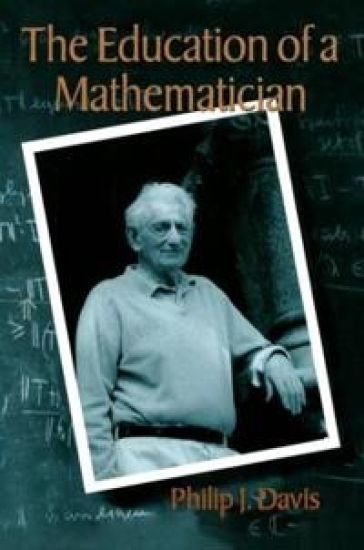
The Education of a Mathematician

The Education of a Mathematician

Philip J. Davis

A K Peters
2000
sidottu
In this charming memoir, a renowned mathematician and winner of the American Book Award traces his career in mathematics from early lessons in horse racing and the realities of life to his adventures on the lecture circuit. A thought-provoking mix of autobiography, history, and insights into the role of mathematics in everyday life, this highly entertaining book will appeal to all readers.
Mathematics & Common Sense

Mathematics & Common Sense

Philip J. Davis

A K Peters
2006
sidottu
From the Preface: "This book is addressed to all who are curious about the nature of mathematics and its role in society. It is neither a text book nor a specialists' book. It consists of a number of loosely linked essays that may be read independently and for which I have tried to provide a leitmotif by throwing light on the relationship between mathematics and common sense. In these essays I hope to foster a critical attitude towards both the existence of common sense in mathematics and the ambiguous role that it can play."
The Schwarz Function and Its Applications

The Schwarz Function and Its Applications

Philip J. Davis

AMERICAN MATHEMATICAL SOCIETY
1974
nidottu
H. A. Schwarz showed us how to extend the notion of reflection in straight lines and circles to reflection in an arbitrary analytic arc. Notable applications were made to the symmetry principle and to problems of analytic continuation. Reflection, in the hands of Schwarz, is an antianalytic mapping. By taking its complex conjugate, we arrive at an analytic function that we have called here the Schwarz Function of the analytic arc. This function is worthy of study in its own right and this essay presents such a study. In dealing with certain familiar topics, the use of the Schwarz Function lends a point of view, a clarity and elegance, and a degree of generality which might otherwise be missing. It opens up a line of inquiry which has yielded numerous interesting things in complex variables; it illuminates some functional equations and a variety of iterations which interest the numerical analyst. The perceptive reader will certainly find here some old wine in relabelled bottles. But one of the principles of mathematical growth is that the relabelling process often suggests a new generation of problems. Means become ends; the medium rapidly becomes the message. This book is not wholly self-contained. Readers will find that they should be familiar with the elementary portions of linear algebra and of the theory of functions of a complex variable.