Kirjojen hintavertailu. Mukana 11 244 527 kirjaa ja 12 kauppaa.

Kirjahaku

Etsi kirjoja tekijän nimen, kirjan nimen tai ISBN:n perusteella.

55 kirjaa tekijältä Philip Miller

The Gardeners Kalendar, Directing What Works Are Necessary to Be Done Every Month, in the Kitchen, Fruit, and Pleasure Gardens, and in the Conservatory. ... by Philip Miller,
The 18th century was a wealth of knowledge, exploration and rapidly growing technology and expanding record-keeping made possible by advances in the printing press. In its determination to preserve the century of revolution, Gale initiated a revolution of its own: digitization of epic proportions to preserve these invaluable works in the largest archive of its kind. Now for the first time these high-quality digital copies of original 18th century manuscripts are available in print, making them highly accessible to libraries, undergraduate students, and independent scholars.Medical theory and practice of the 1700s developed rapidly, as is evidenced by the extensive collection, which includes descriptions of diseases, their conditions, and treatments. Books on science and technology, agriculture, military technology, natural philosophy, even cookbooks, are all contained here.++++The below data was compiled from various identification fields in the bibliographic record of this title. This data is provided as an additional tool in helping to insure edition identification: ++++British LibraryT059404"The gardeners kalendar was published October 1731" (Henrey). With two final leaves of advertisements.London: printed for the author, and sold by C. Rivington, 1732 1731]. xv, 1],252, 4]p., plate; 8
The Gardeners Kalendar, Directing What Works are Necessary to be Done Every Month, in the Kitchen, Fruit, and Pleasure Gardens, and in the Conservatory. ... By Philip Miller, ... The Second Edition; to Which is Added, a Complete Index
The 18th century was a wealth of knowledge, exploration and rapidly growing technology and expanding record-keeping made possible by advances in the printing press. In its determination to preserve the century of revolution, Gale initiated a revolution of its own: digitization of epic proportions to preserve these invaluable works in the largest archive of its kind. Now for the first time these high-quality digital copies of original 18th century manuscripts are available in print, making them highly accessible to libraries, undergraduate students, and independent scholars.Medical theory and practice of the 1700s developed rapidly, as is evidenced by the extensive collection, which includes descriptions of diseases, their conditions, and treatments. Books on science and technology, agriculture, military technology, natural philosophy, even cookbooks, are all contained here.++++The below data was compiled from various identification fields in the bibliographic record of this title. This data is provided as an additional tool in helping to insure edition identification: ++++British LibraryT059408The titlepage is a cancel. With eight leaves of advertisements and index.London: printed for the author, and sold by C. Rivington, 1733. xv, 1],252, 16]p., plate; 8
Figures of the Most Beautiful, Useful, and Uncommon Plants Described in The Gardeners Dictionary, Exhibited on Three Hundred Copper Plates, To Which are Added, Their Descriptions, By Philip Miller, F.R.S. In two Volumes of 2; Volume 1
The 18th century was a wealth of knowledge, exploration and rapidly growing technology and expanding record-keeping made possible by advances in the printing press. In its determination to preserve the century of revolution, Gale initiated a revolution of its own: digitization of epic proportions to preserve these invaluable works in the largest archive of its kind. Now for the first time these high-quality digital copies of original 18th century manuscripts are available in print, making them highly accessible to libraries, undergraduate students, and independent scholars.Medical theory and practice of the 1700s developed rapidly, as is evidenced by the extensive collection, which includes descriptions of diseases, their conditions, and treatments. Books on science and technology, agriculture, military technology, natural philosophy, even cookbooks, are all contained here.++++The below data was compiled from various identification fields in the bibliographic record of this title. This data is provided as an additional tool in helping to insure edition identification: ++++British LibraryT059417London: printed for the author; and sold by John Rivington, A. Millar, H. Woodfall, J. Whiston and B. White, J. Hinton and 8 others in London], 1760. 2v.(vi,200, 4]p.), plates; 2
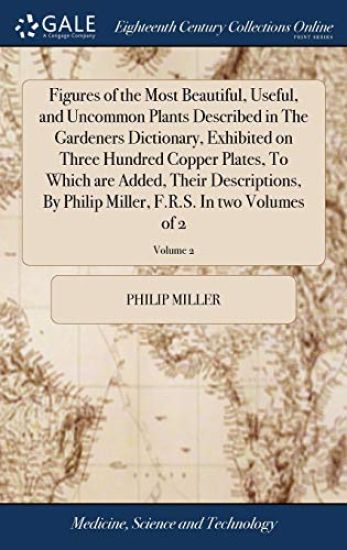
Figures of the Most Beautiful, Useful, and Uncommon Plants Described in The Gardeners Dictionary, Exhibited on Three Hundred Copper Plates, To Which are Added, Their Descriptions, By Philip Miller, F.R.S. In two Volumes of 2; Volume 2
The 18th century was a wealth of knowledge, exploration and rapidly growing technology and expanding record-keeping made possible by advances in the printing press. In its determination to preserve the century of revolution, Gale initiated a revolution of its own: digitization of epic proportions to preserve these invaluable works in the largest archive of its kind. Now for the first time these high-quality digital copies of original 18th century manuscripts are available in print, making them highly accessible to libraries, undergraduate students, and independent scholars.Medical theory and practice of the 1700s developed rapidly, as is evidenced by the extensive collection, which includes descriptions of diseases, their conditions, and treatments. Books on science and technology, agriculture, military technology, natural philosophy, even cookbooks, are all contained here.++++The below data was compiled from various identification fields in the bibliographic record of this title. This data is provided as an additional tool in helping to insure edition identification: ++++British LibraryT059417London: printed for the author; and sold by John Rivington, A. Millar, H. Woodfall, J. Whiston and B. White, J. Hinton and 8 others in London], 1760. 2v.(vi,200, 4]p.), plates; 2
Media Law for Producers

Media Law for Producers

Philip Miller

Focal Press
2003
nidottu
Media Law for Producers is a comprehensive handbook that explains, in lay terms, the myriad legal issues that the producer will face on a regular basis - contracts, permits, defamation, patents, releases and insurance, libel, royalties and residuals, as well as protecting the finished production. This revised and expanded edition includes such Internet-related topics as Internet music law, online registration, and online privacy. Other new topics covered include:· Implied and express contracts in the project/idea submission process · Assignment/transfer of copyright· Music clip licensing· Use of other people's trademarks in media production· Parody as a defense to copyright infringement Clear explanations examine the how and why of different types of production contracts, and checklists provide a quick means for producers to determine when their productions might be at greatest risk to legal challenges. Media Law for Producers also examines the substantial changes in copyright term resulting from recent copyright legislation. Legal problems can be very costly to media producers. Lawyers and court fees, coupled with the loss of work time, can lead to bankruptcy. Media Law for Producers cuts through the legalese and illustrates legal issues to help producers recognize the legal questions that can arise during production.
The Abridgement of the Gardener's Dictionary

The Abridgement of the Gardener's Dictionary

Philip Miller

Cambridge University Press
2014
pokkari
Trained by his father, a market gardener, Philip Miller (1691–1771) rose to become Britain's most eminent horticulturalist in the eighteenth century. Following a period as a nurseryman in Southwark, he was appointed the head gardener of the Chelsea Physic Garden by the Society of Apothecaries in 1722, upon the recommendation of Sir Hans Sloane. Under Miller's supervision, the diversity of plants at Chelsea outstripped that of all other European botanic gardens. His talent was equally reflected in his writings. Miller's most famous work, The Gardener's Dictionary, ran to eight editions during his lifetime, as did his celebrated abridgement, reissued here in its 1771 sixth edition. Ranging widely in coverage from agriculture to winemaking, as well as incorporating traditional gardening topics, the work reflects the progress of contemporary plant science and the breadth of knowledge acquired by one of its foremost practitioners.
Media Law for Producers

Media Law for Producers

Philip Miller

Routledge
2015
sidottu
Media Law for Producers is a comprehensive handbook that explains, in lay terms, the myriad legal issues that the producer will face on a regular basis - contracts, permits, defamation, patents, releases and insurance, libel, royalties and residuals, as well as protecting the finished production. This revised and expanded edition includes such Internet-related topics as Internet music law, online registration, and online privacy. Other new topics covered include:· Implied and express contracts in the project/idea submission process · Assignment/transfer of copyright· Music clip licensing· Use of other people's trademarks in media production· Parody as a defense to copyright infringement Clear explanations examine the how and why of different types of production contracts, and checklists provide a quick means for producers to determine when their productions might be at greatest risk to legal challenges. Media Law for Producers also examines the substantial changes in copyright term resulting from recent copyright legislation. Legal problems can be very costly to media producers. Lawyers and court fees, coupled with the loss of work time, can lead to bankruptcy. Media Law for Producers cuts through the legalese and illustrates legal issues to help producers recognize the legal questions that can arise during production.