Kirjojen hintavertailu. Mukana 11 244 527 kirjaa ja 12 kauppaa.

Kirjahaku

Etsi kirjoja tekijän nimen, kirjan nimen tai ISBN:n perusteella.

10 kirjaa tekijältä Philip Mirowski

More Heat than Light

More Heat than Light

Philip Mirowski

Cambridge University Press
1991
pokkari
More Heat Than Light is a history of how physics has drawn some inspiration from economics and also how economics has sought to emulate physics, especially with regard to the theory of value. It traces the development of the energy concept in Western physics and its subsequent effect upon the invention and promulgation of neoclassical economics. Any discussion of the standing of economics as a science must include the historical symbiosis between the two disciplines. Starting with the philosopher Emile Meyerson’s discussion of the relationship between notions of invariance and causality in the history of science, the book surveys the history of conservation principles in the Western discussion of motion. Recourse to the metaphors of the economy are frequent in physics, and the concepts of value, motion, and body reinforced each other throughout the development of both disciplines, especially with regard to practices of mathematical formalisation. However, in economics subsequent misuse of conservation principles led to serious blunders in the mathematical formalisation of economic theory. The book attempts to provide the reader with sufficient background in the history of physics in order to appreciate its theses. The discussion is technically detailed and complex, and familiarity with calculus is required.
Machine Dreams

Machine Dreams

Philip Mirowski

Cambridge University Press
2001
sidottu
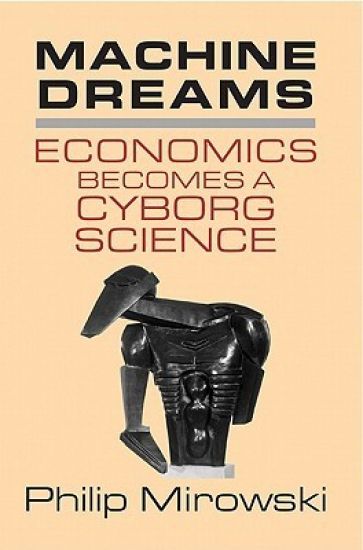
This was the first cross-over book into the history of science written by an historian of economics. It shows how 'history of technology' can be integrated with the history of economic ideas. The analysis combines Cold War history with the history of postwar economics in America and later elsewhere, revealing that the Pax Americana had much to do with abstruse and formal doctrines such as linear programming and game theory. It links the literature on 'cyborg' to economics, an element missing in literature to date. The treatment further calls into question the idea that economics has been immune to postmodern currents, arguing that neoclassical economics has participated in the deconstruction of the integral 'self'. Finally, it argues for an alliance of computational and institutional themes, and challenges the widespread impression that there is nothing else besides American neoclassical economic theory left standing after the demise of Marxism.
Machine Dreams

Machine Dreams

Philip Mirowski

Cambridge University Press
2001
pokkari
This was the first cross-over book into the history of science written by an historian of economics. It shows how 'history of technology' can be integrated with the history of economic ideas. The analysis combines Cold War history with the history of postwar economics in America and later elsewhere, revealing that the Pax Americana had much to do with abstruse and formal doctrines such as linear programming and game theory. It links the literature on 'cyborg' to economics, an element missing in literature to date. The treatment further calls into question the idea that economics has been immune to postmodern currents, arguing that neoclassical economics has participated in the deconstruction of the integral 'self'. Finally, it argues for an alliance of computational and institutional themes, and challenges the widespread impression that there is nothing else besides American neoclassical economic theory left standing after the demise of Marxism.
Science-Mart

Science-Mart

Philip Mirowski

Harvard University Press
2011
sidottu
This trenchant study analyzes the rise and decline in the quality and format of science in America since World War II.During the Cold War, the U.S. government amply funded basic research in science and medicine. Starting in the 1980s, however, this support began to decline and for-profit corporations became the largest funders of research. Philip Mirowski argues that a powerful neoliberal ideology promoted a radically different view of knowledge and discovery: the fruits of scientific investigation are not a public good that should be freely available to all, but are commodities that could be monetized.Consequently, patent and intellectual property laws were greatly strengthened, universities demanded patents on the discoveries of their faculty, information sharing among researchers was impeded, and the line between universities and corporations began to blur. At the same time, corporations shed their in-house research laboratories, contracting with independent firms both in the States and abroad to supply new products. Among such firms were AT&T and IBM, whose outstanding research laboratories during much of the twentieth century produced Nobel Prize–winning work in chemistry and physics, ranging from the transistor to superconductivity.Science-Mart offers a provocative, learned, and timely critique, of interest to anyone concerned that American science—once the envy of the world—must be more than just another way to make money.
The Effortless Economy of Science?

The Effortless Economy of Science?

Philip Mirowski

Duke University Press
2004
sidottu
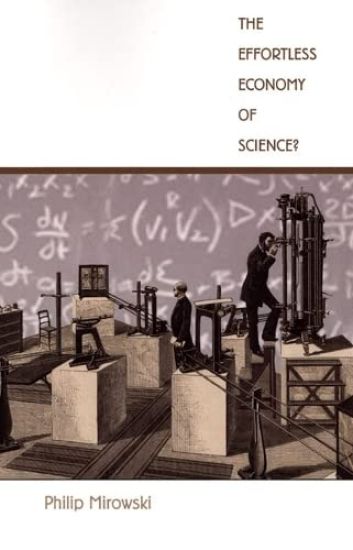
A leading scholar of the history and philosophy of economic thought, Philip Mirowski argues that there has been a top-to-bottom transformation in how scientific research is organized and funded in Western countries over the past two decades and that these changes necessitate a reexamination of the ways that science and economics interact. Mirowski insists on the need to bring together the insights of economics, science studies, and the philosophy of science in order to understand how and why particular research programs get stabilized through interdisciplinary appropriation, controlled attributions of error, and funding restrictions. Mirowski contends that neoclassical economists have persistently presumed and advanced an “effortless economy of science,” a misleading model of a self-sufficient and conceptually self-referential social structure that transcends market operations in pursuit of absolute truth. In the stunning essays collected here, he presents a radical critique of the ways that neoclassical economics is used to support, explain, and legitimate the current social practices underlying the funding and selection of “successful” science projects. He questions a host of theories, including the portraits of science put forth by Karl Popper, Michael Polanyi, and Thomas Kuhn. Among the many topics he examines are the social stabilization of quantitative measurement, the repressed history of econometrics, and the social construction of the laws of supply and demand and their putative opposite, the gift economy. In The Effortless Economy of Science? Mirowski moves beyond grand abstractions about science, truth, and democracy in order to begin to talk about the way science is lived and practiced today.
The Effortless Economy of Science?

The Effortless Economy of Science?

Philip Mirowski

Duke University Press
2004
pokkari
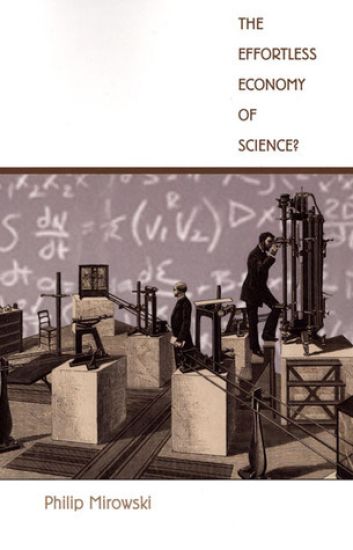
A leading scholar of the history and philosophy of economic thought, Philip Mirowski argues that there has been a top-to-bottom transformation in how scientific research is organized and funded in Western countries over the past two decades and that these changes necessitate a reexamination of the ways that science and economics interact. Mirowski insists on the need to bring together the insights of economics, science studies, and the philosophy of science in order to understand how and why particular research programs get stabilized through interdisciplinary appropriation, controlled attributions of error, and funding restrictions. Mirowski contends that neoclassical economists have persistently presumed and advanced an “effortless economy of science,” a misleading model of a self-sufficient and conceptually self-referential social structure that transcends market operations in pursuit of absolute truth. In the stunning essays collected here, he presents a radical critique of the ways that neoclassical economics is used to support, explain, and legitimate the current social practices underlying the funding and selection of “successful” science projects. He questions a host of theories, including the portraits of science put forth by Karl Popper, Michael Polanyi, and Thomas Kuhn. Among the many topics he examines are the social stabilization of quantitative measurement, the repressed history of econometrics, and the social construction of the laws of supply and demand and their putative opposite, the gift economy. In The Effortless Economy of Science? Mirowski moves beyond grand abstractions about science, truth, and democracy in order to begin to talk about the way science is lived and practiced today.
Latin American Constitutions

Latin American Constitutions

Philip Mirowski

Cambridge University Press
2019
pokkari
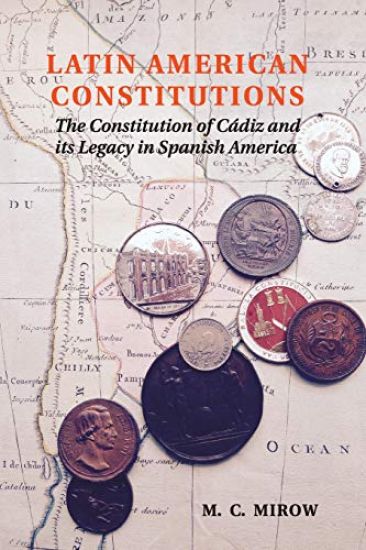
Latin American Constitutions provides a comprehensive historical study of constitutionalism in Latin America from the independence period to the present, focusing on the Constitution of Cádiz, a foundational document in Latin American constitutionalism. Although drafted in Spain, it was applied in many regions of Latin America, and deputies from America formed a significant part of the drafting body. The politicization of constitutionalism reflected in Latin America's first moments proved to be a lasting legacy evident in the legal and constitutional world of the region today: many of Latin America's present challenges to establishing effective constitutionalism can be traced to the debates, ideas, structures, and assumptions of this text. This book explores the region's attempts to create effective constitutional texts and regimes in light of an established practice of linking constitutions to political goals and places important constitutional thinkers and regional constitutions, such as the Mexican Constitution of 1917, into their legal and historical context.
Never Let a Serious Crisis Go to Waste

Never Let a Serious Crisis Go to Waste

Philip Mirowski

Verso Books
2014
nidottu
At the onset of the Great Recession, as house prices sank and joblessness soared, many commentators thought that neoliberalism itself was in its death throes. And yet it seems that-post-apocalypse-we've awoken into a second nightmare more ghastly than the first: a political class still blaming government intervention, a global drive for austerity, stagflation, and exploding sovereign debt crises.Philip Mirowski argues that, as in classic studies of cognitive dissonance, neoliberal thought has become so pervasive that any countervailing evidence serves only to further convince disciples of its ultimate truth. Once neoliberalism became a Theory of Everything-a revolutionary account of self, knowledge, information, markets, and government-it could no longer be falsified by mere data from the 'real' economy.In this sharp, witty and deeply informed account-taking no prisoners in his pursuit of 'zombie' economists-Mirowski surveys the wreckage of what passes for economic thought, and finally provides the basis for an anti-neoliberal account of the current crisis and our future prospects.
The Economic Writings of William Thornton

The Economic Writings of William Thornton

Philip Mirowski

Pickering Chatto (Publishers) Ltd
1999
muu
Thornton's writings are central to the history of the "Laws of Supply and Demand" and seminal in understanding the rise of neoclassical economics. Thornton has been cast as a minor player in John Stuart Mill's recantation of the wages fund doctrine. This text should show how he played a major role.