Kirjojen hintavertailu. Mukana 11 244 527 kirjaa ja 12 kauppaa.

Kirjahaku

Etsi kirjoja tekijän nimen, kirjan nimen tai ISBN:n perusteella.

13 kirjaa tekijältä Philip Morgan

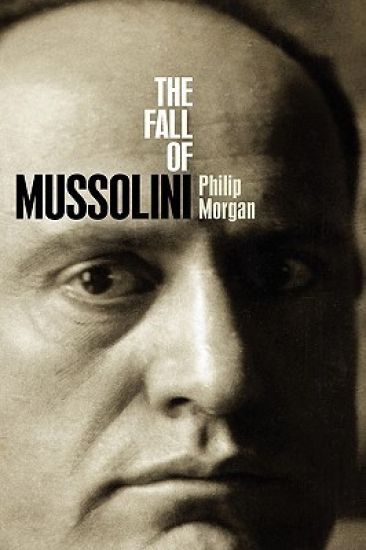
The Fall of Mussolini

The Fall of Mussolini

Philip Morgan

Oxford University Press
2007
sidottu
The dramatic story of Mussolini's fall from power in July 1943, illuminating both the causes and the consequences of this momentous event. Morgan shows how Italians of all classes coped with the extraordinary pressures of wartime living, both on the military and home fronts, and how their experience of the country at war eventually distanced them from the dictator and his fascist regime. Looking beyond Mussolini's initial fall from power, Morgan examines how the Italian people responded to the invasion, occupation, and division of their country by Nazi German and Anglo-American forces - and how crucial the experience of this period was in shaping Italy's post-war sense of nationhood and transition to democracy.
The Fall of Mussolini

The Fall of Mussolini

Philip Morgan

Oxford University Press
2008
nidottu
The dramatic story of Mussolini's fall from power in July 1943, illuminating both the causes and the consequences of this momentous event. Morgan shows how Italians of all classes coped with the extraordinary pressures of wartime living, both on the military and home fronts, and how their experience of the country at war eventually distanced them from the dictator and his fascist regime. Looking beyond Mussolini's initial fall from power, Morgan examines how the Italian people responded to the invasion, occupation, and division of their country by Nazi German and Anglo-American forces - and how crucial the experience of this period was in shaping Italy's post-war sense of nationhood and transition to democracy.
Hitler's Collaborators

Hitler's Collaborators

Philip Morgan

Oxford University Press
2018
sidottu
Hitler's Collaborators focuses the spotlight on one of the most controversial and uncomfortable aspects of the Nazi wartime occupation of Europe: the citizens of those countries who helped Hitler. Although a widespread phenomenon, this was long ignored in the years after the war, when peoples and governments understandably emphasized popular resistance to Nazi occupation as they sought to reconstruct their devastated economies and societies along anti-fascist and democratic lines. Philip Morgan moves away from the usual suspects, the Quislings who backed Nazi occupation because they were fascists, and focuses instead on the businessmen and civil servants who felt obliged to cooperate with the Nazis. These were the people who faced the most difficult choices and dilemmas by dealing with the various Nazi uthorities and agencies, and who were ultimately responsible for gearing the economies of the occupied territories to the Nazi war effort. It was their choices which had the greatest impact on the lives and livelihoods of their fellow countrymen in the occupied territories, including the deportation of slave-workers to the Reich and hundreds of thousands of European Jews to the death camps in the East. In time, as the fortunes of war shifted so decisively against Germany between 1941 and 1944, these collaborators found themselves trapped by the logic of their initial cooperation with their Nazi overlords -- caught up between the demands of an increasingly desperate and extremist occupying power, growing internal resistance to Nazi rule, and the relentlessly advancing Allied armies.
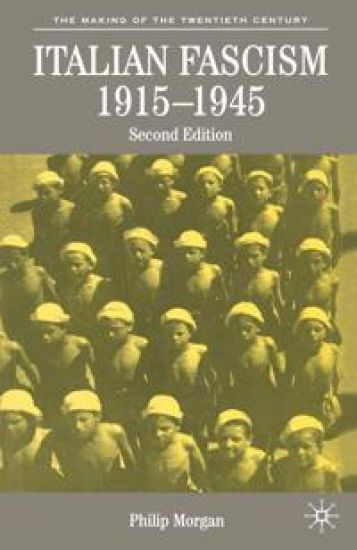
Italian Fascism, 1915-1945

Italian Fascism, 1915-1945

Philip Morgan

Red Globe Press
2003
nidottu
It is now 80 years since Mussolini's Fascism came to power in Italy, but the political heirs of the original Fascism are part of government in today's Italy. The resurgence of neo-fascist and neo-Nazi extremism all over Europe are a reminder of the continuing place of fascism in contemporary European society, despite its political and military defeat in 1945.This thoroughly revised, updated and expanded edition provides a critical and comprehensive overview of the origins of Fascism and the movement's taking and consolidation of power. Philip Morgan:· explains how the experience of the First World War created Fascism· describes how the unsettled post-war conditions in Italy enabled an initially small group of political adventurers around Mussolini to build a large movement and take power in 1922· focuses on the workings of the first ever 'totalitarian' system and its impacts on the lives and outlooks of ordinary Italians· considers the meshing of internal 'fascistisation' and expansionism, which emerged most clearly after 1936 as Italy became more closely aligned with Nazi Germany· examines the demise of Italian Fascism between 1943 and 1945 as Mussolini and his party became the puppets of Nazism· provides an explanation and interpretation of Fascism, locating it in contemporary history and taking account of recent debates on the nature of the phenomenon.Clear and approachable, this essential text is ideal for anyone interested in Italy's turbulent political history in the first half of the twentieth century.
Fascism in Europe, 1919-1945

Fascism in Europe, 1919-1945

Philip Morgan

Routledge
2002
sidottu
Fascism in Europe, 1919-1945 surveys the phenomenon which is still the object of interest and debate over fifty years after its defeat in the Second World War. It introduces the recent scholarship and continuing debates on the nature of fascism as well as the often contentious contributions by foreign historians and political scientists.From the pre-First World War intellectual origins of Fascism to its demise in 1945, this book examines:* the two 'waves' of fascism - in the immediate post-war period and in the late 1920s and early 1930s* whether the European crisis created by the Treaty of Versailles allowed fascism to take root* why fascism came to power in Italy and Germany, but not anywhere else in Europe* fascism's own claim to be an international and internationalist movement* the idea of 'totalitarianism' as the most useful and appropriate way of analyzing the fascist regimes.
Fascism in Europe, 1919-1945

Fascism in Europe, 1919-1945

Philip Morgan

Routledge
2002
nidottu
Fascism in Europe, 1919-1945 surveys the phenomenon which is still the object of interest and debate over fifty years after its defeat in the Second World War. It introduces the recent scholarship and continuing debates on the nature of fascism as well as the often contentious contributions by foreign historians and political scientists.From the pre-First World War intellectual origins of Fascism to its demise in 1945, this book examines:* the two 'waves' of fascism - in the immediate post-war period and in the late 1920s and early 1930s* whether the European crisis created by the Treaty of Versailles allowed fascism to take root* why fascism came to power in Italy and Germany, but not anywhere else in Europe* fascism's own claim to be an international and internationalist movement* the idea of 'totalitarianism' as the most useful and appropriate way of analyzing the fascist regimes.
Prey

Prey

Philip Morgan

Lulu Press Inc
2014
nidottu
Prey is a paranormal thriller that takes you on a terrifying journey through a land where nothing is what it seems to be and the ultimate threat is your own desire. After killing her mother in a traffic accident eighteen-year-old Penny is left on the borderline of madness. Spirited away to Ireland by the doctor who has fallen in love with her, she is hunted through a landscape of monsters, demons and ghosts. Discovering love only to have it snatched away she realises she has to find her way on her own or be annihilated. Which would you choose - defiance or surrender?
Peter the Penguin

Peter the Penguin

Philip Morgan

Lulu.com
2014
pokkari
Peter the Penguin lives at the bottom of the world (The South Pole) with his mummy and his daddy. Peter doesn't like being a Penguin and he doesn't like living in such a cold place He wants to be something else other than a Penguin and he wants to be someplace else where he wouldn't be cold all the time. So Peter spends most of his time daydreaming about what he could be, and where he could go
Italian Fascism, 1915-1945

Italian Fascism, 1915-1945

Philip Morgan

Red Globe Press
2003
sidottu
It is now 80 years since Mussolini's Fascism came to power in Italy, but the political heirs of the original Fascism are part of government in today's Italy. The resurgence of neo-fascist and neo-Nazi extremism all over Europe are a reminder of the continuing place of fascism in contemporary European society, despite its political and military defeat in 1945. This thoroughly revised, updated and expanded edition provides a critical and comprehensive overview of the origins of Fascism and the movement's taking and consolidation of power. Philip Morgan: - Explains how the experience of the First World War created Fascism - Describes how the unsettled post-war conditions in Italy enabled an initially small group of political adventurers around Mussolini to build a large movement and take power in 1922 - Focuses on the workings of the first ever 'totalitarian' system and its impacts on the lives and outlooks of ordinary Italians - Considers the meshing of internal 'fascistisation' and expansionism, which emerged most clearly after 1936 as Italy became more closely aligned with Nazi Germany - Examines the demise of Italian Fascism between 1943 and 1945 as Mussolini and his party became the puppets of Nazism - Provides an explanation and interpretation of Fascism, locating it in contemporary history and taking account of recent debates on the nature of the phenomenon. Clear and approachable, this essential text is ideal for anyone interested in Italy's turbulent political history in the first half of the 20th century.