Kirjojen hintavertailu. Mukana 11 627 363 kirjaa ja 12 kauppaa.

Kirjahaku

Etsi kirjoja tekijän nimen, kirjan nimen tai ISBN:n perusteella.

5 kirjaa tekijältä Phillip B. Gonzales

Política

Política

Phillip B. Gonzales

University of Nebraska Press
2016
sidottu
Política offers a stunning revisionist understanding of the early political incorporation of Mexican-origin peoples into the U.S. body politic in the nineteenth century. Historical sociologist Phillip B. Gonzales reexamines the fundamental issue in New Mexico’s history, namely, the dramatic shift in national identities initiated by Nuevomexicanos when their province became ruled by the United States. Gonzales provides an insightful, rigorous, and controversial interpretation of how Nuevomexicano political competition was woven into the Democratic and Republican two-party system that emerged in the United States between the 1850s and 1912, when New Mexico became a state. Drawing on newly discovered archival and primary sources, he explores how Nuevomexicanos relied on a long tradition of political engagement and a preexisting republican disposition and practice to elaborate a dual-party political system mirroring the contours of U.S. national politics.Política is a tour de force of political history in the nineteenth-century U.S.–Mexico borderlands that reinterprets colonization, reconstructs Euro-American and Nuevomexicano relations, and recasts the prevailing historical narrative of territorial expansion and incorporation in North American imperial history. Gonzales provides critical insights into several discrete historical processes, such as U.S. racialization and citizenship, integration and marginalization, accommodation and resistance, internal colonialism, and the long struggle for political inclusion in the borderlands, shedding light on debates taking place today over Latinos and U.S. citizenship.
Expressing New Mexico

Expressing New Mexico

Phillip B. Gonzales

University of Arizona Press
2007
nidottu
The culture of the Nuevomexicanos, forged by Spanish-speaking residents of New Mexico over the course of many centuries, is known for its richness and diversity. Expressing New Mexico contributes to a present-day renaissance of research on Nuevomexicano culture by assembling eleven original and noteworthy essays. They are grouped under two broad headings: expressing culture and expressing place.? Expressing culture derives from the notion of expressive culture,? referring to fine art? productions, such as music, painting, sculpture, drawing, dance, drama, and film, but it is expanded here to include folklore, religious ritual, community commemoration, ethnopolitical identity, and the pragmatics of ritualized response to the difficult problems of everyday life. Intertwined with the concept of expressive culture is that of place? in relation to New Mexico itself. Place is addressed directly by four of the authors in this anthology and is present in some way and in varying degrees among the rest. Place figures prominently in Nuevomexicano ?character,? contributors argue. They assert that Nuevomexicanos and Nuevomexicanas construct and develop a sense of self that is shaped by the geography and culture of the state as well as by their heritage. Many of the articles deal with recent events or with recent reverberations of important historical events, which imbues the collection with a sense of immediacy. Rituals, traditions, community commemorations, self-concepts, and historical revisionism all play key roles. Contributors include both prominent and emerging scholars united by their interest in, and fascination with, the distinctiveness of Nuevomexicano culture.
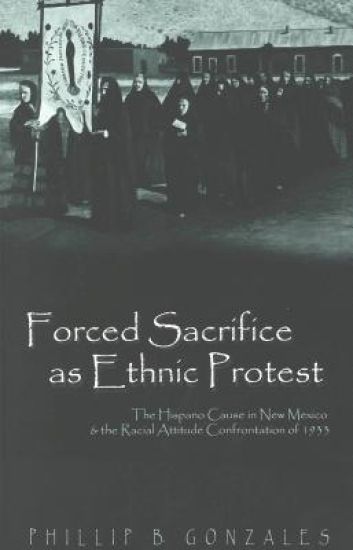
Forced Sacrifice as Ethnic Protest

Forced Sacrifice as Ethnic Protest

Phillip B. Gonzales

Peter Lang Publishing Inc
2000
nidottu
"Forced Sacrifice as Ethnic Protest" brings to light important aspects of identity politics by introducing -forced sacrifice- as a type of protest that ethnic minorities in the United States occasionally mount, particularly against liberal regimes in public institutions. Social science concepts and the literature on social sacrifice help define a spontaneous confrontation in which the protest crowd dramatically forces the institution to dismiss - that is, to sacrifice - one of its own agents as a symbolic concession to ethnic inequality and as a way to open up social reform. The Racial Attitude Confrontation of 1933, involving the Hispanos of New Mexico, is analyzed in terms of forced sacrifice. The Hispano cause is clarified as a significant tradition of ethnic mobilization that arose in the Southwest between the 1880s and the 1930s, revealing some key symbolic and instrumental elements of identity as minority groups mobilize for their interests."
Hispano Nation

Hispano Nation

Phillip B. Gonzales

UNIVERSITY OF NEW MEXICO PRESS
2026
sidottu
A genuinely original exploration of Spanish identity among Nuevomexicanos and Nuevomexicanas, a classic cultural theme in Southwest studies. Spanish identity has always been a striking hallmark of New Mexico culture, yet many questions remain about how this unique and provocative construction originated and what it has meant to the state’s Hispanic populace. Through a meticulous handling of the historical record, Gonzales arrives at a clear definition of what Spanish identity has been and what it continues to be. He uncovers Spanish identity’s origins deep in New Mexico’s past, its cultural and political development in the nineteenth-century, the pinnacle of popularity it enjoyed beginning in the early twentieth century, and its eventual decline. In Hispano Nation Gonzales argues that Spanish identity was formulated in the nineteenth century along the lines of ethnic nationalism. He deftly addresses the controversies that have surrounded Spanish identity, including whether it reflected a “true” ethnic identity in lieu of a Mexican identity for the Nuevomexicano people, and how historical conflict with Indigenous people became ingrained itself in the Spanish Americans’ view of their own heritage. The narrative is enlivened throughout with engaging stories, penetrating analyses, fascinating cultural actors, and visits to known historical legacies.
Hispano Nation

Hispano Nation

Phillip B. Gonzales

UNIVERSITY OF NEW MEXICO PRESS
2026
pokkari
A genuinely original exploration of Spanish identity among Nuevomexicanos and Nuevomexicanas, a classic cultural theme in Southwest studies. Spanish identity has always been a striking hallmark of New Mexico culture, yet many questions remain about how this unique and provocative construction originated and what it has meant to the state’s Hispanic populace. Through a meticulous handling of the historical record, Gonzales arrives at a clear definition of what Spanish identity has been and what it continues to be. He uncovers Spanish identity’s origins deep in New Mexico’s past, its cultural and political development in the nineteenth-century, the pinnacle of popularity it enjoyed beginning in the early twentieth century, and its eventual decline. In Hispano Nation Gonzales argues that Spanish identity was formulated in the nineteenth century along the lines of ethnic nationalism. He deftly addresses the controversies that have surrounded Spanish identity, including whether it reflected a “true” ethnic identity in lieu of a Mexican identity for the Nuevomexicano people, and how historical conflict with Indigenous people became ingrained itself in the Spanish Americans’ view of their own heritage. The narrative is enlivened throughout with engaging stories, penetrating analyses, fascinating cultural actors, and visits to known historical legacies.