Kirjojen hintavertailu. Mukana 11 632 233 kirjaa ja 12 kauppaa.

Kirjahaku

Etsi kirjoja tekijän nimen, kirjan nimen tai ISBN:n perusteella.

10 kirjaa tekijältä Phillip I. Good

Permutation, Parametric, and Bootstrap Tests of Hypotheses

Permutation, Parametric, and Bootstrap Tests of Hypotheses

Phillip I. Good

Springer-Verlag New York Inc.
2004
sidottu
This text is intended to provide a strong theoretical background in testing hypotheses and decision theory for those who will be practicing in the real worldorwhowillbeparticipatinginthetrainingofreal-worldstatisticiansand biostatisticians. In previous editions of this text, my rhetoric was somewhat tentative. I was saying, in e?ect, “Gee guys, permutation methods provide a practical real-world alternative to asymptotic parametric approximations. Why not give them a try?” But today, the theory, the software, and the hardware have come together. Distribution-free permutation procedures are the primary method for testing hypotheses. Parametric procedures and the bootstrap are to be reserved for the few situations in which they may be applicable. Four factors have forced this change: 1. Desire by workers in applied ?elds to use the most powerful statistic for their applications. Such workers may not be aware of the fundamental lemma of Neyman and Pearson, but they know that the statistic they wanttouse—acomplexscoreoraratioofscores,doesnothaveanalready well-tabulated distribution. 2. Pressure from regulatory agencies for the use of methods that yield exact signi?cance levels, not approximations. 3. A growing recognition that most real-world data are drawn from mixtures of populations. 4. A growing recognition that missing data is inevitable, balanced designs the exception. Thus, it seems natural that the theory of testing hypothesis and the more general decision theory in which it is embedded should be introduced via the permutation tests. On the other hand, certain relatively robust param- ric tests such as Student’s t continue to play an essential role in statistical practice.
Analyzing the Large Number of Variables in Biomedical and Satellite Imagery
This book grew out of an online interactive offered through statcourse.com, and it soon became apparent to the author that the course was too limited in terms of time and length in light of the broad backgrounds of the enrolled students. The statisticians who took the course needed to be brought up to speed both on the biological context as well as on the specialized statistical methods needed to handle large arrays. Biologists and physicians, even though fully knowledgeable concerning the procedures used to generate microaarrays, EEGs, or MRIs, needed a full introduction to the resampling methods—the bootstrap, decision trees, and permutation tests, before the specialized methods applicable to large arrays could be introduced. As the intended audience for this book consists both of statisticians and of medical and biological research workers as well as all those research workers who make use of satellite imagery including agronomists and meteorologists, the book provides a step-by-step approach to not only the specialized methods needed to analyze the data from microarrays and images, but also to the resampling methods, step-down multi-comparison procedures, multivariate analysis, as well as data collection and pre-processing. While many alternate techniques for analysis have been introduced in the past decade, the author has selected only those techniques for which software is available along with a list of the available links from which the software may be purchased or downloaded without charge. Topical coverage includes: very large arrays; permutation tests; applying permutation tests; gathering and preparing data for analysis; multiple tests; bootstrap; applying the bootstrap; classification methods; decision trees; and applying decision trees.
Introduction to Statistics Through Resampling Methods and R/S-PLUS
Stimulate learning through discovery With its emphasis on the discovery method, this book allows readers to discover solutions on their own rather than simply copy answers or apply a formula by rote. Readers will quickly master and learn to apply statistical methods, such as bootstrap, decision trees, and permutations, to better characterize, report, test, and classify their research findings. In addition to traditional methods, specialized methods are covered, allowing readers to select and apply the most effective method for their research, including: * Tests and estimation procedures for one, two, and multiple samples * Model building * Multivariate analysis * Complex experimental design Throughout the text, the R programming language is used to illustrate new concepts and assist readers in completing exercises. Readers may download the freely available R programming language from the Internet or take advantage of the menu-driven S-PLUS(r) program. Written in an informal, highly accessible style, this text is an excellent guide to descriptive statistics, estimation, testing hypotheses, and model building.All the pedagogical tools needed to facilitate quick learning are provided: * More than two hundred exercises scattered throughout the text stimulate readers' thinking and actively engage them in applying their newfound skills * Companion FTP site provides access to all data sets and programs discussed in the text * Dozens of thought-provoking questions in the final chapter, Problem Solving, assist readers in applying statistics to address real-life problems * Instructor's manual provides answers to exercises * Helpful appendices include an introduction to S-PLUS(r) features This text serves as an excellent introduction to statistics for students in all disciplines. The accessible style and focus on real-life problem solving are perfectly suited for both students and practitioners.
Introduction to Statistics Through Resampling Methods and Microsoft Office Excel
Learn statistical methods quickly and easily with the discovery method With its emphasis on the discovery method, this publication encourages readers to discover solutions on their own rather than simply copy answers or apply a formula by rote. Readers quickly master and learn to apply statistical methods, such as bootstrap, decision trees, t-test, and permutations to better characterize, report, test, and classify their research findings. In addition to traditional methods, specialized methods are covered, allowing readers to select and apply the most effective method for their research, including: * Tests and estimation procedures for one, two, and multiple samples * Model building * Multivariate analysis * Complex experimental design Throughout the text, Microsoft Office Excel(r) is used to illustrate new concepts and assist readers in completing exercises. An Excel Primer is included as an Appendix for readers who need to learn or brush up on their Excel skills. Written in an informal, highly accessible style, this text is an excellent guide to descriptive statistics, estimation, testing hypotheses, and model building. All the pedagogical tools needed to facilitate quick learning are provided: * More than 100 exercises scattered throughout the text stimulate readers' thinking and actively engage them in applying their newfound skills * Companion FTP site provides access to all data sets discussed in the text * An Instructor's Manual is available upon request from the publisher * Dozens of thought-provoking questions in the final chapter assist readers in applying statistics to solve real-life problems * Helpful appendices include an index to Excel and Excel add-in functions This text serves as an excellent introduction to statistics for students in all disciplines. The accessible style and focus on real-life problem solving are perfectly suited to both students and practitioners.
A Manager's Guide to the Design and Conduct of Clinical Trials
This newly updated edition of the benchmark guide to computer-assisted clinical trials provides a comprehensive primer for prospective managers. It covers every critical issue of the design and conduct of clinical trials, including study design, organization, regulatory agency liaison, data collection and analysis, as well as recruitment, software, monitoring, and reporting. Keeping the same user-friendly format as the original, this Second Edition features new examples and the latest developments in regulatory guidelines, such as e-submission procedures and computerized direct data acquisition. The new edition also reflects the increasing globalization of clinical trial activities, and includes new information about international standards and procedures, including the Common Technical Document and CDISC standards. This step-by-step guide is supported by handy checklists and extracts from submitted protocols. Experienced author and consultant Phillip Good incorporateshumorous yet instructive anecdotes to illustrate common pitfalls. Based on the proven industrial formula of planning, implementing, and finally performing essential checks, the book's three sections-"Plan," "Do," and "Check"-includethe following material: * Should the trials be conducted? * Put it in the computer and keep it there * Staffing for success * Designing trials and determining sample size * Budgeting * Recruiting and retaining patients and physicians * Data management * Monitoring the trials * Data analysis * After action review * Exception handling Executive and managerial professionals involved in the design and analysis of clinical experiments, along with clinical research associates, biostatisticians, and students in public health will find A Manager's Guide an indispensable resource. Praise for the First Edition: ". . . readable, informative and at times witty . . . never stops being concise and well written . . . a book worth a read . . ." -Statistics in Medicine "The book is very prescriptive and full of lists and tables with which to guide managers in making effective decisions in using computer-assisted clinical trials in pharmaceutical studies." -Technometrics "This book is must-have reading for anyone in the business . . ." -Clinical Chemistry
Resampling Methods

Resampling Methods

Phillip I. Good

Birkhauser Boston Inc
2005
sidottu
"…the author has packaged an excellent and modern set of topics around the development and use of quantitative models.... If you need to learn about resampling, this book would be a good place to start." Technometrics (Review of the Second Edition) This thoroughly revised and expanded third edition is a practical guide to data analysis using the bootstrap, cross-validation, and permutation tests. Only requiring minimal mathematics beyond algebra, the book provides a table-free introduction to data analysis utilizing numerous exercises, practical data sets, and freely available statistical shareware. Topics and Features - Practical presentation covers both the bootstrap and permutations along with the program code necessary to put them to work. - Includes a systematic guide to selecting the correct procedure for a particular application. - Detailed coverage of classification, estimation, experimental design, hypothesis testing, and modeling. - Suitable for both classroom use and individual self-study. New to the Third Edition - Procedures are grouped by application; a prefatory chapter guides readers to the appropriate reading matter. - Program listings and screen shots now accompany each resampling procedure. - To simplify programming, code for readers to download and apply is posted at http://www.springeronline.com/0-8176-4386-9. - Notation has been simplified and, where possible, eliminated. - A glossary and answers to selected exercises are included. With its accessible style and intuitive topic development, the book is an excellent basic resource for the power, simplicity, and versatility of resampling methods. It is an essential resource for statisticians, biostatisticians, statistical consultants, students, and research professionals in the biological, physical, and social sciences, engineering, and technology.
Introduction to Statistics Through Resampling Methods and R
A highly accessible alternative approach to basic statistics Praise for the First Edition: "Certainly one of the most impressive little paperback 200-page introductory statistics books that I will ever see . . . it would make a good nightstand book for every statistician."—Technometrics Written in a highly accessible style, Introduction to Statistics through Resampling Methods and R, Second Edition guides students in the understanding of descriptive statistics, estimation, hypothesis testing, and model building. The book emphasizes the discovery method, enabling readers to ascertain solutions on their own rather than simply copy answers or apply a formula by rote. The Second Edition utilizes the R programming language to simplify tedious computations, illustrate new concepts, and assist readers in completing exercises. The text facilitates quick learning through the use of: More than 250 exercises—with selected "hints"—scattered throughout to stimulate readers' thinking and to actively engage them in applying their newfound skills An increased focus on why a method is introduced Multiple explanations of basic concepts Real-life applications in a variety of disciplines Dozens of thought-provoking, problem-solving questions in the final chapter to assist readers in applying statistics to real-life applications Introduction to Statistics through Resampling Methods and R, Second Edition is an excellent resource for students and practitioners in the fields of agriculture, astrophysics, bacteriology, biology, botany, business, climatology, clinical trials, economics, education, epidemiology, genetics, geology, growth processes, hospital administration, law, manufacturing, marketing, medicine, mycology, physics, political science, psychology, social welfare, sports, and toxicology who want to master and learn to apply statistical methods.
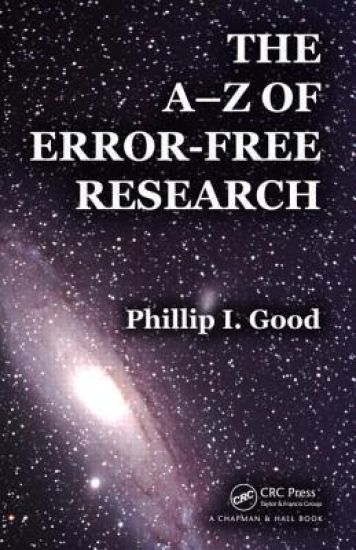
The A-Z of Error-Free Research

The A-Z of Error-Free Research

Phillip I. Good

CRC Press
2018
sidottu
A Practical Guide with Step-by-Step Explanations, Numerous Worked Examples, and R CodeThe A–Z of Error-Free Research describes the design, analysis, modeling, and reporting of experiments, clinical trials, and surveys. The book shows you when to use statistics, the best ways to cope with variation, and how to design an experiment, determine optimal sample size, and collect useable data. It also helps you choose the best statistical procedures for your application and takes you step by step through model development and reporting results for publication.Transition from Student to ResearcherHelping you become a confident researcher, the book begins with an overview of when—and when not—to use statistics. It guides you through the planning and data collection phases and presents various data analysis techniques, including methods for sample size determination. The author then covers techniques for developing models that provide a basis for future research. He also discusses reporting techniques to ensure your research efforts get the proper credit. The book concludes with case-control and cohort studies.
The A-Z of Error-Free Research

The A-Z of Error-Free Research

Phillip I. Good

Taylor Francis Inc
2012
nidottu
A Practical Guide with Step-by-Step Explanations, Numerous Worked Examples, and R CodeThe A–Z of Error-Free Research describes the design, analysis, modeling, and reporting of experiments, clinical trials, and surveys. The book shows you when to use statistics, the best ways to cope with variation, and how to design an experiment, determine optimal sample size, and collect useable data. It also helps you choose the best statistical procedures for your application and takes you step by step through model development and reporting results for publication.Transition from Student to ResearcherHelping you become a confident researcher, the book begins with an overview of when—and when not—to use statistics. It guides you through the planning and data collection phases and presents various data analysis techniques, including methods for sample size determination. The author then covers techniques for developing models that provide a basis for future research. He also discusses reporting techniques to ensure your research efforts get the proper credit. The book concludes with case-control and cohort studies.
Permutation, Parametric, and Bootstrap Tests of Hypotheses

Permutation, Parametric, and Bootstrap Tests of Hypotheses

Phillip I. Good

Springer-Verlag New York Inc.
2010
nidottu
This text is intended to provide a strong theoretical background in testing hypotheses and decision theory for those who will be practicing in the real worldorwhowillbeparticipatinginthetrainingofreal-worldstatisticiansand biostatisticians. In previous editions of this text, my rhetoric was somewhat tentative. I was saying, in e?ect, “Gee guys, permutation methods provide a practical real-world alternative to asymptotic parametric approximations. Why not give them a try?” But today, the theory, the software, and the hardware have come together. Distribution-free permutation procedures are the primary method for testing hypotheses. Parametric procedures and the bootstrap are to be reserved for the few situations in which they may be applicable. Four factors have forced this change: 1. Desire by workers in applied ?elds to use the most powerful statistic for their applications. Such workers may not be aware of the fundamental lemma of Neyman and Pearson, but they know that the statistic they wanttouse—acomplexscoreoraratioofscores,doesnothaveanalready well-tabulated distribution. 2. Pressure from regulatory agencies for the use of methods that yield exact signi?cance levels, not approximations. 3. A growing recognition that most real-world data are drawn from mixtures of populations. 4. A growing recognition that missing data is inevitable, balanced designs the exception. Thus, it seems natural that the theory of testing hypothesis and the more general decision theory in which it is embedded should be introduced via the permutation tests. On the other hand, certain relatively robust param- ric tests such as Student’s t continue to play an essential role in statistical practice.