110 BOOK REVIEWS is a collection of more or less extensive book reviews, including quotes, that took the author several years to accomplish, and which he offers, with foremost college students' needs in mind, for a special price, a price of under fifty cent for one review. The reviews are divided in three parts: - The New Paradigm in Business, Marketing & Career, consisting of 10 reviews Here authors like Edward de Bono, Laurence G. Boldt, Tom Butler-Bowdon or Sergio Zyman are to be found. - The New Paradigm in Science and Systems Theory, consisting of 43 reviews Here authors like Fritjof Capra, Riane Eisler, Masaru Emoto, Amit Goswami, Ervin Laszlo, Candace Pert, Dean Radin, Wilhelm Reich, Rupert Sheldrake, Michael Talbot, Russell Targ, William Tiller or the movie 'What the Bleep Do We Know ' figure. - The New Paradigm in Consciousness, Psychology, Healing & Spirituality, consisting of 57 reviews Here you can find authors such as Joseph Campbell, Deepak Chopra, Fran oise Dolto, Mircea Eliade, Jonathan Goldman, Stanislav Grof, Manly P. Hall, Carl Jung, J. Krishnamurti, Charles W. Leadbeater, Alexander Lowen, Terence McKenna, Ralph Metzner, Thomas Moore, Joseph Murphy, Jeremy Narby, Michael Newton, Michel Odent, O. Carl Simonton, Hal Stone, Dora van Gelder or Alberto Villoldo. The books were carefully selected so as to reflect the new paradigm for each of the three domains examined. Most of the authors reviewed are world-famous, but there are also important authors, like the late child therapist Fran oise Dolto, that are lesser known in the Anglo-Saxon world and that the author has known in person. The author has translated the original French quotes himself in English as he found the official translations faulty for various reasons. All reviews contain quotes that the author carefully selected from large quotes selections he made from each book, but could not publish integrally because of copyright. The 724 pages volume contains an integral bibliography of all works reviewed.
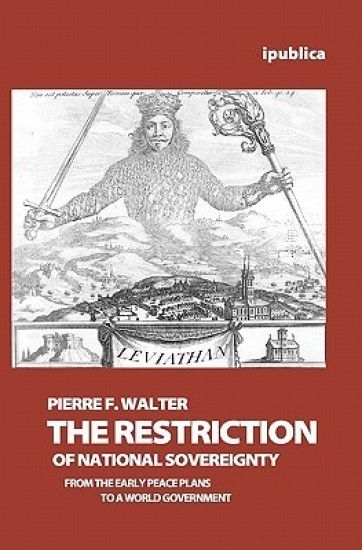
Many today seem to have forgotten that the original idea for building a united Europe was to establish an international political system suited to purport peace, stability and growth for all nation states, regardless of their military might, or their economic and political power. The projects discussed in this study were targeting at bringing about a new era of peace through the restriction of national sovereignty. The people who drafted these projects were no lesser than the greatest philosophers of Europe, among them Abb de Saint-Pierre, Jean-Jacques Rousseau, Immanuel Kant, Saint-Simon, and Count Coudenhove-Kalergi. The study shows that world peace is conditioned upon the restriction of national sovereignty, one of the most dangerous concepts of international law. It is an idea that goes back to the Renaissance and was drafted mainly under the pulpit of Jean Bodin and Niccol Machiavelli. No other concept in international relations has cost the lives of so many victims of war, wherever in the world. Besides, it is alien in today's international network culture and at a time where the relationship ruler-vassal has become one of government-citizen. When nations understand that in a networked international community, any war means auto-destruction by implication, the need for the restriction of sovereignty through the establishment of a supranational authority or world government becomes obvious.
THE IDIOT GUIDE TO SERVANT LEADERSHIP presents a novel approach to understanding and training leadership for top and middle management audiences. This guide is more than a book on teaching leadership to professional audiences in that it addresses the lay reader and shows how to raise leadership qualities in everyone's life. The author's approach is original in the sense that he has enriched and transformed the Western leadership paradigm through basic elements of Oriental wisdom, taken from Zen and the I Ching, thereby expanding the paradigm beyond the borders of the Western corporate culture, and adapting it for the corporate world in South-East Asia. The author claims that his leadership concept fits international culture better than a purely Western leadership concept, also because it meet the needs of an international lay audience that today increasingly consists of free-lancers from all around the world who are eager to build their own personal leadership style, thereby raising their chances of a professional career beyond their national borders. The 'Warrior of Peace' training contained in this guide is the author's original idea of which he wrote the first draft back in 1997; he further contends that since the Renaissance, the present guide is the first compendium of this kind, in that it offers a holistic approach to leadership and self-improvement. By the same token, the author claims his peak performance concept (Time and Peace) being an absolute novelty, going against all what is currently taught and trained in the coaching and championship industries, as it is based not upon principles developed in sport, but principles applied by sages, hierophants and Zen masters since times immemorial. The audience for this guide is both the corporate world, free-lancers from all over the world, and an interested lay public that has basic notions of what leadership does and what it is required for. The guide can be read by a young audience as well, and can safely be put in the hands of college students.
FRAN OISE DOLTO AND LANGUAGE is about one of the greatest psychoanalysts the world has known; she was one of the pioneers of child psychoanalysis. Pierre F. Walter interviewed Fran oise Dolto in 1986, after having visited "La Maison Verte" in Paris, a communication center she had created for parents and children, that mainly served to prepare children for greater lapses of time away from their parents and the early Kindergarten experience. The interview took place in Dolto's apartment at 260, rue Saint-Jacques, near the Panth on, Paris. The author reports that he discussed with Dr. Dolto his permissive educational approach and that the dialogue then expanded on Summerhill, R. D. Laing's work with psychotic children in England, compared to Dr. Dolto's own approach to healing child psychosis. Eventually, they discovered a similarity of opinions about the psychoanalytic theories of Alice Miller and Lloyd DeMause. The author relates that Fran oise Dolto was by and large critical regarding these authors' almost obsessive stress on 'child protection'. A correspondence followed up to the interview which was published, after Dr. Dolto's death, with the author's permission, by Gallimard Publishers, Paris. The author clarifies Fran oise Dolto's position with regard to Freud's theory of the Oedipus Complex and her very clear-cut views and expert opinions on child sexuality. The volume comes with all quotes in the book reviews translated to English by the author, who is bilingual German-French. The quotes collections, however, were intentionally left in their original French version.
THE IDIOT GUIDE TO CREATIVITY & CAREER is alternative in the sense that it doesn't offer quick fixes, but an approach to raise the awareness level of the whole of the person. The author contends that true selfhelp must encourage the reader to be critical in the first place, and develop their self-thinking abilities, which is one quality of several when designing a first-hand life and becoming truly responsible for our destiny. To be critical means to question tradition and authority, in the first place; it means to look for realizing our personal style and cognitive preferences. The guide addresses a young audience and all those who are, later in life, in need of career change and expansion. The main focus of the guide is upon developing and using creativity as a primary tool for personal growth and expansion, and further, the creative expansion of the whole self. The author's approach is holistic and spiritual in the sense that it considers the human being as a functional and organic organism that is primarily self-organizing and that is mainly driven by an inner program. We are directing our destinies through the inner programs we are writing, while most people do this unconsciously. From the moment we begin to take charge of our lives and begin living a first-hand life, we begin to consciously direct our destiny. We do this first of all by reprogramming ourselves in accordance with our best intentionality. There are few selfhelp guides that are deliberately holistic in their approach, that offer an encyclopedic approach to knowledge, which encompasses non-mainstream knowledge, that are beyond giving quick fixes and that are academic in the sense to be based on almost three decades of academic research. The value of this guide also consists in the fact that the author's own life path is an accidented one in the sense that he was misled early in life, driven into the wrong career, which was a considerable waste of time, more than two decades of a life lived with being around the wrong people, studying the wrong majors, suffering endless frustrations, and focusing on qualities and goals that were not his because they were not in alignment with his soul values and karmic challenges.Yet it was through this basic self-transformation the author went through that he might be able to lead others today in their search for realizing their true self and their real vocation, to become self-leaders and leading others positively and empathetically, and with a deep commitment to integrity, honesty and truthfulness in relationships.
FRITJOF CAPRA AND THE SYSTEMS VIEW OF LIFE is a passionate study about the great contemporary physicist and a review of six of his books. The author considers Fritjof Capra as one of the most important authors on new science and systems research. He found Capra's Tao of Physics in 1985, at a time when his life was in a complete reorientation. He compares the impact of the book on his psyche and his personal evolution with his discovery of the I Ching and Taoism, as well as the writings and psychoanalytic teaching of Fran oise Dolto. The author underlines Capra's unique gift of genius to formulate and explain complex scientific and philosophical insights and interrelations in a way that the educated reader can understand. He sees certain parallels in Capra's life with the lives of Albert Einstein and Wilhelm Reich who, like him, were from Germanic origin and after their emigration to the United States only wrote and published in English. The author especially lauds Capra's basically non-judgmental worldview and his ability to understand people from ultra-orthodox to very liberal with the same generosity and magnanimity. Another noteworthy instance from Capra's life is his long involvement in the counter culture and his meeting with most of the celebrities of that culture, as for example Timothy Leary, Stan Grof, Terence McKenna, Gregory Bateson, or Ronald David Laing and Thomas Szasz, the founders of the antipsychiatry movement. The author especially notes Capra's merit is to have introduced the systems view of life to scientific research, while he is not the originator of the idea, which was mainly developed by Ludwig von Bertalanffy, Ilya Prigogine, Humberto Maturana and Francisco Varela. But Capra has carefully surveyed and summarized this important research that is generally difficult to grasp to the non-scientific reader, and has rendered the important idea accessible for the interested lay audience.
THE IDIOT GUIDE TO INTUITION is a guide for developing intuition in everyone's life. The author shows in the three parts of the book, the awakening of true innocence, the recovery and healing of the inner child, and the eschatological experience of awakening to soul, how to develop deep intuition.It's almost like a mathematical formula that could be expressed as innocence plus a healthy creative inner child, plus spiritual opening equals intuition. In simpler terms it could be said that intuition is the result of an innocent mind in which the inner child functions without obstructions, in creative freedom, and embedded in an inner team where also the inner adult and the inner parent have their functional right of existence. Part One is a systematic guide to the how-to for creating innocence. This is being done not by learning something but on the contrary by unlearning much of conditioned knowledge that has to be cleared before true innocence can unfold. The author contends that the meaning of innocence is misconstrued and misunderstood in our culture, especially when it's applied to children, hence the need to apply true language for making a divide between sentimentality and truth. Part Two is a guide for recovering and healing our inner child, and inner child artwork, that is, spontaneous art and composition, and Part Three is a quite original text that shows how the reader can develop spirituality by a purely intuitive approach, thereby finding their own genuine approach to religion, as a personal quest. There is no need to be innocent, it's a choice but once people see the power of innocence, they may want to give it a try. Innocence is also a safety device, for nothing bad will ever happen to the truly innocent person. Innocence is the true power, it makes for excellent relationships with all beings, it makes for a modest, humble attitude, it makes thereby for a long life, and for good health.
THE IDIOT GUIDE TO SANITY presents an outline for a sane and holistic, consciousness-based education. The author's educational approach starts from what is, not from what should be, not from an ideal, thus, but from the actual constitution of the human being, with all the complexity inherent in it. He contends that children are born sane and are rendered more or less insane by an educational system that till now considers the human being as the impossible human, that is, a creature that is basically faulty and has to be improved and upgraded by education, and morality. The present view view opposes this patriarchal educational paradigm and shows that traditional education brings about fragmentation, ignorance and widespread violence. The author shows in this guide that a sane educational approach is functional, and not moralistic, and that it must overcome the neo-platonic dualism that is rooted in the death instinct, rather than in our libido. As the child is whole by nature, education does not really need to do anything for raising healthy humans. It should rather restrain from doing many things it usually does and that are counter-productive to raising children sanely. The sane educator is one who is able to maintain a healthy balance between emotions and intellect. He will be an observer rather than a manager, a witness rather than a judge, a friend rather than a parent replacement. He accompanies the child, as a guide, a tutor.The audience for this guide are all those involved in educating children, as well as educational policy makers, also parents, educational associations, politicians, pediatricians and child psychologists, and also the lay public, especially those who are looking for a new way to educate children now and in the future.
THE IDIOT GUIDE TO SCIENCE presents a historical and systemic outline of holistic science from its tender beginnings as heretical knowledge until today's more or less established holistic science paradigm as it emerges from the cutting edge of modern science.The author denotes Cartesian reductionist science as fake because it shuts out from its scientific understanding ten times more than it encompasses in its residual scientific perception of reality. In a time where science and religion converge, to paraphrase Vidette Todaro-Franceschi, it is important to behold for not only a young audience that what is achieved is not to be taken for granted, for it was paid with the price of untold human suffering. It is important to uphold this critical perspective in a time where countless interest groups all try to back their claims up by, often contradictory, scientific research. That is why the book just cites the crude facts of real science to survive in a basically non-scientific (and highly irrational) worldview where science and religion were largely opposing each other.The author assembled for more than twenty years the material around the research on the cosmic life energy or what today is called the zero-point field, expression used, for example, by Lynne McTaggart, the L-Field in the research of Harold Saxton Burr, the A-Field coined by Ervin Laszlo or the quantum vacuum, to speak in the terminology of William A. Tiller.The present book is however not a scientific treatise, but a selfhelp guide. What it attempts to do is to open the reader's critical mind or self-thinking capacity, which is of course an endeavor especially targeting younger people. From that starting point, the reader may then inquire by himself or herself, to get a more complete picture.