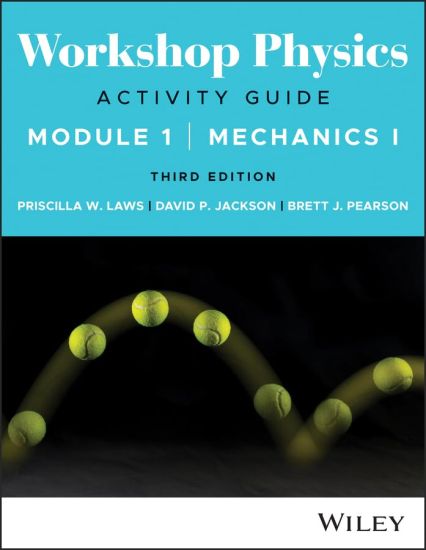
The Workshop Physics Activity Guide is a set of student workbooks designed to serve as the foundation for a two-semester calculus-based introductory physics course. It consists of four Modules, with a total of 28 units, that interweave text materials with activities that include prediction, qualitative observation, explanation, equation derivation, mathematical modeling, quantitative experiments, and problem solving. The modules help students understand the basis of knowledge in physics as interplay between observations, experiments, definitions, and mathematical theory. The inquiry-based activities in the modules give students the opportunity to work collaboratively to solve problems, while thinking critically to make predictions and observations. Students use a powerful set of computer tools to record, display, and analyze data, as well as to develop mathematical models of physical phenomena. The design of many of the activities is based on the outcomes of physics education research. Module 1 Unit 1 Our Place in the UniverseUnit 2 Measurement and UncertaintyUnit 3 Introduction to One-Dimensional MotionUnit 4 Motion with Constant AccelerationUnit 5 Force, Mass, and Motion in One DimensionUnit 6 Gravity and Projectile MotionUnit 7 Applications of Newton's Laws
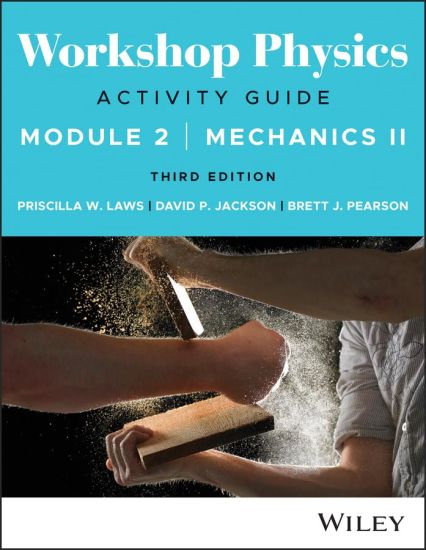
The Workshop Physics Activity Guide is a set of student workbooks designed to serve as the foundation for a two-semester calculus-based introductory physics course. It consists of four Modules, with a total of 28 units, that interweave text materials with activities that include prediction, qualitative observation, explanation, equation derivation, mathematical modeling, quantitative experiments, and problem solving. The modules help students understand the basis of knowledge in physics as interplay between observations, experiments, definitions, and mathematical theory. The inquiry-based activities in the modules give students the opportunity to work collaboratively to solve problems, while thinking critically to make predictions and observations. Students use a powerful set of computer tools to record, display, and analyze data, as well as to develop mathematical models of physical phenomena. The design of many of the activities is based on the outcomes of physics education research. Module 2 Unit 8 Momentum and Collisions in One DimensionUnit 9 Momentum and Collisions in Two DimensionsUnit 10 Work and EnergyUnit 11 Energy ConservationUnit 12 Rotational MotionUnit 13 Rotational Momentum and its Relation to TorqueUnit 14 Simple Harmonic MotionUnit 15 Oscillations, Determinism, and Chaos
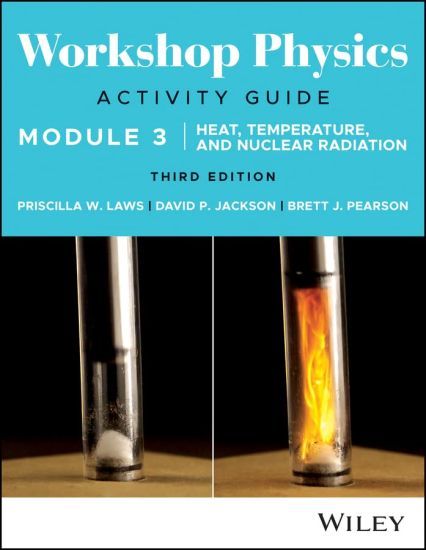
The Workshop Physics Activity Guide is a set of student workbooks designed to serve as the foundation for a two-semester calculus-based introductory physics course. It consists of four Modules, with a total of 28 units, that interweave text materials with activities that include prediction, qualitative observation, explanation, equation derivation, mathematical modeling, quantitative experiments, and problem solving. The modules help students understand the basis of knowledge in physics as interplay between observations, experiments, definitions, and mathematical theory. The inquiry-based activities in the modules give students the opportunity to work collaboratively to solve problems, while thinking critically to make predictions and observations. Students use a powerful set of computer tools to record, display, and analyze data, as well as to develop mathematical models of physical phenomena. The design of many of the activities is based on the outcomes of physics education research. Module 3 Unit 16 Heat and TemperatureUnit 17 Principles of ThermodynamicsUnit 18 Thermodynamics Processes and Heat EnginesUnit 28 Radioactivity and Radon
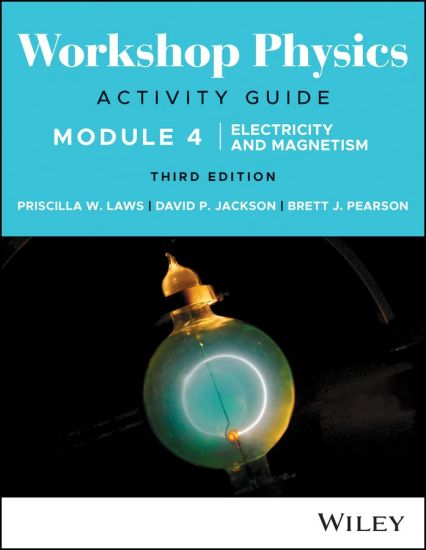
The Workshop Physics Activity Guide is a set of student workbooks designed to serve as the foundation for a two-semester calculus-based introductory physics course. It consists of four Modules, with a total of 28 units, that interweave text materials with activities that include prediction, qualitative observation, explanation, equation derivation, mathematical modeling, quantitative experiments, and problem solving. The modules help students understand the basis of knowledge in physics as interplay between observations, experiments, definitions, and mathematical theory. The inquiry-based activities in the modules give students the opportunity to work collaboratively to solve problems, while thinking critically to make predictions and observations. Students use a powerful set of computer tools to record, display, and analyze data, as well as to develop mathematical models of physical phenomena. The design of many of the activities is based on the outcomes of physics education research. Module 4 Unit 19 Electric Forces and FieldsUnit 20 Electric Flux and Gauss' LawUnit 21 Electric PotentialUnit 22 Introduction to Electric CircuitsUnit 23 Circuit AnalysisUnit 24 Capacitors and RC CircuitsUnit 25 ElectronicsUnit 26 Magnets and Magnetic FieldsUnit 27 Electricity and Magnetism
RealTime Physics is a series of introductory laboratory modules that use computer data acquisition tools (microcomputer-based lab or MBL tools) to help students develop important physics concepts while acquiring vital laboratory skills. Besides data acquisition, computers are used for basic mathematical modeling, data analysis, and simulations. There are 4 RealTime Physics modules: Module 1: Mechanics, Module 2: Heat and Thermodynamics, Module 3: Electricity and Magnetism, and Module 4: Light and Optics.
RealTime Physics is a series of introductory laboratory modules that use computer data acquisition tools (microcomputer-based lab or MBL tools) to help students develop important physics concepts while acquiring vital laboratory skills. Besides data acquisition, computers are used for basic mathematical modeling, data analysis, and simulations. There are 4 RealTime Physics modules: Module 1: Mechanics, Module 2: Heat and Thermodynamics, Module 3: Electricity and Magnetism, and Module 4: Light and Optics.
The authors of RealTime Physics Active Learning Laboratories, Module 1: Mechanics, 3rd Edition - David Sokoloff, Priscilla Laws, and Ron Thornton - have been pioneers in the revolution of the physics industry. In this edition, they provide a set of labs that utilize modern lab technology to provide hands-on information, as well as an empirical look at several new key concepts. They focus on the teaching/learning issues in the lecture portion of the course, as well as logistical lab issues such as space, class size, staffing, and equipment maintenance. Issues similar to those in the lecture have to with preparation and willingness to study.