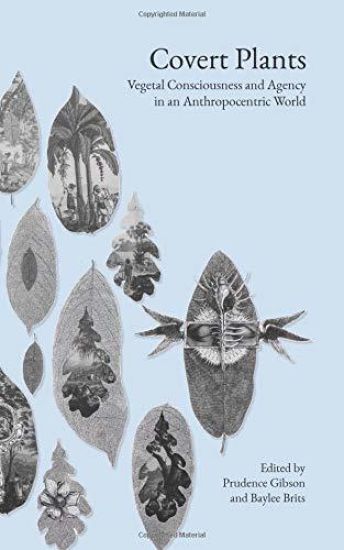
Covert Plants contributes to newly emerging discourses on the implications of vegetal life for the arts and culture. This stretches to changes in our perception of 'nature' and to the adapting roles of botany, evolutionary ecology, and environmental aesthetics in the humanities. Its editors and contributors seek various expressions of vegetal life rather than the mere representation of such, and they proceed from the conviction that a rigorous approach to thinking with and through vegetal life must be interdisciplinary. At a time when urgent calls for restorative care and reparative action have been sounded for the environment, this essay volume presents a range of academic and creative perspectives, from evolutionary biology to literary theory, philosophy to poetry, which respond to the perplexing problems and paradoxes of vegetal thinking.Representations of vegetal life often include plant analogies and plant imagery. These representations have at times obscured the diversity of plant behavior and experience. Covert Plants probes the implications of vegetal life for thought and how new plant science is changing our perception of the vegetal - around us and in us. How can we think, speak, and write about plant life without falling into human-nature dyads, or without tumbling into reductive theoretical notions about the always complex relations between cognition and action, identity and value, subject and object?A full view of this shifting perspective requires a 'stereoscopic' lens through which to view plants, but also simultaneously to alter our human-centered viewpoint. Plants are no longer the passive object of contemplation, but are increasingly resembling 'subjects, ' 'stakeholders, ' or 'actors.' As such, the plant now makes unprecedented demands upon the nature of contemplation itself. Moreover, the aesthetic, political, and legal implications of new knowledge regarding plants' ability to communicate, sense, and learn require intensive, cross-disciplinary investigation. By doing this, we can intervene into current attitudes to climate change and sustainability, and hopefully revise, for the better, human philosophies, ethics, and aesthetics that touch upon plant life.TABLE OF CONTENTS// Baylee Brits and Prudence Gibson, "Introduction: Covert Plants" - Prudence Gibson and Michael Marder, "Art Expresses Its Own Appearance: A Conversation with Michael Marder" - Prudence Gibson, "The Colour Green" - Baylee Brits, "Brain Trees: Neuroscientific Metaphor and Botanical Thought" - Dalia Nassar, "Metaphoric Plants: Goethe's Metamorphosis of Plants and the Metaphors of Reason" - Stephen Muecke, "Mixed up with Trees: The Gadgur and the Dreaming" - Monica Gagliano, "Eco-psychology and the Return to the Dream of Nature" - Suzanne Anker, "The Blue Rose" - Susie Pratt, "Trees as Landlords and Other Public Experiments: An Interview with Natalie Jeremijenko" - Tessa Laird, "Spores from Space: Becoming the Alien" - Jennifer Mae Hamilton, "Gardening After the Anthropocene: Creating Different Relations between Humans and Edible Plants in Sydney" - Lucas Ihlein, "Agricultural Inventiveness: Beyond Environmental Management?" - Andrew Belletty, "An Ear to the Ground" - Ben Woodard, "Continuous Green Abstraction: Embodied Knowledge, Intuition, and Metaphor" - Lisa Dowdall, "Figures" - Poems by Luke Fischer, Justin Clemens, Paul Dawson, and Tamryn Bennett.