Kirjojen hintavertailu. Mukana 12 016 292 kirjaa ja 12 kauppaa.

Kirjahaku

Etsi kirjoja tekijän nimen, kirjan nimen tai ISBN:n perusteella.

9 kirjaa tekijältä R Saravanan

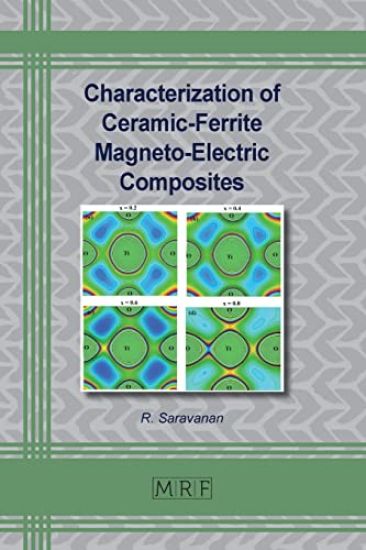
Characterization of Ceramic-Ferrite Magneto-Electric Composites
Magneto-electric ceramic composites are important materials for designing new microwave sensors (e.g. field probes) and devices such as filters, attenuators, capacitive resonators, gyrators and devices for medical applications. The book presents new research results for the following composite systems: (1-x) BaTiO3 + x NiFe2O4 II (1-x); BaTiO3 + x ZnFe2O4; (1-x) BaTiO3 + x CoFe2O4 and (1-x) BaTiO3 + x MgFe2O4.Keywords: Magneto-Electric Composites, Powder X-ray diffraction (PXRD), Scanning Electron Microscopy (SEM), Energy Dispersive X-ray Spectroscopy (EDS), UV-Visible Spectrophotometry (UV-Vis), Electrical (Dielectric and P-E) Characterization, Magnetic Characterization (M-H), Structural Parameters, Morphological Studies, Elementary Analysis, Optical Studies, Electrical Studies, Magnetic Studies, Charge Density Analysis.
Transition Metal Doped Spintronics Materials

Transition Metal Doped Spintronics Materials

R Saravanan

Materials Research Forum LLC
2023
pokkari
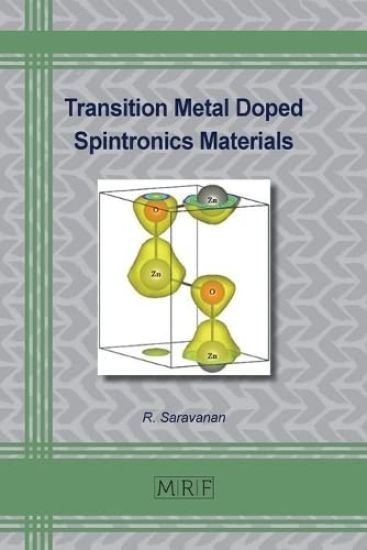
The book presents new research on the synthesis and characterization of various oxide based dilute magnetic spintronics materials (ODMS). The characterization techniques included powder X-ray diffraction, scanning electron microscopy, vibrating sample magnetometry and UV visible spectrometry. The morphological, magnetic and optical properties are reported. Electron density distribution studies are presented in the form of three, two and one dimensional electron density maps.Keywords: Spintronics Materials, Zn1-xTixO, Zn1-xFexO, Zn1-xVxO, Zn1-xNix/2Vx/2O, Synthesis, X-ray Diffraction. Rietveld Analysis, Surface Morphological Properties, Optical Properties, Magnetic Properties, Charge Density Analysis, Electron Density Distribution.
Multiferroic Materials

Multiferroic Materials

R Saravanan

Materials Research Forum LLC
2023
pokkari
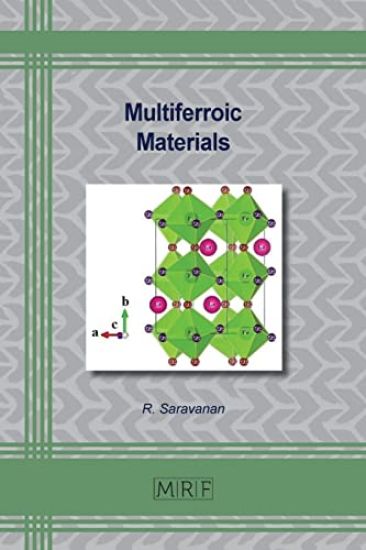
The magnetoelectric properties of multiferroic materials have a high potential for applications in the fields of data storage, spin valves, spintronics, memories, sensors and microelectronic devices. The book presents both a detailed literature review of the field, and the experimental results obtained from various characterization and analytical techniques performed on four series of lanthanum orthoferrite type multiferroics. These materials have been used in solid oxide fuel cells (SOFC), magneto-hydrodynamic power generation (MHD), capacitors and energy storage devices in microelectronics, non-volatile magnetic memory devices and ferroelectric random access memories (Fe-RAM).Keywords: Multiferroics, Lanthanum Orthoferrites, Ferromagnetism, Ferroelectricity, Electrical Conductivity, Thermal Stability, Dielectric Constant, Solid Oxide Fuel Cell (SOFC), Magneto-Hydrodynamic Power Generation (MHD), Capacitors, Energy Storage Devices, Magnetic Memory Devices, Ferroelectric Random Access Memories (Fe-RAM), Charge Density Measurements.
Solid Oxide Fuel Cell (SOFC) Materials

Solid Oxide Fuel Cell (SOFC) Materials

R Saravanan

Materials Research Forum LLC
2018
pokkari
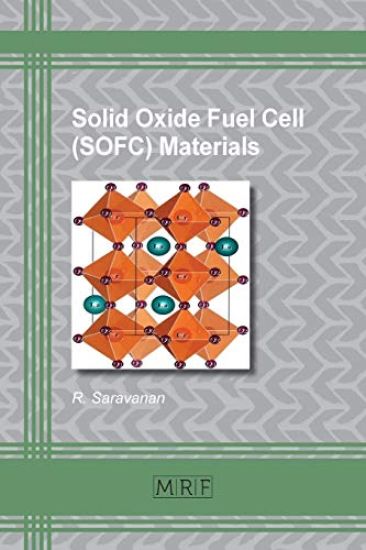
Developing materials for SOFC applications is one of the key topics in energy research. The book focuses on manganite structured materials, such as doped lanthanum chromites and lanthanum manganites, which have interesting properties: thermal and chemical stability, mixed ionic and electrical conductivity, electrocatalytic activity, magnetocaloric property and colossal magnetoresistance (CMR). These materials have applications in solid oxide fuel cells, high temperature NOx sensors, hard disk read heads, magnetic sensors and magnetoresistive random access memories. For the first time, the charge density distributions have been studied in these materials as synthesized by high temperature solid state reaction. Charge density analysis is helpful in understanding the physical and chemical properties of materials and in developing optimized structures. The morphological, elemental, optical and magnetic properties of the materials have also been studied.
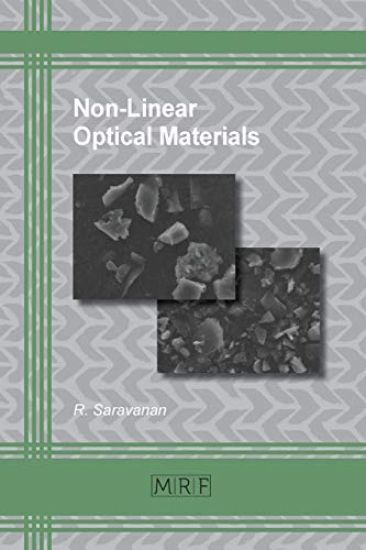
Non-Linear Optical Materials

Non-Linear Optical Materials

R Saravanan

Materials Research Forum LLC
2018
pokkari
Chapter I provides an introduction to linear optics and the physical origin of non-linear optical phenomena. The principle characterization techniques for analyzing the microstructural, optical and morphological properties of non-linear optical materials are discussed: Powder X-ray diffraction (PXRD), UV-Visible spectroscopy, scanning electron microscopy (SEM), and energy dispersive X-ray spectroscopy (EDS). Also presented are methods for the structural refinement of these materials, as well as the analysis of electron density distribution by means of novel techniques and the corresponding computational procedures. Chapter II describes sample preparation and PXRD analysis of a number of non-linear optical materials, such as PbMoO4, LiNbO3, Ce: Gd3Ga5O12, CaCO3, Yb: CaF2, and Al2O3, Cr: Al2O3, V: Al2O3. Chapter III deals with the optical properties and micro-structural characterization of non-linear optical materials, such as PbMoO4, LiNbO3, Ce: Gd3Ga5O12, CaCO3, Yb: CaF2, and Al2O3, Cr: Al2O3, V: Al2O3. The band gap, crystallite size and particle size of these materials are determined by means of UV-visible spectroscopy, powder X-ray profile analysis and scanning electron microscopy. Also discussed is the elemental compositional analysis for PbMoO4, LiNbO3, Ce: Gd3Ga5O12, CaCO3, Yb: CaF2, and Al2O3, Cr: Al2O3, V: Al2O3. Chapter IV focusses on the electron density distribution analysis of non-linear optical materials, such as PbMoO4, LiNbO3, Ce: Gd3Ga5O12, CaCO3, Yb: CaF2, and Al2O3, Cr: Al2O3, V: Al2O3. The results are presented in the form of electron density maps and profiles. The bonding behavior of these materials is studied using both quantitative and qualitative analysis. Chapter V centers on the inter-atomic ordering in non-linear optical materials, and presents computations of the pair distribution function (atomic correlation function) for selected materials.
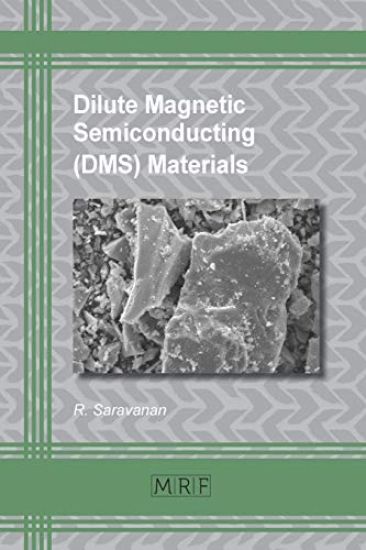
Dilute Magnetic Semiconducting (DMS) Materials

Dilute Magnetic Semiconducting (DMS) Materials

R Saravanan

Materials Research Forum LLC
2018
pokkari
Diluted Magnetic Semiconductors (DMS) play a vital role in modern electronics industry. It is important to understand the fundamental properties of these materials in order to apply them to their full potential. This book presents an analysis of the charge density distribution and other properties of some silicon and germanium based diluted magnetic semiconductors. A quantitative analysis of the charge density distribution has been done in order to obtain measurements of the charges involved in the bonding, which are decisive for the physical and chemical properties of the DMS materials. Also, the local structures of the materials have been analyzed by studying their powder X-ray diffraction intensities. Analysis of the magnetic properties of the DMS materials is mandatory and has been accomplished by magnetic measurements carried out using a vibrating sample magnetometer. The morphology of the DMS materials has been studied using scanning electron micrographs.
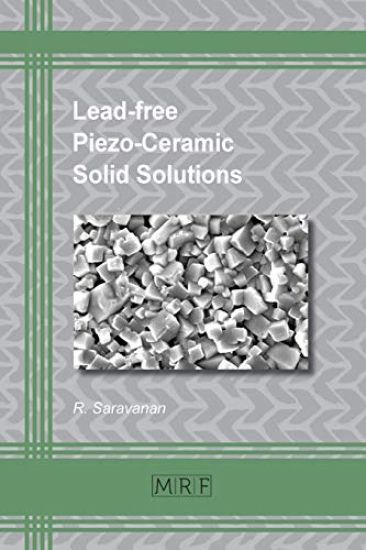
Lead-free Piezo-Ceramic Solid Solutions

Lead-free Piezo-Ceramic Solid Solutions

R Saravanan

Materials Research Forum LLC
2018
pokkari
Discover in this book the results of a systematic investigation of the dielectric, ferroelectric and piezoelectric properties of promising lead-free solid solution ceramics. Lead-based perovskite ceramics are most important for piezoelectric and ferroelectric devices, but the toxicity of lead has raised serious environmental issues. This is why much research presently is concerned with the development of efficient lead-free systems. Lead-free ceramics with the most promising piezoelectric properties are based on barium titanate, modified sodium potassium niobate, sodium bismuth titanate, etc. The present book presents the results of a systematic investigation of the dielectric, ferroelectric and piezoelectric properties of this type of lead-free solid solution ceramics as obtained by way of powder X-ray diffraction, scanning electron microscopy, energy dispersive X-ray spectroscopy, UV-visible spectroscopy, dielectric, ferroelectric and piezoelectric measurements. Also determined was the electron density distribution of five series of lead-free barium titanate piezoelectric ceramics using experimental X-ray diffraction data.