Kirjojen hintavertailu. Mukana 12 016 292 kirjaa ja 12 kauppaa.

Kirjahaku

Etsi kirjoja tekijän nimen, kirjan nimen tai ISBN:n perusteella.

7 kirjaa tekijältä Rafe Blaufarb

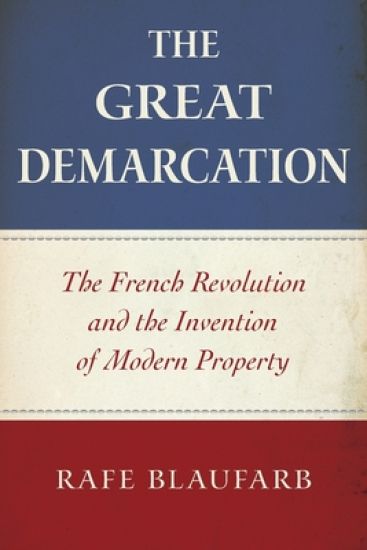
The Great Demarcation

The Great Demarcation

Rafe Blaufarb

Oxford University Press Inc
2019
nidottu
What does it mean to own something? What sorts of things can be owned, and what cannot? How does one relinquish ownership? What are the boundaries between private and public property? Over the course of a decade, the French Revolution grappled with these questions. Punctuated by false starts, contingencies, and unexpected results, this process laid the foundations of the Napoleonic Code and modern notions of property. As Rafe Blaufarb demonstrates in this ambitious work, the French Revolution remade the system of property-holding that had existed in France before 1789. The revolutionary changes aimed at two fundamental goals: the removal of formal public power from the sphere of property and the excision of property from the realm of sovereignty. The revolutionaries accomplished these two aims by abolishing privately-owned forms of power, such as jurisdictional lordship and venal public office, and by dismantling the Crown domain, thus making the state purely sovereign. This brought about a Great Demarcation: a radical distinction between property and power from which flowed the critical distinctions between the political and the social, state and society, sovereignty and ownership, the public and private. It destroyed the conceptual basis of the Old Regime, laid the foundation of France's new constitutional order, and crystallized modern ways of thinking about polities and societies. By tracing how the French Revolution created a new legal and institutional reality, The Great Demarcation shows how the revolutionary transformation of Old Regime property helped inaugurate political modernity

The Great Demarcation

The Great Demarcation

Rafe Blaufarb

Oxford University Press Inc
2016
sidottu
The Great Demarcation explores how the French Revolution transformed the system of property-holding that had existed in France before 1789, thus creating the framework for modern definitions of property and political forms. This book examines the Revolution not from an economic or social perspective, but through the lens of the laws and institutions of property. The Revolution's dramatic legal restructuring aimed at two fundamental goals: removing formal public power from the sphere of private property, and excising property rights from the realm of the new sovereign, the nation. The revolutionaries accomplished these two aims by abolishing privately-owned forms of public power--such as jurisdictional lordship and venal public office--and by dismantling the Crown domain to construct a purely sovereign State. These efforts brought about a Great Demarcation: a radical distinction between property and power from which flowed critical distinctions between the political and the social, state and society, sovereignty and ownership, the public and private. These distinctions destroyed the conceptual basis of the Old Regime, laid the foundation of France's new constitutional order, and crystallized modern ways of thinking about polities and societies. This, Blaufarb claims, was the Revolution's fundamental act, the stake in the Old Regime's heart, and the basis of all of its other reforms. Tracing how the French Revolution sought to remake the country's legal and institutional reality, The Great Demarcation shows how the revolutionary transformation of Old Regime property helped to inaugurate political modernity.
The Revolutionary Atlantic

The Revolutionary Atlantic

Rafe Blaufarb

Oxford University Press Inc
2017
nidottu
This is a sourcebook on the "revolutionary Atlantic," a term historians increasingly use to describe the way the many revolutions from 1776 (USA) to 1826 (end of the wars of independence in Latin America) can be viewed as part of a connected whole. It is the first text to examine the American Revolution, the French Revolution, the Haitian Revolution, and the various Latin American Revolutions from a synoptic perspective.
Napolean Symbol for an Age

Napolean Symbol for an Age

Rafe Blaufarb

St Martin's Press
2007
nidottu
By calming revolutionary turbulence while preserving fundamental gains of 1789, Napoleon Bonaparte laid the foundations of modern France. But his impact reached beyond France's borders as well. His legacy of war, civil rights, exploitation, and national awakening reshaped identities across the European continent, while in the Atlantic world he destroyed the colonial order and helped plant the seeds of American power. In this collection of wide-ranging primary sources -- including confidential memoranda and correspondence, speeches, memoirs, letters, police reports, and songs, most of which appear in English translation for the first time -- Rafe Blaufarb situates Napoleon within his time while opening a broad perspective on the nature and impact of Napoleonic rule. His introduction provides a narrative of Napoleon's rise and fall and frames the key issues of Napoleon's life and times. Useful pedagogical tools include maps, illustrations, a chronology, questions for consideration, and a selected bibliography.
The Politics of Fiscal Privilege in Provence, 1530s-1830s

The Politics of Fiscal Privilege in Provence, 1530s-1830s

Rafe Blaufarb

The Catholic University of America Press
2012
sidottu
Rafe Blaufarb examines the interwoven problems of taxation and social privilege in this treatment of the contention over fiscal privilege between the seigneurial nobility and the taxpayers of Provence. From the 1530s until the French Revolution and beyond, a series of deceptively simple questions divided privileged from non-privileged elite's in the province: what made land noble and, hence, tax exempt; how could land acquire or lose noble status? Aired in tribunals ranging from local village courts to the royal council in Versailles, these questions fuelled a long-running dispute that shaped the political life of early modern Provence, planted the seeds of revolutionary social conflict, and influenced provincial politics into the nineteenth century. This book sheds new light on two major fields of scholarly enquiry— early modern state-formation and revolutionary origins—and suggests a new explanation for the rise and fall of French absolutism. By fostering conflict between different kinds of local elite's, taxation not only undermined provincial cohesion and invited the intervention of royal authority but also helped to generate the salient social antagonisms of 1789. Although the book treats only a single province, its long-term chronology and broad source base ranging from village archives to the records of the central state provide a more holistic view of early modern French history than shorter-term, Paris-centred studies.
The French Army 1750–1820

The French Army 1750–1820

Rafe Blaufarb

Manchester University Press
2017
nidottu
This book examines the transformation of the French military profession during the momentous period that saw the death of royal absolutism, the rise and fall of successive revolutionary regimes, the consolidation of Napoleonic rule and the restoration of the Bourbon monarchy after the Empire’s final collapse. Crossing traditional chronological boundaries, it brings together periods in French history that are usually treated separately and challenges established views of change and continuity during the Age of Revolution. Based on a wealth of archival sources, this book is as much a social history of ideas like equality, talent, and merit as a military history.