Kirjojen hintavertailu. Mukana 12 016 292 kirjaa ja 12 kauppaa.

Kirjahaku

Etsi kirjoja tekijän nimen, kirjan nimen tai ISBN:n perusteella.

2 kirjaa tekijältä Randall J. LeVeque

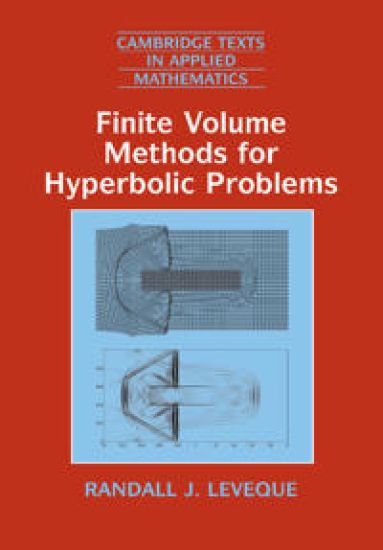
Finite Volume Methods for Hyperbolic Problems

Finite Volume Methods for Hyperbolic Problems

Randall J. LeVeque

Cambridge University Press
2002
pokkari
This book contains an introduction to hyperbolic partial differential equations and a powerful class of numerical methods for approximating their solution, including both linear problems and nonlinear conservation laws. These equations describe a wide range of wave propagation and transport phenomena arising in nearly every scientific and engineering discipline. Several applications are described in a self-contained manner, along with much of the mathematical theory of hyperbolic problems. High-resolution versions of Godunov's method are developed, in which Riemann problems are solved to determine the local wave structure and limiters are then applied to eliminate numerical oscillations. These methods were originally designed to capture shock waves accurately, but are also useful tools for studying linear wave-propagation problems, particularly in heterogenous material. The methods studied are implemented in the CLAWPACK software package and source code for all the examples presented can be found on the web, along with animations of many of the simulations. This provides an excellent learning environment for understanding wave propagation phenomena and finite volume methods.
Numerical Methods for Conservation Laws

Numerical Methods for Conservation Laws

Randall J. LeVeque

Birkhauser Verlag AG
1992
nidottu
These notes developed from a course on the numerical solution of conservation laws first taught at the University of Washington in the fall of 1988 and then at ETH during the following spring. The overall emphasis is on studying the mathematical tools that are essential in de­ veloping, analyzing, and successfully using numerical methods for nonlinear systems of conservation laws, particularly for problems involving shock waves. A reasonable un­ derstanding of the mathematical structure of these equations and their solutions is first required, and Part I of these notes deals with this theory. Part II deals more directly with numerical methods, again with the emphasis on general tools that are of broad use. I have stressed the underlying ideas used in various classes of methods rather than present­ ing the most sophisticated methods in great detail. My aim was to provide a sufficient background that students could then approach the current research literature with the necessary tools and understanding. Without the wonders of TeX and LaTeX, these notes would never have been put together. The professional-looking results perhaps obscure the fact that these are indeed lecture notes. Some sections have been reworked several times by now, but others are still preliminary. I can only hope that the errors are. not too blatant. Moreover, the breadth and depth of coverage was limited by the length of these courses, and some parts are rather sketchy.