Kirjojen hintavertailu. Mukana 11 627 220 kirjaa ja 12 kauppaa.

Kirjahaku

Etsi kirjoja tekijän nimen, kirjan nimen tai ISBN:n perusteella.

3 kirjaa tekijältä Randall Ott

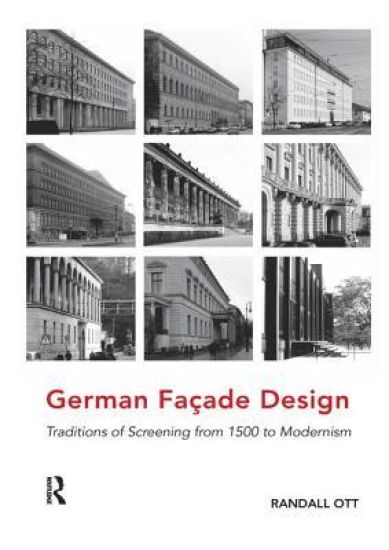
German Façade Design

German Façade Design

Randall Ott

Routledge
2017
nidottu
German architecture prior to the modern period has received less systemic, analytical study than that of Italy, France, and Britain. Scholarly discussion of broad traditions or continuities within Germanic or Central European façade design is even sparser. Baroque era studies of the region mostly devote themselves to isolated architects, monuments, or movements. Modernism's advent decisively changed this: Germanic architecture enjoyed sudden ascendancy. Yet, even so, study specifically of that region's façades still lagged – nothing compares to the dozens of treatments of Le Corbusier's façade systems, for example, and how these juxtapose with French neoclassical or Italian Renaissance methods. Given the paucity of multi-period studies, one can be forgiven for believing Germany's effervescence of radical, modern works seems unprecedented. This book takes up these multiple quandaries. It identifies and documents a previously unrecognized compositional tradition - characterized here as the 'screen façade' – and posits it as a counter-narrative critiquing the essentialist, 'authentic' canon currently dominant in Western architectural history. By crossing evenly over the dividing line between the historical and modern periods, it offers valuable insights on indigenous roots underlying some aspects of Germany's invigorating early twentieth-century architectural developments. The book chronologically examines 400 years of closely related facades, concentrated in Germany but also found in Austria, the Czech Republic, German-speaking Switzerland, and nearby areas of Central Europe. While nearly 75 buildings are mentioned and illustrated, a dozen are given extensive analysis and the book focuses on the works of three architects – Schinkel, Behrens and Mies. Relationships between examples of these three architects' façades far transcend mere homage amongst masters. Glimmers of the system they eventually codify are apparent as early as at Heidelberg Castle in 1559 and Nürnberg's Rathaus in 1622. The book argues that in Germany, northern Gothic affinities for bisection, intense repetition and rote aggregation intersected with southern Classical affinities for symmetry, hierarchy and centrality, thereby spawning a unique hybrid product – the screen. Instead of graphic formality, this study is guided by on-site perceptions, propositional contrasts, means of approach, interpretive conflicts and emotion and it relates the design of these façades to concepts proposed by contemporary philosophers including Novalis, Hegel, Nietzsche, Freud, Adorno, and, most importantly, Gadamer on hermeneutics.
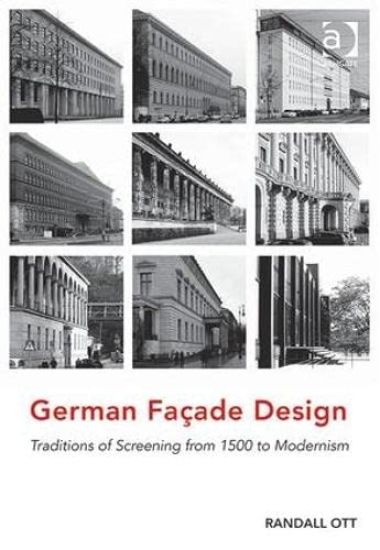
German Façade Design

German Façade Design

Randall Ott

Routledge
2016
sidottu
German architecture prior to the modern period has received less systemic, analytical study than that of Italy, France, and Britain. Scholarly discussion of broad traditions or continuities within Germanic or Central European façade design is even sparser. Baroque era studies of the region mostly devote themselves to isolated architects, monuments, or movements. Modernism's advent decisively changed this: Germanic architecture enjoyed sudden ascendancy. Yet, even so, study specifically of that region's façades still lagged – nothing compares to the dozens of treatments of Le Corbusier's façade systems, for example, and how these juxtapose with French neoclassical or Italian Renaissance methods. Given the paucity of multi-period studies, one can be forgiven for believing Germany's effervescence of radical, modern works seems unprecedented. This book takes up these multiple quandaries. It identifies and documents a previously unrecognized compositional tradition - characterized here as the 'screen façade' – and posits it as a counter-narrative critiquing the essentialist, 'authentic' canon currently dominant in Western architectural history. By crossing evenly over the dividing line between the historical and modern periods, it offers valuable insights on indigenous roots underlying some aspects of Germany's invigorating early twentieth-century architectural developments. The book chronologically examines 400 years of closely related facades, concentrated in Germany but also found in Austria, the Czech Republic, German-speaking Switzerland, and nearby areas of Central Europe. While nearly 75 buildings are mentioned and illustrated, a dozen are given extensive analysis and the book focuses on the works of three architects – Schinkel, Behrens and Mies. Relationships between examples of these three architects' façades far transcend mere homage amongst masters. Glimmers of the system they eventually codify are apparent as early as at Heidelberg Castle in 1559 and Nürnberg's Rathaus in 1622. The book argues that in Germany, northern Gothic affinities for bisection, intense repetition and rote aggregation intersected with southern Classical affinities for symmetry, hierarchy and centrality, thereby spawning a unique hybrid product – the screen. Instead of graphic formality, this study is guided by on-site perceptions, propositional contrasts, means of approach, interpretive conflicts and emotion and it relates the design of these façades to concepts proposed by contemporary philosophers including Novalis, Hegel, Nietzsche, Freud, Adorno, and, most importantly, Gadamer on hermeneutics.
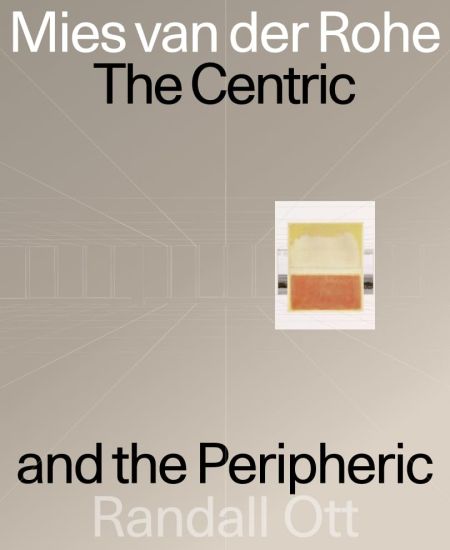
Mies van der Rohe

Mies van der Rohe

Randall Ott

Oro Editions
2025
sidottu
This volume presents anew the influential 20th-century architect Ludwig Mies van der Rohe, whose reputation has unfairly languished. Critics often see him as a chameleon who turned against the vibrant aesthetic culture of Berlin upon emigrating to Chicago and created instead the spare, tectonically obsessed, blank box stylism that looms over so many American downtowns. That prevailing interpretation ignores the aesthetic and conceptual coherence within his oeuvre. Mies often spoke vaguely of a “great form” emerging within modernity. He spent his career seeking to express this condition in the spaces he designed. Through close analysis of over sixty of his buildings and projects, this study reveals that underlying essence. A formal dialectic of center/periphery threads throughout his production, which gives nascent form to the profound societal tensions he sensed. A peculiar interleafing of the centric and the peripheric dominates his shaping of space. Rarely is Mies considered formally. Using nearly a hundred new analytical diagrams, this book unlocks fresh interrelations between his compositions and between his career’s phases. Unexpected parallels are struck with nineteenth-century Romantic artists like Caspar David Friedrich and with modernists like Piet Mondrian and Mark Rothko. The strands within Mies’s deep readings on philosophy are expanded by comparing him with regional thinkers. The outlines of the “great form” Mies sensed become clearer. A new and integral Mies emerges, far different from previous interpretations and with enhanced relevance for our contemporary condition.