Kirjojen hintavertailu. Mukana 11 617 060 kirjaa ja 12 kauppaa.

Kirjahaku

Etsi kirjoja tekijän nimen, kirjan nimen tai ISBN:n perusteella.

4 kirjaa tekijältä Randolph C. Head

Early Modern Democracy in the Grisons

Early Modern Democracy in the Grisons

Randolph C. Head

Cambridge University Press
2002
pokkari
The Freestate of the Three Leagues in the Grisons, a rural confederation in the Swiss Alps, was one of the most unusual political entities in early modern Europe. In the sixteenth century, its inhabitants enjoyed popular sovereignty and remarkable local autonomy, and many of them insisted on political equality among citizens, and on political leaders’ responsibilities to their communities. The author uses pamphlets and political documents to trace the Freestate’s evolution, focusing on its institutional structure and on the political language used by its inhabitants. This language included radical statements about ‘democracy’ and rule by the ‘common man’. Even so, the Freestate participated in contemporary European political developments; but because it was different, it provides new perspectives on political ideas in sixteenth-century Europe. It represents a political culture distinct from both absolutism and later liberal ideas.
Making Archives in Early Modern Europe

Making Archives in Early Modern Europe

Randolph C. Head

Cambridge University Press
2020
pokkari
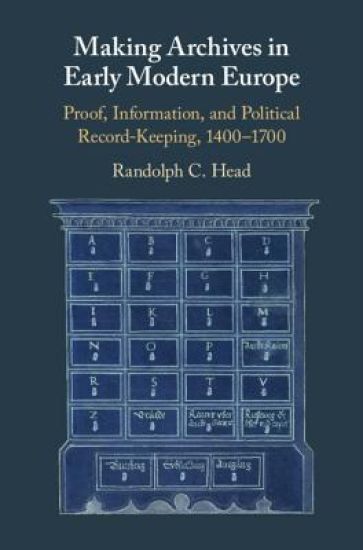
European states were overwhelmed with information around 1500. Their agents sought to organize their overflowing archives to provide trustworthy evidence and comprehensive knowledge that was useful in the everyday exercise of power. This detailed comparative study explores cases from Lisbon to Vienna to Berlin in order to understand how changing information technologies and ambitious programs of state-building challenged record-keepers to find new ways to organize and access the information in their archives. From the intriguing details of how clerks invented new ways to index and catalog the expanding world to the evolution of new perspectives on knowledge and power among philologists and historians, this book provides illuminating vignettes and revealing comparisons about a core technology of governance in early modern Europe. Enhanced by perspectives from the history of knowledge and from archival science, this wide-ranging study explores the potential and the limitations of knowledge management as media technologies evolved.
Making Archives in Early Modern Europe

Making Archives in Early Modern Europe

Randolph C. Head

Cambridge University Press
2019
sidottu
European states were overwhelmed with information around 1500. Their agents sought to organize their overflowing archives to provide trustworthy evidence and comprehensive knowledge that was useful in the everyday exercise of power. This detailed comparative study explores cases from Lisbon to Vienna to Berlin in order to understand how changing information technologies and ambitious programs of state-building challenged record-keepers to find new ways to organize and access the information in their archives. From the intriguing details of how clerks invented new ways to index and catalog the expanding world to the evolution of new perspectives on knowledge and power among philologists and historians, this book provides illuminating vignettes and revealing comparisons about a core technology of governance in early modern Europe. Enhanced by perspectives from the history of knowledge and from archival science, this wide-ranging study explores the potential and the limitations of knowledge management as media technologies evolved.
Jenatsch's Axe

Jenatsch's Axe

Randolph C. Head

University of Rochester Press
2016
pokkari
A richly documented investigation of a well-known figure in Swiss history who crossed diverse social and cultural boundaries in pre-modern Europe. During the turbulent events of Europe's Thirty Years' War, both ruthlessness and adaptability were crucial ingredients for success. In this engaging volume, Randolph C. Head traces the career of an extraordinarily adaptable and ruthless figure, George Jenatsch (1596-1639). Born a Protestant pastor's son, Jenatsch's career took him from the clergy to the military to the nobility. A passionate Calvinist in his youth, he converted to Catholicism and prudenceas his power grew. A native speaker of the Romansh language, he crossed the boundaries of language and local loyalty in his service to France, Venice, and his own people. Violence marked every turning point of his life. After fleeing the "Holy Massacre" of Protestants in the Valtellina in 1620, Jenatsch helped assassinate the powerful George Jenatsch in 1621, using an axe. He killed his commanding officer in a duel in 1629, and his own life ended in a tavern in 1639 when he was murdered -- with an axe -- by a man dressed as a bear. After his death, myth took over. Rumors spread that Jenatsch was killed by the same axe that he had wielded on von Planta -- and from therethe story only got better, culminating in Conrad Ferdinand Meyer's celebrated 1876 novel, Jurg Jenatsch. This study meticulously traces the social boundaries that characterized seventeenth-century Europe -- region, religion, social state, and kinship -- by analyzing a distinctive life that crossed them all. Professor Randolph C. Head teaches European History at the University of California, Riverside and is the author of Early Modern Democracy in the Grisons.