Kirjojen hintavertailu. Mukana 12 016 292 kirjaa ja 12 kauppaa.

Kirjahaku

Etsi kirjoja tekijän nimen, kirjan nimen tai ISBN:n perusteella.

4 kirjaa tekijältä Randy K. Lippert

Sanctuary, Sovereignty, Sacrifice

Sanctuary, Sovereignty, Sacrifice

Randy K. Lippert

University of British Columbia Press
2005
sidottu
Facing immediate deportation, a lone Guatemalan migrant entered sanctuary in a Montreal church in December 1983. Thus began the practice of sanctuary in Canada. By 2003, thirty-six incidents involving 261 migrants had occurred nationwide.Sanctuary, Sovereignty, Sacrifice closely examines sanctuary practice in Canada. Randy Lippert suggests that, far from being a coherent social movement, sanctuary practice is a localized and isolated phenomenon, and often not primarily religious in orientation. It is also remarkably successful – in every documented incident, state authorities were kept at bay and providers avoided arrest. In most cases, migrants also ultimately received legal status.Drawing on theories of governmentality, Lippert traces the emergence of this practice to a shift in responsibility for refugees and immigrants from the state to churches and communities. Here sanctuary practices and spaces are shaped by a form of pastoral power that targets needs and operates through sacrifice, and by a sovereign power that is exceptional, territorial, and spectacular. Correspondingly, law plays a complex role in sanctuary, appearing variously as a form of oppression, a game, and a source of majestic authority that overshadows the state.A thorough and original account of contemporary sanctuary practice, this book tackles theoretical and methodological questions in governmentality and socio-legal studies concerning methodology, nonliberal power, the role of legal narratives, and the nature of resistance.Sanctuary, Sovereignty, Sacrifice will be of interest to scholars and students in socio-legal studies, criminology, sociology, political science, social history, anthropology, and religious studies, and will appeal to anyone interested in immigration and refugee law and policy.

Sanctuary, Sovereignty, Sacrifice

Sanctuary, Sovereignty, Sacrifice

Randy K. Lippert

University of British Columbia Press
2006
pokkari
Facing immediate deportation, a lone Guatemalan migrant entered sanctuary in a Montreal church in December 1983. Thus began the practice of sanctuary in Canada. By 2003, thirty-six incidents involving 261 migrants had occurred nationwide.Sanctuary, Sovereignty, Sacrifice closely examines sanctuary practice in Canada. Randy Lippert suggests that, far from being a coherent social movement, sanctuary practice is a localized and isolated phenomenon, and often not primarily religious in orientation. It is also remarkably successful – in every documented incident, state authorities were kept at bay and providers avoided arrest. In most cases, migrants also ultimately received legal status.Drawing on theories of governmentality, Lippert traces the emergence of this practice to a shift in responsibility for refugees and immigrants from the state to churches and communities. Here sanctuary practices and spaces are shaped by a form of pastoral power that targets needs and operates through sacrifice, and by a sovereign power that is exceptional, territorial, and spectacular. Correspondingly, law plays a complex role in sanctuary, appearing variously as a form of oppression, a game, and a source of majestic authority that overshadows the state.A thorough and original account of contemporary sanctuary practice, this book tackles theoretical and methodological questions in governmentality and socio-legal studies concerning methodology, nonliberal power, the role of legal narratives, and the nature of resistance.Sanctuary, Sovereignty, Sacrifice will be of interest to scholars and students in socio-legal studies, criminology, sociology, political science, social history, anthropology, and religious studies, and will appeal to anyone interested in immigration and refugee law and policy.
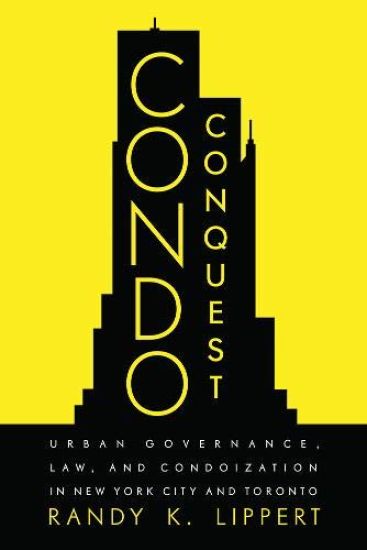
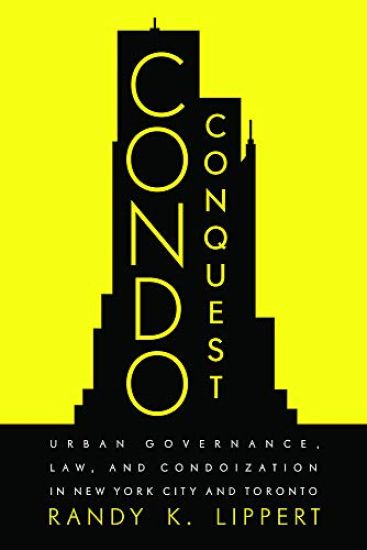
Condo Conquest

Condo Conquest

Randy K. Lippert

University of British Columbia Press
2019
sidottu
When condominiums first emerged in North American cities in the 1960s, they were a new kind of housing governed by boards of resident owners volunteering in a community. Condo Conquest shows how the condo and its inner governance have since become something else entirely, taken over – or conquered – by an assemblage of firms specializing in condo law, real estate, security, and property management, as well as growing numbers of non-resident investors who purchase condo units as commodities.Drawing on the accounts of residents and board directors in Toronto and New York and myriad other sources, Randy Lippert takes a close look at the inner workings of condoization. He shows how condo governance increasingly involves a complex set of legal, social, and spatial relationships among various elements assembled together, including commercial agents, forms of knowledge, and technologies. The first major study of condominium governance in North America, Condo Conquest questions assumptions about the condo and its governance. By illuminating the complex set of agents, processes, and forms of knowledge that have taken over the condo world, Lippert discerns a number of troubling trends that imperil the condo’s future and undermine the integrity of urban communities.
Condo Conquest

Condo Conquest

Randy K. Lippert

University of British Columbia Press
2019
pokkari
When condominiums first emerged in North American cities in the 1960s, they were a new kind of housing governed by boards of resident owners volunteering in a community. Condo Conquest shows how the condo and its inner governance have since become something else entirely, taken over – or conquered – by an assemblage of firms specializing in condo law, real estate, security, and property management, as well as growing numbers of non-resident investors who purchase condo units as commodities.Drawing on the accounts of residents and board directors in Toronto and New York and myriad other sources, Randy Lippert takes a close look at the inner workings of condoization. He shows how condo governance increasingly involves a complex set of legal, social, and spatial relationships among various elements assembled together, including commercial agents, forms of knowledge, and technologies. The first major study of condominium governance in North America, Condo Conquest questions assumptions about the condo and its governance. By illuminating the complex set of agents, processes, and forms of knowledge that have taken over the condo world, Lippert discerns a number of troubling trends that imperil the condo’s future and undermine the integrity of urban communities.