Kirjojen hintavertailu. Mukana 11 342 296 kirjaa ja 12 kauppaa.

Kirjahaku

Etsi kirjoja tekijän nimen, kirjan nimen tai ISBN:n perusteella.

27 kirjaa tekijältä Raymond Angelo Belliotti

Niccolo Machiavelli

Niccolo Machiavelli

Raymond Angelo Belliotti

Lexington Books
2008
sidottu
Machiavelli is usually understood as a thinker who separated morality from politics or who championed Roman, pagan morality over conventional, Christian morality. Belliotti argues, instead, that Machiavelli's innovation is his understanding of the perhaps irresolvable moral conflicts that exist within political leaders who fulfill the duties of their offices while accepting the authority of absolute moral principles. Machiavelli is a moral pessimist who insists that politicians must 'risk their souls' when performing their public responsibilities. Politicians and military leaders must dirty their hands in service to their constituents. This is especially the case when one strong man founds a state or reforms a corrupt state. History washes away_that is, excuses_many of the horrifying deeds that are required in such cases. Belliotti does not try to domesticate Machiavelli by picturing him as a liberal humanist inclined only toward free government. Nor does he paint him as a teacher of evil. Instead, the book offers a balanced understanding of the Florentine, with special focus on his insights and his myopias. Machiavelli's view of human nature and his conclusion that international affairs have always been and will always be a series of zero-sum contests lead him to stunning discoveries and glaring errors alike.
Niccolo Machiavelli

Niccolo Machiavelli

Raymond Angelo Belliotti

Lexington Books
2010
nidottu
Machiavelli is usually understood as a thinker who separated morality from politics or who championed Roman, pagan morality over conventional, Christian morality. Belliotti argues, instead, that Machiavelli's innovation is his understanding of the perhaps irresolvable moral conflicts that exist within political leaders who fulfill the duties of their offices while accepting the authority of absolute moral principles. Machiavelli is a moral pessimist who insists that politicians must 'risk their souls' when performing their public responsibilities. Politicians and military leaders must dirty their hands in service to their constituents. This is especially the case when one strong man founds a state or reforms a corrupt state. History washes away_that is, excuses_many of the horrifying deeds that are required in such cases. Belliotti does not try to domesticate Machiavelli by picturing him as a liberal humanist inclined only toward free government. Nor does he paint him as a teacher of evil. Instead, the book offers a balanced understanding of the Florentine, with special focus on his insights and his myopias. Machiavelli's view of human nature and his conclusion that international affairs have always been and will always be a series of zero-sum contests lead him to stunning discoveries and glaring errors alike.
Roman Philosophy and the Good Life

Roman Philosophy and the Good Life

Raymond Angelo Belliotti

Lexington Books
2009
sidottu
A practical people not prone to be lured to philosophical abstraction for its own sake, the Romans looked toward philosophy for guidance on how to live. Though wary of Greek philosophy, the Romans would come to see the need for philosophies such as Stoicism, Epicureanism, Platonism, and Aristotelianism to point the way to leading the good life. With the help of these philosophies, they attempted to grapple with some of most enduring concerns of the human condition: Who am I? How should I live my life? What, if anything, is my destiny? Raymond Angelo Belliotti's Roman Philosophy and the Good Life provides an accessible picture of these major philosophical influences in Rome and details the crucial role they played during times of major social upheaval. Belliotti demonstrates the contemporary relevance of some of the philosophical issues faced by the Romans, and offers ways in which today's society can learn from the Romans in our attempt to create meaningful lives. Roman Philosophy and the Good Life will certainly intrigue those who are drawn to Roman history and politics, and especially those who enjoy viewing philosophy in action.
Roman Philosophy and the Good Life

Roman Philosophy and the Good Life

Raymond Angelo Belliotti

Lexington Books
2009
nidottu
A practical people not prone to be lured to philosophical abstraction for its own sake, the Romans looked toward philosophy for guidance on how to live. Though wary of Greek philosophy, the Romans would come to see the need for philosophies such as Stoicism, Epicureanism, Platonism, and Aristotelianism to point the way to leading the good life. With the help of these philosophies, they attempted to grapple with some of most enduring concerns of the human condition: Who am I? How should I live my life? What, if anything, is my destiny? Raymond Angelo Belliotti's Roman Philosophy and the Good Life provides an accessible picture of these major philosophical influences in Rome and details the crucial role they played during times of major social upheaval. Belliotti demonstrates the contemporary relevance of some of the philosophical issues faced by the Romans, and offers ways in which today's society can learn from the Romans in our attempt to create meaningful lives. Roman Philosophy and the Good Life will certainly intrigue those who are drawn to Roman history and politics, and especially those who enjoy viewing philosophy in action.
Posthumous Harm

Posthumous Harm

Raymond Angelo Belliotti

Lexington Books
2013
nidottu
Reasonable people agree that, other things being equal, it is immoral to fail to fulfill deathbed promises, to maliciously defame the dead, and to mistreat corpses. But philosophical controversy swirls over why such acts are morally wrong. Are these acts wrong only because they violate moral norms against breaking promises, lying, and abusing others? Are these acts morally deficient because they wrong the dead? Are these acts morally wrong because they harm or injure the dead? Or are these acts blameworthy because they wrong, harm, or injure those who survive the deaths? Who are the genuine victims, if any, of these morally wrong acts? When first confronting such questions seriously, we discover paradoxes. On one hand, we are inclined to think that the dead person is in some sense wronged, harmed, or injured by posthumous treachery. After all, when a promise is broken, when someone is maliciously defamed, and when someone’s request concerning the disposition of his remains is dismissed, we are inclined to think of the victims as the promisee, the defamed person, and the ignored person, respectively. On the other hand, in the case of the dead there are no “people” who might be identified as victims. Assuming that death marks finality, once we are dead we are no more. So perhaps the typical moral paradigms dissolve in such cases. Posthumous Harm: Why the Dead are Still Vulnerable addresses these issues and the host of questions surrounding them.
Jesus the Radical

Jesus the Radical

Raymond Angelo Belliotti

Lexington Books
2013
sidottu
Jesus the Radical: The Parables and Modern Morality connects the lessons of six parables of the New Testament with philosophical issues structured around contemporary morality and the art of leading a good human life. In this manner, Raymond Angelo Belliotti highlights just how radical was the historical Jesus’ moral message and how enormous a challenge he raised to the conventional wisdom of his time. More important, this book demonstrates how deeply opposed is Jesus’ moral message to the dominant moral understandings of our time. Although our conventional morality is generally profoundly influenced by Judeo-Christianity, several of Jesus’ revolutionary insights have been marginalized. By imagining how our world would appear if those insights were highlighted, we can perceive more clearly the people we are and the people we might become. Belliotti's analysis of the parables will be of keen interest to professional philosophers, theologians, and educated lay people interested in the connections between religion and philosophy.
Happiness Is Overrated

Happiness Is Overrated

Raymond Angelo Belliotti

Rowman Littlefield Publishers
2003
sidottu
Happiness Is Overrated begins with an historical overview of the development of the concept of 'happiness' from Plato to contemporary writers, highlighting the best scholarship emerging from philosophy, psychology, and sociology. Belliotti includes practical advice on how to attain happiness and addresses issues centered on the meaning of life. Happiness, he argues, is not the greatest personal good, or even a great good in itself. In fact, sometimes happiness isn't a good at all. If we pursue worthwhile, exemplary lives and find happiness along the way, then we are lucky. If we don't, then we can take pride and derive satisfaction from a life well lived. Ultimately, the greatest personal good is realized in leading a robustly meaningful, valuable life.
Happiness Is Overrated

Happiness Is Overrated

Raymond Angelo Belliotti

Rowman Littlefield Publishers
2003
nidottu
Happiness Is Overrated begins with an historical overview of the development of the concept of 'happiness' from Plato to contemporary writers, highlighting the best scholarship emerging from philosophy, psychology, and sociology. Belliotti includes practical advice on how to attain happiness and addresses issues centered on the meaning of life. Happiness, he argues, is not the greatest personal good, or even a great good in itself. In fact, sometimes happiness isn't a good at all. If we pursue worthwhile, exemplary lives and find happiness along the way, then we are lucky. If we don't, then we can take pride and derive satisfaction from a life well lived. Ultimately, the greatest personal good is realized in leading a robustly meaningful, valuable life.
Watching Baseball, Seeing Philosophy

Watching Baseball, Seeing Philosophy

Raymond Angelo Belliotti

McFarland Co Inc
2008
pokkari
There are uncanny connections between nine baseball greats and the great thinkers of the West. This book offers a very practical application of Western philosophy by examining these icons of American sport and culture. The intensity and single-mindedness of Ted Williams breathes life into Camus' Sisyphus; Billy Martin's maniacal competitiveness recalls Niccolo Machiavelli's take on politics, which he characterized as a zero-sum game; the homespun philosophy of Satchel Paige echoes the wisdom of Marcus Aurelius; and the many facets of Joe DiMaggio's personality cry out for the resolution that Nietzsche's doctrine of perspectivism might have given. Also covered are the connections between Joe Torre and Aristotle; Jackie Robinson and Antonio Gramsci; Mickey Mantle and St. Thomas Aquinas; John Franco and William James; and Jose Canseco and Immanuel Kant.
Machiavelli's Secret

Machiavelli's Secret

Raymond Angelo Belliotti

State University of New York Press
2016
pokkari
Uncovers clues regarding the inner life of Machiavelli's political leaders.The political statesman, Machiavelli tells us, must love his country more than his own soul. Political leaders must often transgress clear moral principles, using means that are typically wrong, even horrifying. What sort of inner life does a leader who "uses evil well" experience and endure? The conventional view held by most scholars is that a Machiavellian statesman lacks any "inwardness" because Machiavelli did not delve into the state of mind one might find in a politician with "dirty hands." While such a leader would bask in his glory, the argument goes, we can only wonder at the condition of the soul they have presumably risked in discharging their duties. In Machiavelli's Secret, Raymond Angelo Belliotti uncovers a range of clues in Machiavelli's writings that, when pieced together, reveal that the Machiavellian hero most certainly has "inwardness" and is surely deeply affected by the evil means he must sometimes employ. Belliotti not only reveals the nature of this internal condition, but also provides a springboard for the possibility of Machiavelli's ideal statesman.
Power

Power

Raymond Angelo Belliotti

State University of New York Press
2016
sidottu
Deepens our understanding of power through a survey of how its dynamics have been understood from ancient times to the present.Frequently understood in simplistic and often highly negative terms, the concept of power has proven to be both uncommonly intriguing and maddeningly elusive. In Power, Raymond Angelo Belliotti begins by fashioning a general definition of power that is refined enough to capture the numerous types of power in all their multifaceted complexity. He then proceeds in a series of discrete yet thematically connected meditations to explore the meaning of power in ancient, modern, and contemporary thought. In grappling with the critical questions surrounding the accumulation, distribution, and exercise of personal and social power, this work allows us to confront fundamental questions of who we are and how we might live better lives.
The Godfather and Sicily

The Godfather and Sicily

Raymond Angelo Belliotti

STATE UNIVERSITY OF NEW YORK PRESS
2022
pokkari
Offers a distinctive interpretation of The Godfather as a novel and film sequence.In this interdisciplinary work, Raymond Angelo Belliotti presents an interpretation of The Godfather as, among other things, a commentary on the transformation of personal identity within the Sicilian and Italian immigrant experience. The book explores both the novel and the film sequence in terms of an existential conflict between two sets of values that offer competing visions of the world: on the one hand, a nineteenth-century Sicilian perspective grounded in honor and the accumulation of power within a culturally specific family order; and on the other, a twentieth-century American perspective that celebrates individualism and commercial success. Analyzing concepts such as honor, power, will to power, respect, atonement, repentance, forgiveness, and a meaningful life, Belliotti applies these analyses to the cultural understandings transported to America by nineteenth-century Italian immigrants, casting fresh light on Old World allegiances to l'ordine della famiglia (the family order), la via vecchia (the old way), and the patriarchal ideal of uomo di pazienza (the man of patience), as well as the Sicilian code of honor. The two sets of values-Old World Sicilian and twentieth-century American-coalesce uneasily in the same cultural setting, and their conflict is irresolvable.
The Godfather and Sicily

The Godfather and Sicily

Raymond Angelo Belliotti

State University of New York Press
2021
sidottu
Offers a distinctive interpretation of The Godfather as a novel and film sequence.In this interdisciplinary work, Raymond Angelo Belliotti presents an interpretation of The Godfather as, among other things, a commentary on the transformation of personal identity within the Sicilian and Italian immigrant experience. The book explores both the novel and the film sequence in terms of an existential conflict between two sets of values that offer competing visions of the world: on the one hand, a nineteenth-century Sicilian perspective grounded in honor and the accumulation of power within a culturally specific family order; and on the other, a twentieth-century American perspective that celebrates individualism and commercial success. Analyzing concepts such as honor, power, will to power, respect, atonement, repentance, forgiveness, and a meaningful life, Belliotti applies these analyses to the cultural understandings transported to America by nineteenth-century Italian immigrants, casting fresh light on Old World allegiances to l'ordine della famiglia (the family order), la via vecchia (the old way), and the patriarchal ideal of uomo di pazienza (the man of patience), as well as the Sicilian code of honor. The two sets of values-Old World Sicilian and twentieth-century American-coalesce uneasily in the same cultural setting, and their conflict is irresolvable.
Jesus the Radical

Jesus the Radical

Raymond Angelo Belliotti

Lexington Books
2015
nidottu
Jesus the Radical: The Parables and Modern Morality connects the lessons of six parables of the New Testament with philosophical issues structured around contemporary morality and the art of leading a good human life. In this manner, Raymond Angelo Belliotti highlights just how radical was the historical Jesus’ moral message and how enormous a challenge he raised to the conventional wisdom of his time. More important, this book demonstrates how deeply opposed is Jesus’ moral message to the dominant moral understandings of our time. Although our conventional morality is generally profoundly influenced by Judeo-Christianity, several of Jesus’ revolutionary insights have been marginalized. By imagining how our world would appear if those insights were highlighted, we can perceive more clearly the people we are and the people we might become. Belliotti's analysis of the parables will be of keen interest to professional philosophers, theologians, and educated lay people interested in the connections between religion and philosophy.
Values, Virtues, and Vices, Italian Style

Values, Virtues, and Vices, Italian Style

Raymond Angelo Belliotti

Fairleigh Dickinson University Press
2020
sidottu
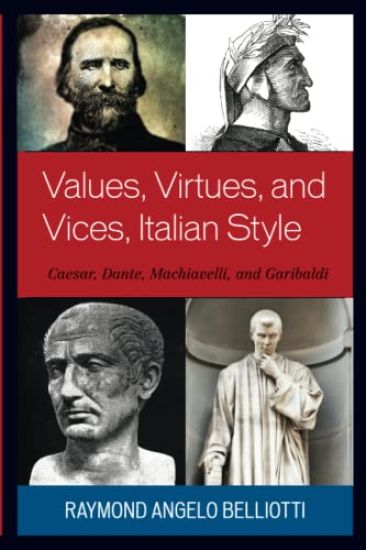
Values, Virtues, and Vices, Italian Style illustrates the story of the evolution of Italian values, virtues, and vices is a narrative of longing, exhilaration, and devastation, a journey of the spirit that all human beings necessarily undertake but navigate with varying degrees of success. The lives of Caesar, Dante, Machiavelli, and Garibaldi demonstrate how we can lead staunchly meaningful lives even within an inherently meaningless universe. The ambition of this work is nothing more, nothing less, than entangling, through a careful examination of the values, virtues, and vices of four famous historical figures, a host of overlapping but distinct concepts, such as pride, honor, justification, excuse, repentance, and forgiveness that frame human existence. Belliotti’s objective is that by conducting such an interdisciplinary inquiry we might better position ourselves to craft our characters within the limitations enjoined by our cosmic circumstances. As always, however, we must deliberate, choose, and act under conditions of inescapable uncertainty; assume responsibility for the people we are becoming; and, hopefully, depart the planet with honor and merited pride. Along the way, we might even magnify our link in the generational chain that defines our identity.
Values, Virtues, and Vices, Italian Style

Values, Virtues, and Vices, Italian Style

Raymond Angelo Belliotti

Fairleigh Dickinson University Press
2021
nidottu
Values, Virtues, and Vices, Italian Style illustrates the story of the evolution of Italian values, virtues, and vices is a narrative of longing, exhilaration, and devastation, a journey of the spirit that all human beings necessarily undertake but navigate with varying degrees of success. The lives of Caesar, Dante, Machiavelli, and Garibaldi demonstrate how we can lead staunchly meaningful lives even within an inherently meaningless universe. The ambition of this work is nothing more, nothing less, than entangling, through a careful examination of the values, virtues, and vices of four famous historical figures, a host of overlapping but distinct concepts, such as pride, honor, justification, excuse, repentance, and forgiveness that frame human existence. Belliotti’s objective is that by conducting such an interdisciplinary inquiry we might better position ourselves to craft our characters within the limitations enjoined by our cosmic circumstances. As always, however, we must deliberate, choose, and act under conditions of inescapable uncertainty; assume responsibility for the people we are becoming; and, hopefully, depart the planet with honor and merited pride. Along the way, we might even magnify our link in the generational chain that defines our identity.
Heroism and Wisdom, Italian Style

Heroism and Wisdom, Italian Style

Raymond Angelo Belliotti

Fairleigh Dickinson University Press
2022
sidottu
This is an interdisciplinary work that philosophically analyzes concepts such as heroism; practical wisdom; honor; Nietzsche’s notions of will to power, the overman, and the three metamorphoses; Plato’s understanding of love; creating meaning in life; the issue of morally dirty hands in political administration; the relationship between political means and ends; the proper role of positive duties in society; the aspirations of grand strivers; and the linkages between biological, biographical, and autobiographical lives, all in the context of explaining and evaluating the lives and works of fourteen historically significant Italian: Gaius Julius Caesar, Brunetto Latini, Dante Alighieri, Caterina Sforza, Niccolò Machiavelli, Giuseppe Mazzini, Giuseppe Garibaldi, Francesca Cabrini, Gabriele D’Annunzio, Antonio Gramsci, Salvatore Giuliano, Oriana Fallaci, Giovanni Falcone, and Paolo Borsellino.By dissecting the lives and philosophies of the figures discussed in this work, by extracting moral, political, and existential lessons from their aspirations and enterprises, by reflecting on their ideals from the vantage point of our divergent social context, by evaluating their virtues and vices from a wider perspective, and by confronting the conceptual puzzles and social impediments hampering the exercise of practical wisdom and heroism, we may confront the people that we are and reimagine the people we might become.
Italian Rebels

Italian Rebels

Raymond Angelo Belliotti

Fairleigh Dickinson University Press
2022
sidottu
This interdisciplinary work philosophically analyzes the role of positive duties in moral theory, the efficacy of theocratic republicanism, viable strategies for political revolutions, the implications of an enduring Sicilian ethos, and the profits and perils of the individual-community continuum, in service of distinctive interpretations of the lives and ideologies of Giuseppe Mazzini, Antonio Gramsci, and Salvatore Giuliano. Il Risorgimento Italiano, the national unification movement, refers to the period from 1821, the initial unsuccessful Milanese and Piedmontese insurrections against Austria, to 1870, the annexing of Rome into the Kingdom of Italy, which itself was established in 1861. The movement and its aftermath hovered over the lives of the Genoese republican prophet of Italian liberation and unification, the Sardinian communist political theorist imprisoned by The Black Shirts, and the Sicilian separatist murdering and fighting for his life and the honor of his island.By dissecting the lives and philosophies of Mazzini, Gramsci, and Giuliano, by extracting moral, political, and existential lessons from their aspirations and enterprises, by reflecting on their ideals from our divergent social context, by evaluating their virtues and vices from a wider perspective, we may confront the people that we are and reimagine the people we might become.
Dante’s Inferno

Dante’s Inferno

Raymond Angelo Belliotti

Springer Nature Switzerland AG
2020
sidottu
This book provides a recipe for healthy moral and personal transformation. Belliotti takes seriously Dante’s deepest yearnings: to guide human well-being; to elevate social and political communities; to remedy the poisons spewed by the seven capital vices; and to celebrate the connections between human self-interest, virtuous living, and spiritual salvation. By closely examining and analyzing five of Dante’s more vivid characters in hell—Piero della Vigna, Brunetto Latini, Farinata degli Uberti, Cavalcante de’ Cavalcanti, and Guido da Montefeltro—and extracting the moral lessons Dante intends them to convey, and by conceptually analyzing envy, arrogance, pride, and human flourishing, the author challenges readers to interrogate and refine their modes of living.