Kirjojen hintavertailu. Mukana 12 361 754 kirjaa ja 12 kauppaa.

Kirjahaku

Etsi kirjoja tekijän nimen, kirjan nimen tai ISBN:n perusteella.

3 kirjaa tekijältä Raymond G. O'Connor

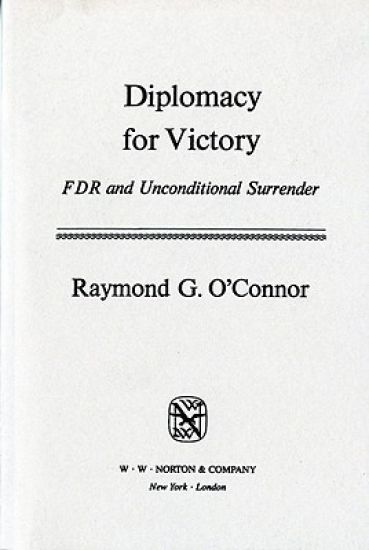
Diplomacy for Victory

Diplomacy for Victory

Raymond G. O'Connor

WW Norton Co
1971
nidottu
That statement, demanding the unconditional surrender of Germany, Italy, and Japan, was attacked immediately by those who felt it would prolong the war. Now, three decades later, it is still the subject of heated debate. In this new study, Raymond G. O'Connor views the unconditional surrender policy as one of Roosevelt's great successes. It did not prolong the war, and by eliminating the preconditions for a negotiated peace, and the territorial disputes that accompany them, it helped to maintain the tenuous relationship between the three Allied leaders, so important in bringing about the Axis capitulation. Equally important, the policy was a vital instrument in achieving the war's political objectives—objectives the author says Roosevelt understood better than his British counterpart, Winston Churchill. With the availability of new sources, Professor O'Connor has been able to reconsider thoroughly all aspects of the unconditional surrender policy, from its origins and Churchill's role in its formation to its effects on the victory it helped to bring about.
Commanders in Chief

Commanders in Chief

Raymond G. O'Connor

University Press of Kansas
1993
nidottu
Since 1798, when Congress authorised John Adams to employ the navy to capture armed French vessels preying on American shipping along the Atlantic coast, US presidents have grappled with the complexities of war. Some have dealt with it skilfully while others have tended towards the inept. Some have wanted to exert their war powers while others have shied away from them. Some have been successful while others have not. Never having had their authority clearly defined, the presidents, as commanders in chief, have been allowed to interpret the scope of their involvement in wartime decision-making. The question of whether a president can order forces into combat against another nation has never been resolved and precedent supports both sides. ""Essentially, says Raymond O'Connor, ""the president can do whatever he can get away with."" ""Commanders in Chief"" offering an enlightening look at the president's constitutional and political roles during wartime, brings together the work of several prominent historians. These experts analyse the war powers of the presidency as well as the wartime leadership of six presidents - William McKinley, Woodrow Wilson, Franklin Roosevelt, Harry Truman, Lyndon Johnson and Richard Nixon. Two of the authors take provocative revisionist views of their subjects. Lewis Gould asserts that McKinley delivered able and talented leadership during the Spanish-American War, while Robert Ferrell sharply criticises Wilson's leadership during World War I. On the other hand, Warren Kimball emphatically confirms the high ranking by most scholars of Roosevelt as the most gifted wartime chief executive of the 20th century, and Clayton James substantiates Truman's strong and pragmatic leadership in two conflicts. In Frank Vandiver's essay on Johnson, and Stephen Ambrose's on Nixon, the authors emphasise the diversity of challenges the two presidents faced during the controversial Vietnam War. Revising and updating earlier studies, including ""The Ultimate Decision: The President as Commander in Chief"", the 1960 collection edited by Ernest May, this book offers a thoughtful critique of the character and capabilities of America's modern commanders in chief.
Origins of the American Navy

Origins of the American Navy

Raymond G. O'Connor

University Press of America
1993
sidottu
This book is a study of the factors and circumstances that lead to the establishment and development of an American Navy, and of the role of sea power in the founding, growth, and independence of the thirteen colonies and the protection and promotion of the national interest at home and abroad in the early years of the Republic. The very existence and prosperity of the colonies, which were created during an era of discovery and international rivalry for the spoils of new worlds, depended on the Royal navy and the merchant vessels of the mother country, a lesson learned by the colonial leaders as they sought a 'redress of wrongs' and then assumed leadership of a sovereign nation in the midst of a hostile and volatile world. The author of this book stresses the political, economic, and ideological considerations that motivated the colonial and national leaders as they conceived and implemented a concept of sea power.