Kirjojen hintavertailu. Mukana 11 342 296 kirjaa ja 12 kauppaa.

Kirjahaku

Etsi kirjoja tekijän nimen, kirjan nimen tai ISBN:n perusteella.

4 kirjaa tekijältä Raymond Nickerson

Conditional Reasoning

Conditional Reasoning

Raymond Nickerson

Oxford University Press Inc
2015
sidottu
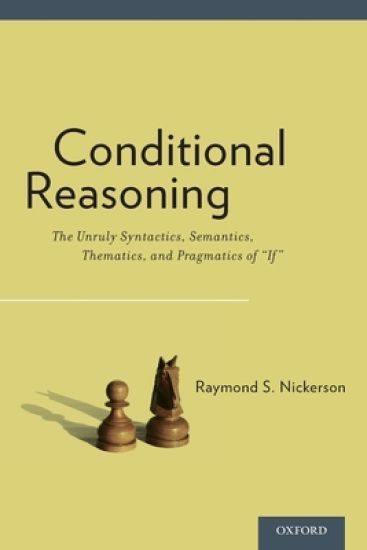
Conditional reasoning is reasoning that involves statements of the sort If A (Antecedent) then C (Consequent). This type of reasoning is ubiquitous; everyone engages in it. Indeed, the ability to do so may be considered a defining human characteristic. Without this ability, human cognition would be greatly impoverished. "What-if" thinking could not occur. There would be no retrospective efforts to understand history by imagining how it could have taken a different course. Decisions that take possible contingencies into account could not be made; there could be no attempts to influence the future by selecting actions on the basis of their expected effects. Despite the commonness and importance of conditional reasoning and the considerable attention it has received from scholars, it remains the subject of much continuing debate. Unsettled questions, both normative and empirical, continue to be asked. What constitutes normative conditional reasoning? How do people engage in it? Does what people do match what would be expected of a rational agent with the abilities and limitations of human beings? If not, how does it deviate and how might people's ability to engage in it be improved? This book reviews the work of prominent psychologists and philosophers on conditional reasoning. It describes empirical research on how people deal with conditional arguments and on how conditional statements are used and interpreted in everyday communication. It examines philosophical and theoretical treatments of the mental processes that support conditional reasoning. Its extensive coverage of the subject makes it an ideal resource for students, teachers, and researchers with a focus on cognition across disciplines.
Conditional Reasoning

Conditional Reasoning

Raymond Nickerson

Oxford University Press Inc
2017
nidottu
Conditional reasoning is reasoning that involves statements of the sort If A (Antecedent) then C (Consequent). This type of reasoning is ubiquitous; everyone engages in it. Indeed, the ability to do so may be considered a defining human characteristic. Without this ability, human cognition would be greatly impoverished. "What-if" thinking could not occur. There would be no retrospective efforts to understand history by imagining how it could have taken a different course. Decisions that take possible contingencies into account could not be made; there could be no attempts to influence the future by selecting actions on the basis of their expected effects. Despite the commonness and importance of conditional reasoning and the considerable attention it has received from scholars, it remains the subject of much continuing debate. Unsettled questions, both normative and empirical, continue to be asked. What constitutes normative conditional reasoning? How do people engage in it? Does what people do match what would be expected of a rational agent with the abilities and limitations of human beings? If not, how does it deviate and how might people's ability to engage in it be improved? This book reviews the work of prominent psychologists and philosophers on conditional reasoning. It describes empirical research on how people deal with conditional arguments and on how conditional statements are used and interpreted in everyday communication. It examines philosophical and theoretical treatments of the mental processes that support conditional reasoning. Its extensive coverage of the subject makes it an ideal resource for students, teachers, and researchers with a focus on cognition across disciplines.
Mathematical Reasoning

Mathematical Reasoning

Raymond Nickerson

Psychology Press Ltd
2015
nidottu
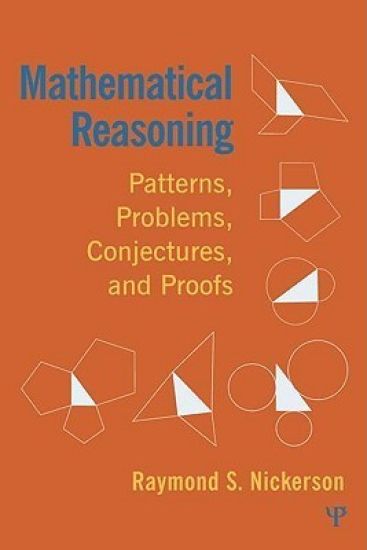
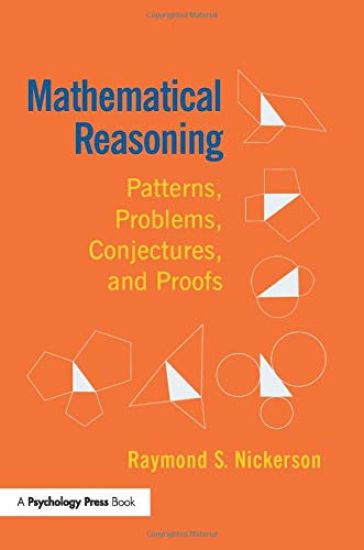
The development of mathematical competence -- both by humans as a species over millennia and by individuals over their lifetimes -- is a fascinating aspect of human cognition.This book explores when and why the rudiments of mathematical capability first appeared among human beings, what its fundamental concepts are, and how and why it has grown into the richly branching complex of specialties that it is today. It discusses whether the ‘truths’ of mathematics are discoveries or inventions, and what prompts the emergence of concepts that appear to be descriptive of nothing in human experience. Also covered is the role of esthetics in mathematics: What exactly are mathematicians seeing when they describe a mathematical entity as ‘beautiful’? There is discussion of whether mathematical disability is distinguishable from a general cognitive deficit and whether the potential for mathematical reasoning is best developed through instruction.This volume is unique in the vast range of psychological questions it covers, as revealed in the work habits and products of numerous mathematicians. It provides fascinating reading for researchers and students with an interest in cognition in general and mathematical cognition in particular. Instructors of mathematics will also find the book’s insights illuminating.
Mathematical Reasoning

Mathematical Reasoning

Raymond Nickerson

Psychology Press Ltd
2009
sidottu
The development of mathematical competence -- both by humans as a species over millennia and by individuals over their lifetimes -- is a fascinating aspect of human cognition.This book explores when and why the rudiments of mathematical capability first appeared among human beings, what its fundamental concepts are, and how and why it has grown into the richly branching complex of specialties that it is today. It discusses whether the ‘truths’ of mathematics are discoveries or inventions, and what prompts the emergence of concepts that appear to be descriptive of nothing in human experience. Also covered is the role of esthetics in mathematics: What exactly are mathematicians seeing when they describe a mathematical entity as ‘beautiful’? There is discussion of whether mathematical disability is distinguishable from a general cognitive deficit and whether the potential for mathematical reasoning is best developed through instruction.This volume is unique in the vast range of psychological questions it covers, as revealed in the work habits and products of numerous mathematicians. It provides fascinating reading for researchers and students with an interest in cognition in general and mathematical cognition in particular. Instructors of mathematics will also find the book’s insights illuminating.