Kirjojen hintavertailu. Mukana 11 699 587 kirjaa ja 12 kauppaa.

Kirjahaku

Etsi kirjoja tekijän nimen, kirjan nimen tai ISBN:n perusteella.

36 kirjaa tekijältä Raymond Queneau

Fiche de lecture Les Fleurs bleues de Raymond Queneau (Analyse littéraire de référence et résumé complet)
La collection Conna tre une oeuvre vous offre la possibilit de tout savoir des Fleurs bleues de Raymond Queneau gr ce une fiche de lecture aussi compl te que d taill e. La r daction, claire et accessible, a t confi e un sp cialiste universitaire. Cette fiche de lecture r pond une charte qualit mise en place par une quipe d'enseignants. Ce livre contient la biographie de Raymond Queneau, la pr sentation de l'oeuvre, le r sum d taill (chapitre par chapitre), les raisons du succ s, les th mes principaux et l' tude du mouvement litt raire de l'auteur.
Fiche de lecture Exercices de style de Raymond Queneau (Analyse littéraire de référence et résumé complet)
La collection Conna tre une oeuvre vous offre la possibilit de tout savoir de l'ouvrage Exercices de style, de Raymond Queneau, gr ce une fiche de lecture aussi compl te que d taill e. La r daction, claire et accessible, a t confi e un sp cialiste universitaire. Cette fiche de lecture r pond une charte qualit mise en place par une quipe d'enseignants. Ce livre contient la biographie de Raymond Queneau, la pr sentation de l'oeuvre, le r sum d taill (chapitre par chapitre), les raisons du succ s, les th mes principaux et l' tude du mouvement litt raire de l'auteur.

Exercices de style de Raymond Queneau (fiche de lecture et analyse complète de l'oeuvre)
Venez d couvrir l'oeuvre de Raymond Queneau gr ce une analyse litt raire de r f rence crite par un sp cialiste universitaire, cette fiche de lecture est recommand e par de nombreux enseignants. Cet ouvrage contient la biographie de l' crivain, le r sum d taill , le mouvement litt raire, le contexte de publication de l'oeuvre et l'analyse compl te. Retrouvez tous nos titres au format PDF sur: www.fichedelecture.fr.
Les Fleurs bleues de Raymond Queneau (fiche de lecture et analyse complète de l'oeuvre)
Venez d couvrir Les Fleurs bleues de Raymond Queneau gr ce une analyse litt raire de r f rence crite par un sp cialiste universitaire, cette fiche de lecture est recommand e par de nombreux enseignants. Cet ouvrage contient la biographie de l' crivain, le r sum d taill , le mouvement litt raire, le contexte de publication de l'oeuvre et l'analyse compl te. Retrouvez tous nos titres sur: www.fichedelecture.fr.
Zazie in the Metro

Zazie in the Metro

Raymond Queneau

Penguin Classics
2001
pokkari
Impish, foul-mouthed Zazie arrives in Paris from the country to stay with Gabriel, her female-impersonator uncle. All she really wants to do is ride the metro, but finding it shut because of a strike, Zazie looks for other means of amusement and is soon caught up in a comic adventure that becomes wilder and more manic by the minute. In 1960 Queneau's cult classic was made into a hugely successful film by Louis Malle. Packed full of word play and phonetic games, Zazie in the Metro remains as stylish and witty as ever.
Stories and Remarks

Stories and Remarks

Raymond Queneau

University of Nebraska Press
2000
pokkari
Stories and Remarks collects the best of Raymond Queneau's shorter prose. The works span his career and include short stories, an uncompleted novel, melancholic and absurd essays, occasionally baffling "Texticles," a pastiche of Alice in Wonderland, and his only play. Talking dogs, boozing horses, and suicides come head to head with ruminations on the effects of aerodynamics on addition, rhetorical dreams, and a pioneering example of permutational fiction influenced by computer language. Also included is Michel Leiris's preface from the French edition, an introduction by the translator, and endnotes addressing each piece individually. Raymond Queneau—polyglot, novelist, philosopher, poet, mathematician, screenwriter, and translator—was one of the most significant figures in twentieth-century French letters. His work touches on many of the major literary movements of his lifetime, from surrealism to the experimental school of the nouveau roman. He also founded the Oulipo, a collection of writers and mathematicians dedicated to the search for artificial inspiration via the application of constraint.
The Sunday of Life

The Sunday of Life

Raymond Queneau

NEW DIRECTIONS PUBLISHING CORPORATION
1977
nidottu
The Sunday of Life (Le Dimanche de la vie), the late Raymond Queneau's tenth novel, was first published in French by Gallimard in 1951 and is now appearing for the first time in this country, in a translation by Barbara Wright. Critics are universally agreed that it and the later Zazie dans le m tro (1959) show Queneau at his zaniest and most cheerful, and it is not surprising that both these novels have been made into popular and successful films. But as always with Queneau, beneath the apparent absurdities of plot and the bumbling of his rather ordinary characters, there is a precision of structure and purpose that, ironically enough, places the work of this earliest of new-wave novelists squarely in the tradition of the eighteenth-century roman philosophique. In the ingenuous ex-Private Valentin Br , the central figure in The Sunday of Life, Queneau has created that oddity in modern fiction, the Hegelian na f. Highly self-conscious yet reasonably satisfied with his lot, imbued with the good humor inherent in the naturally wise, Valentin meets the painful nonsense of life's adventures with a slightly bewildered detachment. As Barbara Wright so aptly writes: "Though The Sunday of Life is set in one of the most traumatic of recent periods--1936-40, the dark years leading up to the Second World War and including the fall of France... it nevertheless does indeed manage to be one of Queneau's happiest, sunniest, and most undated novels: it far transcends anything like a mere chronicle of times."
Exercises in Style

Exercises in Style

Raymond Queneau

NEW DIRECTIONS PUBLISHING CORPORATION
1981
nidottu
The plot of Exercises in Style is simple: a man gets into an argument with another passenger on a bus. However, this anecdote is told 99 more times, each in a radically different style, as a sonnet, an opera, in slang, and with many more permutations. This virtuoso set of variations is a linguistic rust-remover, and a guide to literary forms.
The Blue Flowers

The Blue Flowers

Raymond Queneau

New Directions Publishing Corporation
2018
nidottu
The Blue Flowers follows two unlikely characters: Cidrolin, who alternates between drinking and napping on a barge parked along the Seine in the 1960s, and the Duke d'Auge as he rages through history--about 700 years of it--refusing to crusade, clobbering his king with a cannon, and dabbling in alchemy. But is it just a coincidence that the Duke appears only when Cidrolin is dozing? And vice versa? As Raymond Queneau explains: "There is an old Chinese saying: 'I dream that I am a butterfly and pray there is a butterfly dreaming he is me.' The same can be said of the characters in this novel--those who live in the past dream of those who live in the modern era--and those who live in the modern era dream of those who live in the past." Channeling Villon and C line, Queneau attempts to bring the language of the French streets into common literary usage, and his mad wordplays, puns, bawdy jokes, and anachronistic wackiness have been kept amazingly and glitteringly intact by the incomparable translator Barbara Wright.
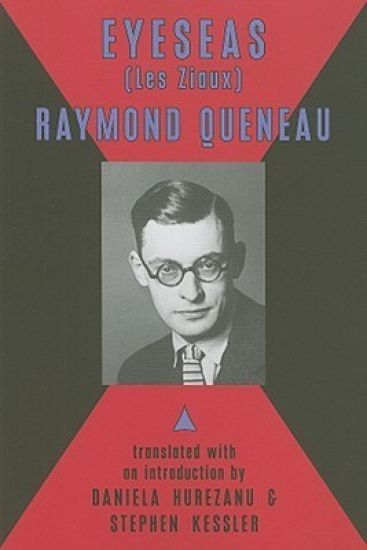
EyeSeas

EyeSeas

Raymond Queneau

Black Widow Press
2008
pokkari
In the United States, Raymond Queneau (1903-1976) is known mainly for his novel Zazie dans le metro, which was made into a film by Louis Malle, for Excercises in Style, and for being the founder and one of the most important members of the literary movement known as Oulipo. In France and much of Europe Queneau is known for his prolific and wide ranging writings. During his lifetime some eighteen novels, ten volumes of poetry, seven volumes of essays, and countless other published essays and commentaries kept him in public view and continue to do so today as new biographies, symposiums, and critical writings on him appear with regularity. Les Ziaux (Eyeseas) present a bilingual survey of his poems as written from his early Surrealist days of the 1920's through to 1943 and is representative of Queneau's range of poetic voices. As so little of Queneau's poetry has been published in English, we hope this translation will not only fill a serious void but may also help to inspire interest in the poetry of one of the most important French writers of the twentieth-century.
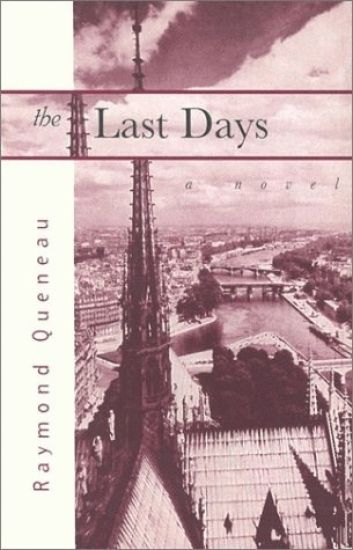
Last Days

Last Days

Raymond Queneau

Dalkey Archive Press
1996
nidottu
The Last Days is Raymond Queneau's autobiographical novel of Parisian student life in the 1920s: Vincent Tuquedenne tries to reconcile his love for reading with the sterility of studying as he hopes to study his way out of the petite bourgeoisie to which he belongs. Vincent and his generation are contrasted with an older generation of retired teachers and petty crooks, and both generations come under the bemused gaze of the waiter Alfred, whose infallible method of predicting the future mocks prevailing scientific models. Similarly, Queneau's literary universe operates under its own laws, joining rigorous artistry with a warm evocation of the last days of a bygone world.
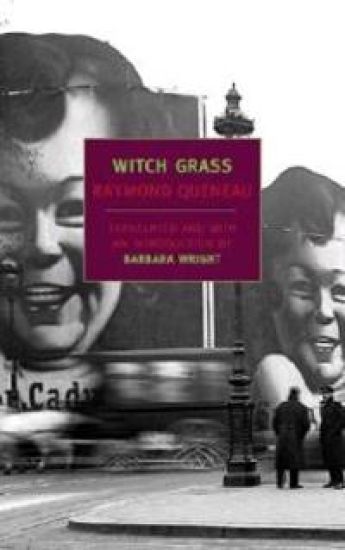
Witch Grass

Witch Grass

Raymond Queneau

New York Review of Books
2003
nidottu
Seated in a Paris caf , a man glimpses another man, a shadowy figure hurrying for the train: Who is he? he wonders, How does he live? And instantly the shadow comes to life, precipitating a series of comic run-ins among a range of disreputable and heartwarming characters living on the sleazy outskirts of the city of lights. Witch Grass (previously titled The Bark Tree) is a philosophical farce, an epic comedy, a mesmerizing book about the daily grind that is an enchantment itself.
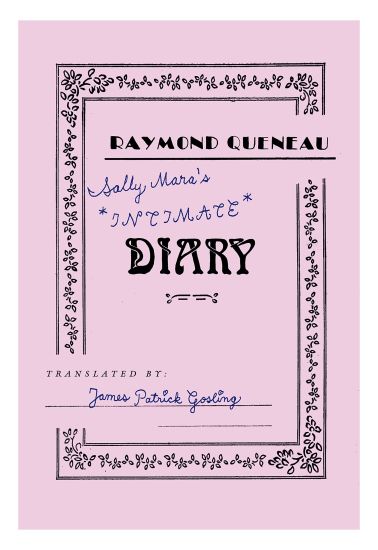
Sally Mara's Intimate Journal

Sally Mara's Intimate Journal

Raymond Queneau

Dalkey Archive Press
2023
pokkari
Sally Mara’s Intimate Diary, dating from 1950, is exceptional; a salacious, black humorous and meaningful story by the influential and erudite French novelist, Raymond Queneau. When ‘Sally Mara’ begins her diary in January 1934, she is 17 years old and lives with her mother, older brother and younger sister in south central Dublin. The everyday language is, of course, English, but she is writing in ‘newly-learned’ French to impress her beloved and just departed French tutor, a professional polyglot linguist. To impress him even more, she decides to learn Irish in order to write a novel of some kind in Irish. However, the action throughout is determined by Sally’s resolution to overcome her ignorance of the mysteries of sex and reproduction. The often sensual and dark humour of Sally Mara’s Journal intime is founded on language and languages, so this translation, while prioritizing clarity, aims to maintain ‘Frenchness’, tinged of course with Dublinese. Surprisingly, for a French author, Irish words and phrases occur throughout; these are not translated but, like some challenging French phrases, are supported by footnotes. In 1949, when Raymond Queneau wrote Journal intime, published anonymously under the pseudonym Sally Mara, he was, as always, greatly influenced by James Joyce and fascinated by the limitations of language. He was also in need of the ready money provided by Éditions du Scorpion, publishers of erotic and violent pulp fiction, and of Journal intime.
Pierrot Mon Ami

Pierrot Mon Ami

Raymond Queneau

Dalkey Archive Press
2023
pokkari
Pierrot Mon Ami, considered by many to be one of Raymond Queneau’s finest achievements, is a quirky coming-of-age novel concerning a young man’s initiation into a world filled with deceit, fraud, and manipulation. From his short-lived job at a Paris amusement park where he helps to raise women’s skirts to the delight of an unruly audience, to his frustrated and unsuccessful love of Yvonne, to his failed assignment to care for the tomb of the shadowy Prince Luigi of Poldevia, Pierrot stumbles about, nearly immune to the effects of duplicity.This “innocent” implies how his story, at almost every turn, undermines, upsets, and plays upon our expectations, leaving us with more questions than answers, and doing so in a gloriously skewed style (admirably re-created by Barbara Wright, Queneau’s principle translator).
Exercises in Style

Exercises in Style

Raymond Queneau

Alma Classics
2013
nidottu
On a crowded bus at midday, the narrator observes one man accusing another of jostling him deliberately. When a seat is vacated, the first man takes it. Later, in another part of town, the man is spotted again, while being advised by a friend to have another button sewn onto his overcoat. Exercises in Style retells this apparently unremarkable tale ninety-nine times, employing a variety of styles, ranging from sonnet to cockney to mathematical formula. Too funny to be merely a pedantic thesis, this virtuoso set of themes and variations is a linguistic rustremover, a guide to literary forms and a demonstration of imagery and inventiveness.
The Sunday of Life

The Sunday of Life

Raymond Queneau

Alma Classics
2017
nidottu
When shop-owner Julia Segovia decides that she’s going to marry the handsome if exceedingly young and naive soldier Valentin Brû, he willingly goes along with her scheme. Little does he know that he will have to contend with disgruntled in-laws, eccentric locals, a cunning wife, a shifty career in fortune-telling, the approaching threat of war with Germany and the mysteries of Parisian public transport.With a cast of eccentric characters, amusing incidents and an uplifting tone, The Sunday of Life – its title playfully alluding to Hegel’s theory of history – is a scintillating novel which showcases Queneau’s trademark punning, sly wit and delight in the absurdity of people and situations.