Kirjojen hintavertailu. Mukana 12 290 406 kirjaa ja 12 kauppaa.

Kirjahaku

Etsi kirjoja tekijän nimen, kirjan nimen tai ISBN:n perusteella.

4 kirjaa tekijältä Rice Timothy

Modeling Ethnomusicology

Modeling Ethnomusicology

Rice Timothy

Oxford University Press Inc
2017
sidottu
Ethnomusicology is an academic discipline with a very broad mandate: to understand why and how human beings are musical through the study of music in all its geographical and historical diversity. Ethnomusicological scholarship, however, has been remiss in articulating such goals, methods, and theories. A renowned figure in the field, Timothy Rice is one of the few scholars to regularly address this problem. In this volume, he offers a compilation of essays drawn from across his career that finds implicit and yet largely unrecognized patterns unifying ethnomusicology over its recent history. Modeling Ethnomusicology summarizes thirty years of thinking about the field of ethnomusicology as Rice frames and reframes the content of eight of his most important essays from their original context in relation to the environment of today's ethnomusicology. Rice proposes a variety of models meant to guide students and researchers in their study of ethnomusicology. Some of these models pull together disparate strands of the field, while others propose heuristic models that generate questions for researchers as they plan and conduct their research. A new introduction to these essays reviews the history of his writing about ethnomusicology and proposes an innovative model for theorizing in ethnomusicology by ethnomusicologists. This book will be an enduring, essential text in undergraduate and graduate ethnomusicology classrooms, as well as a must-buy for established scholars in the field.
Modeling Ethnomusicology

Modeling Ethnomusicology

Rice Timothy

Oxford University Press Inc
2017
nidottu
Ethnomusicology is an academic discipline with a very broad mandate: to understand why and how human beings are musical through the study of music in all its geographical and historical diversity. Ethnomusicological scholarship, however, has been remiss in articulating such goals, methods, and theories. A renowned figure in the field, Timothy Rice is one of the few scholars to regularly address this problem. In this volume, he offers a compilation of essays drawn from across his career that finds implicit and yet largely unrecognized patterns unifying ethnomusicology over its recent history. Modeling Ethnomusicology summarizes thirty years of thinking about the field of ethnomusicology as Rice frames and reframes the content of eight of his most important essays from their original context in relation to the environment of today's ethnomusicology. Rice proposes a variety of models meant to guide students and researchers in their study of ethnomusicology. Some of these models pull together disparate strands of the field, while others propose heuristic models that generate questions for researchers as they plan and conduct their research. A new introduction to these essays reviews the history of his writing about ethnomusicology and proposes an innovative model for theorizing in ethnomusicology by ethnomusicologists. This book will be an enduring, essential text in undergraduate and graduate ethnomusicology classrooms, as well as a must-buy for established scholars in the field.
Music in Bulgaria

Music in Bulgaria

Rice Timothy

Oxford University Press Inc
2003
muu
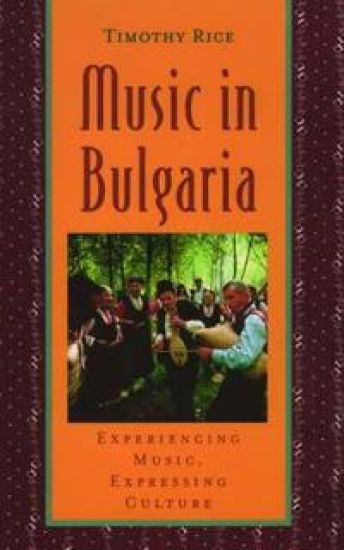
Designed for undergraduates with little or no background in world music, Music in Bulgaria is one of several volumes that can be used along with Thinking Musically, the main book in the Global Music Series, in any introductory world music or ethnomusicology course. Music in Bulgaria provides an overview of the cultural, historical, and political meaning of traditional Bulgarian music. It begins by exploring how Bulgaria's rural traditions affect the expression and interpretation of its music and goes on to examine how the country's social, political, and economic histories have influenced its music over many decades. The book also shows how the musical traditions of Bulgaria have been preserved despite the social changes brought about by the post-WWII era of industrialization and urbanization. It analyzes how Bulgarian music has spread throughout other cultures and how it has made its mark on new forms of popular music. Music in Bulgaria features eyewitness accounts of local performances, interviews with performers, and numerous listening examples. It is packaged with a 70-minute CD that includes examples of the music discussed in the text.
Ethnomusicology: A Very Short Introduction

Ethnomusicology: A Very Short Introduction

Rice Timothy

Oxford University Press Inc
2014
nidottu
Ethnomusicologists believe that all humans, not just those we call musicians, are musical, and that musicality is one of the essential touchstones of the human experience. This insight raises big questions about the nature of music and the nature of humankind, and ethnomusicologists argue that to properly address these questions, we must study music in all its geographical and historical diversity. In this Very Short Introduction, one of the foremost ethnomusicologists, Timothy Rice, offers a compact and illuminating account of this growing discipline, showing how modern researchers go about studying music from around the world, looking for insights into both music and humanity. The reader discovers that ethnomusicologists today not only examine traditional forms of music-such as Japanese gagaku, Bulgarian folk music, Javanese gamelan, or Native American drumming and singing-but also explore more contemporary musical forms, from rap and reggae to Tex-Mex, Serbian turbofolk, and even the piped-in music at the Mall of America. To investigate these diverse musical forms, Rice shows, ethnomusicologists typically live in a community, participate in and observe and record musical events, interview the musicians, their patrons, and the audience, and learn to sing, play, and dance. It's important to establish rapport with musicians and community members, and obtain the permission of those they will work with closely over the course of many months and years. We see how the researcher analyzes the data to understand how a particular musical tradition works, what is distinctive about it, and how it bears the personal, social, and cultural meanings attributed to it. Rice also discusses how researchers may apply theories from anthropology and other social sciences, to shed further light on the nature of music as a human behavior and cultural practice. About the Series: Oxford's Very Short Introductions series offers concise and original introductions to a wide range of subjects—from Islam to Sociology, Politics to Classics, Literary Theory to History, and Archaeology to the Bible. Not simply a textbook of definitions, each volume in this series provides trenchant and provocative—yet always balanced and complete—discussions of the central issues in a given discipline or field. Every Very Short Introduction gives a readable evolution of the subject in question, demonstrating how the subject has developed and how it has influenced society. Eventually, the series will encompass every major academic discipline, offering all students an accessible and abundant reference library. Whatever the area of study that one deems important or appealing, whatever the topic that fascinates the general reader, the Very Short Introductions series has a handy and affordable guide that will likely prove indispensable.