Kirjojen hintavertailu. Mukana 11 342 296 kirjaa ja 12 kauppaa.

Kirjahaku

Etsi kirjoja tekijän nimen, kirjan nimen tai ISBN:n perusteella.

10 kirjaa tekijältä Richard Brookhiser

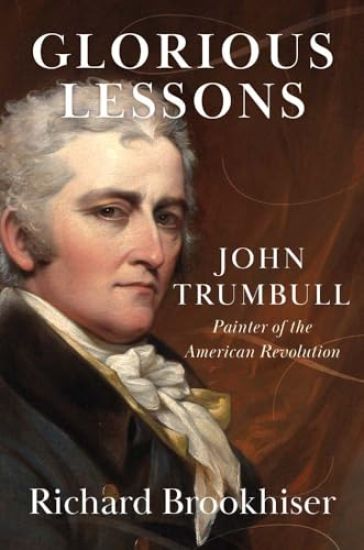
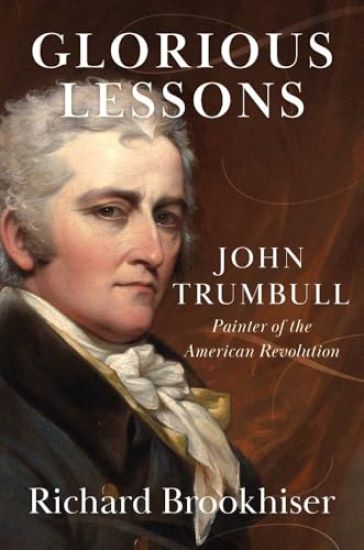
Glorious Lessons

Glorious Lessons

Richard Brookhiser

YALE UNIVERSITY PRESS
2024
sidottu
The complicated life and legacy of John Trumbull, whose paintings portrayed both the struggle and the principles that distinguished America’s founding moment “Nuanced, engaging and incisive.”—Stephen Brumwell, Wall Street Journal “Succinct, both scholarly and direct. . . . Wonderful art history.”—Brian T. Allen, National Review John Trumbull (1756–1843) experienced the American Revolution firsthand—he served as aid to George Washington and Horatio Gates, was shot at, and was jailed as a spy. He made it his mission to record the war, giving visual form to what most citizens of the new United States thought: that they had brought into the world a great and unprecedented political experiment. His purpose, he wrote, was “to preserve and diffuse the memory of the noblest series of actions which have ever presented themselves in the history of man.” Although Trumbull’s contemporaries viewed him as a painter, Trumbull thought of himself as a historian. Richard Brookhiser tells Trumbull’s story of acclaim and recognition, a story complicated by provincialism, war, a messy personal life, and, ultimately, changing fashion. He shows how the artist’s fifty-year project embodied the meaning of American exceptionalism and played a key role in defining the values of the new country. Trumbull depicted the story of self-rule in the modern world—a story as important and as contested today as it was 250 years ago.
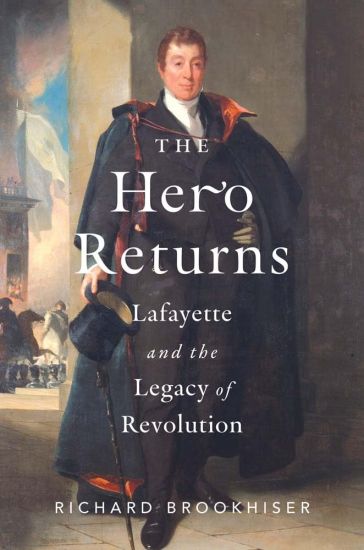
The Hero Returns

The Hero Returns

Richard Brookhiser

YALE UNIVERSITY PRESS
2026
sidottu
The return of a revered revolutionary and the meaning of independence in a divided nation—in the 1820s and today In 1824, the legendary French hero of the American Revolution, Gilbert du Motier de Lafayette, commenced an epic tour of the United States at the invitation of President James Monroe. On this thirteen-month trip across all twenty-four states, Lafayette (1757–1834) witnessed an evolving young nation grappling with its ideals, achievements, and challenges: a contested yet peaceful presidential election, engineering marvels like the Erie Canal, and the persistent tragedy of slavery. Journalist and historian Richard Brookhiser shows us what Lafayette saw on this storied adventure through the fifty-year-old republic—the hoopla, oratory, journalism, struggle, failure, and idealism. As the United States marks the 250th anniversary of its independence, Brookhiser invites readers to ponder the same critical question posed by Lafayette and his contemporaries: How well has America upheld the promise of its revolution? With vivid storytelling and acute insight, Brookhiser reflects on an era marked by triumph and turbulence—an era with compelling parallels to the present—and offers enduring lessons on liberty and democracy.
Glorious Lessons

Glorious Lessons

Richard Brookhiser

YALE UNIVERSITY PRESS
2025
pokkari
The complicated life and legacy of John Trumbull, whose paintings portrayed both the struggle and the principles that distinguished America’s founding moment “Nuanced, engaging and incisive.”—Stephen Brumwell, Wall Street Journal “Succinct, both scholarly and direct. . . . Wonderful art history.”—Brian T. Allen, National Review John Trumbull (1756–1843) experienced the American Revolution firsthand—he served as aid to George Washington and Horatio Gates, was shot at, and was jailed as a spy. He made it his mission to record the war, giving visual form to what most citizens of the new United States thought: that they had brought into the world a great and unprecedented political experiment. His purpose, he wrote, was “to preserve and diffuse the memory of the noblest series of actions which have ever presented themselves in the history of man.” Although Trumbull’s contemporaries viewed him as a painter, Trumbull thought of himself as a historian. Richard Brookhiser tells Trumbull’s story of acclaim and recognition, a story complicated by provincialism, war, a messy personal life, and, ultimately, changing fashion. He shows how the artist’s fifty-year project embodied the meaning of American exceptionalism and played a key role in defining the values of the new country. Trumbull depicted the story of self-rule in the modern world—a story as important and as contested today as it was 250 years ago.
What Would the Founders Do?

What Would the Founders Do?

Richard Brookhiser

Basic Books
2007
pokkari
What would George Washington do about weapons of mass destruction? How would Benjamin Franklin feel about unwed mothers? What would Alexander Hamilton think about minorities in the military? Examining a host of issues from terrorism to women's rights, acclaimed historian Richard Brookhiser reveals why we still turn to the Founders in moments of struggle, farce, or disaster. Washington, Franklin, Jefferson, Hamilton, Madison, Adams and all the rest have an unshakable hold on our collective imagination. We trust them more than today's politicians because they built our country, they wrote our user's manuals-the Declaration of Independence, the Constitution-and they ran the nation while it was still under warranty and could be returned to the manufacturer. If anyone knows how the U.S.A. should work, it must be the Founders. Brookhiser uses his vast knowledge to apply their views to today's issues. He also explores why what the Founders would think still matters. Written with Brookhiser's trademark eloquence and wit, while drawing on his deep understanding of American history, What Would the Founders Do? sheds new light on the disagreements and debates that have shaped our country from the beginning.Now, more than ever, we need the Founders-inspiring, argumentative, amusing know-it-alls-to help us work through the issues that divide us.
Founders' Son

Founders' Son

Richard Brookhiser

Basic Books
2014
sidottu
Abraham Lincoln grew up in the long shadow of the Founding Fathers. Seeking an intellectual and emotional replacement for his own taciturn father, Lincoln turned to the great men of the founding,Washington, Paine, Jefferson,and their great documents,the Declaration of Independence, the Constitution,for knowledge, guidance, inspiration, and purpose. Out of the power vacuum created by their passing, Lincoln emerged from among his peers as the true inheritor of the Founders' mantle, bringing their vision to bear on the Civil War and the question of slavery.In Founders'son , celebrated historian Richard Brookhiser presents a compelling new biography of Abraham Lincoln that highlights his lifelong struggle to carry on the work of the Founding Fathers. Following Lincoln from his humble origins in Kentucky to his assassination in Washington, D.C., Brookhiser shows us every side of the man: labourer, lawyer, congressman, president storyteller, wit, lover of ribald jokes depressive, poet, friend, visionary. And he shows that despite his many roles and his varied life, Lincoln returned time and time again to the Founders. They were rhetorical and political touchstones, the basis of his interest in politics, and the lodestars guiding him as he navigated first Illinois politics and then the national scene. But their legacy with not sufficient. As the Civil War lengthened and the casualties mounted Lincoln wrestled with one more paternal figure,God the Father,to explain to himself, and to the nation, why ending slavery had come at such a terrible price.Bridging the rich and tumultuous period from the founding of the United States to the Civil War, Founders'son is unlike any Lincoln biography to date. Penetrating in its insight, elegant in its prose, and gripping in its vivid recreation of Lincoln's roving mind at work, this book allows us to think anew about the first hundred years of American history, and shows how we can, like Lincoln, apply the legacy of the Founding Fathers to our times.
James Madison

James Madison

Richard Brookhiser

Basic Books
2013
pokkari
James Madison led one of the most influential and prolific lives in American history, and his story,although all too often overshadowed by his more celebrated contemporaries,is integral to that of the nation. Madison helped to shape our country as perhaps no other Founder: collabourating on the Federalist Papers and the Bill of Rights, resisting government overreach by assembling one of the nation's first political parties (the Republicans, who became today's Democrats), and taking to the battlefield during the War of 1812, becoming the last president to lead troops in combat. In this penetrating biography, eminent historian Richard Brookhiser presents a vivid portrait of the Father of the Constitution," an accomplished yet humble statesman who nourished Americans' fledgling liberty and vigorously defended the laws that have preserved it to this day.
John Marshall

John Marshall

Richard Brookhiser

Basic Books
2018
sidottu
In 1801, a 45-year-old Revolutionary War veteran and politician, slovenly, genial, brilliant, and persuasive, became the fourth chief justice of the United States, a post he would hold for a record thirty-four years. Before John Marshall joined the Court, the judicial branch was viewed as the poor sister of the federal government, lacking in dignity and clout. After his passing, the Supreme Court of the United States would never be ignored again. John Marshall is award-winning and bestselling author Richard Brookhiser's definitive biography of America's longest-serving Chief Justice.Marshall (1755-1835) was born in Northern Virginia and served as a captain during the Revolutionary War and then as a delegate to the Virginia state convention. He was a friend and admirer of George Washington, and a cousin and enemy of Thomas Jefferson. His appointment to the Supreme Court came almost by chance-Adams saw him as the last viable option, after previous appointees declined the nomination. Yet he took to the court immediately, turning his sharp mind toward strengthening America's fragile legal order.Americans had inherited from their colonial past a deep distrust of judges as creatures of arbitrary royal power; in reaction, newly independent states made them pawns of legislative whim. The result was legal caprice, sometimes amounting to chaos. Marshall wanted a strong federal judiciary, led by the Supreme Court, to define laws, protect rights, and balance the power of the legislative and executive branches. However, America's legal system, he believed, was threatened by specific individuals-namely Thomas Jefferson and the early Republican Party-who were intent on undermining the Constitution and respect for law in order to empower themselves.As a Federalist and a follower of Washington and Hamilton, he also wanted a strong national government, favorable to business. In his three decades on the court, Marshall accomplished just that. As Brookhiser vividly relates, in a string of often-colorful cases involving businessmen, educators, inventors, scoundrels, Native Americans, and slaves, Marshall clipped the power of the states vis-à-vis the federal government, established the Supreme Court's power to correct or rebuke Congress or the president, and bolstered commerce and contracts. John Marshall's modus operandi was charm and wit, frequently uniting his fellow justices around unanimous decisions in even the most controversial cases. For better and for worse, he made the Supreme Court a central part of American life.John Marshall is the definitive biography of America's greatest judge and most important early Chief Justice.
Alexander Hamilton, American

Alexander Hamilton, American

Richard Brookhiser

Simon Schuster
2000
pokkari
Alexander Hamilton is one of the least understood, most important, and most impassioned and inspiring of the founding fathers. At last Hamilton has found a modern biographer who can bring him to full-blooded life; Richard Brookhiser. In these pages, Alexander Hamilton sheds his skewed image as the "bastard brat of a Scotch peddler," sex scandal survivor, and notoriously doomed dueling partner of Aaron Burr. Examined up close, throughout his meteoric and ever-fascinating (if tragically brief) life, Hamilton can at last be seen as one of the most crucial of the founders. Here, thanks to Brookhiser's accustomed wit and grace, this quintessential American lives again.
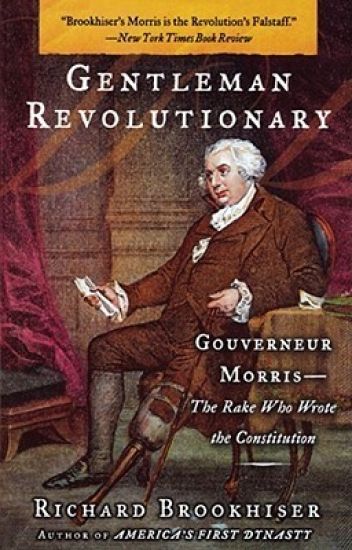
Gentleman Revolutionary

Gentleman Revolutionary

Richard Brookhiser

The Free Press
2004
pokkari
Since 1996, Richard Brookhiser has devoted himself to recovering the Founding for modern Americans. The creators of our democracy had both the temptations and the shortcomings of all men, combined with the talents and idealism of the truly great. Among them, no Founding Father demonstrates the combination of temptations and talents quite so vividly as the least known of the greats, Gouverneur Morris. His story is one that should be known by every American -- after all, he drafted the Constitution, and his hand lies behind many of its most important phrases. Yet he has been lost in the shadows of the Founders who became presidents and faces on our currency. As Brookhiser shows in this sparkling narrative, Morris's story is not only crucial to the Founding, it is also one of the most entertaining and instructive of all. Gouverneur Morris, more than Washington, Jefferson, or even Franklin, is the Founding Father whose story can most readily touch our hearts, and whose character is most sorely needed today. He was a witty, peg-legged ladies' man. He was an eyewitness to two revolutions (American and French) who joked with George Washington, shared a mistress with Talleyrand, and lost friends to the guillotine. In his spare time he gave New York City its street grid and New York State the Erie Canal. His keen mind and his light, sure touch helped make our Constitution the most enduring fundamental set of laws in the world. In his private life, he suited himself; pleased the ladies until, at age fifty-seven, he settled down with one lady (and pleased her); and lived the life of a gentleman, for whom grace and humanity were as important as birth. He kept his good humor through war, mobs, arson, death, and two accidents that burned the flesh from one of his arms and cut off one of his legs below the knee. Above all, he had the gift of a sunny disposition that allowed him to keep his head in any troubles. We have much to learn from him, and much pleasure to take in his company.
Give Me Liberty: A History of America's Exceptional Idea
An award-winning historian recounts the history of American liberty through the stories of thirteen essential documentsNationalism is inevitable: It supplies feelings of belonging, identity, and recognition. It binds us to our neighbors and tells us who we are. But increasingly -- from the United States to India, from Russia to Burma -- nationalism is being invoked for unworthy ends: to disdain minorities or to support despots. As a result, nationalism has become to many a dirty word.In Give Me Liberty, award-winning historian and biographer Richard Brookhiser offers up a truer and more inspiring story of American nationalism as it has evolved over four hundred years. He examines America's history through thirteen documents that made the United States a new country in a new world: a free country. We are what we are because of them; we stay true to what we are by staying true to them.Americans have always sought liberty, asked for it, fought for it; every victory has been the fulfillment of old hopes and promises. This is our nationalism, and we should be proud of it.