Kirjojen hintavertailu. Mukana 12 390 323 kirjaa ja 12 kauppaa.

Kirjahaku

Etsi kirjoja tekijän nimen, kirjan nimen tai ISBN:n perusteella.

11 kirjaa tekijältä Richard Carrier

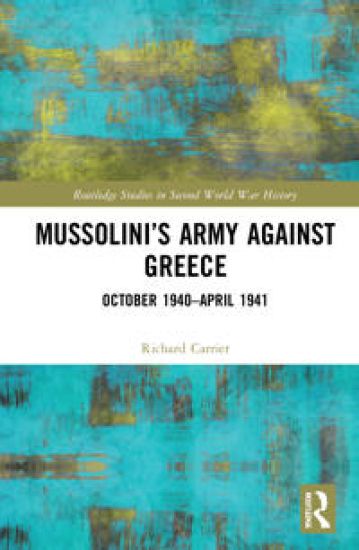
Mussolini’s Army against Greece

Mussolini’s Army against Greece

Richard Carrier

TAYLOR FRANCIS LTD
2022
nidottu
This book analyses why the Italian army failed to defeat its Greek opponent between October 1940 and April 1941. It thoroughly examines the multiple forms of ineffectiveness that plagued the political leadership as well as the military organisation.Mussolini’s aggression of Greece ranks among the most neglected campaigns of the Second World War. Initiated on 28 October 1940, the offensive came to a halt less than ten days later; by mid-November, the Greek counter-offensive put the Italian armies on the defensive, and back in Albania. From then on, the fatal interaction between failing command structures, inadequate weapons and equipment, unprepared and unmotivated combatants, and terrible logistics lowered to a dangerous level the fighting power of Italian combatants. This essay proposes that compared to the North African and Russian campaigns where the Regio Esercito achieved a decent level of military effectiveness, the operation against Greece was a military fiasco. Only the courage of its soldiers and the German intervention saved the dictator’s army from complete disaster.This book would appeal to anyone interested in the history of the world war, and to those involved in the study of military effectiveness and intrigued by why armies fail.
Not the Impossible Faith

Not the Impossible Faith

Richard Carrier

Lulu.com
2009
pokkari
Dr. Richard Carrier is an expert in the history of the ancient world and a critic of Christian attempts to distort history in defense of their faith. Not the Impossible Faith is a tour de force in that genre, dissecting and refuting the oft-repeated claim that Christianity could not have succeeded in the ancient world unless it was true. Though framed as a detailed rebuttal to Christian apologist J.P. Holding (author of The Impossible Faith), Carrier takes a general approach that educates the reader on the history and sociology of the ancient world, answering many questions like: How did Christians approach evidence? Was there a widespread prejudice against the testimony of women? Was resurrection such a radical idea? Who would worship a crucified criminal? And much more. Written with occasional humor and an easy style, and thoroughly referenced, with many entertaining "gotcha!" moments, Not the Impossible Faith is a must-read for anyone interested in the origins of Christianity.
Mussolini’s Army against Greece

Mussolini’s Army against Greece

Richard Carrier

Routledge
2021
sidottu
This book analyses why the Italian army failed to defeat its Greek opponent between October 1940 and April 1941. It thoroughly examines the multiple forms of ineffectiveness that plagued the political leadership as well as the military organisation.Mussolini’s aggression of Greece ranks among the most neglected campaigns of the Second World War. Initiated on 28 October 1940, the offensive came to a halt less than ten days later; by mid-November, the Greek counter-offensive put the Italian armies on the defensive, and back in Albania. From then on, the fatal interaction between failing command structures, inadequate weapons and equipment, unprepared and unmotivated combatants, and terrible logistics lowered to a dangerous level the fighting power of Italian combatants. This essay proposes that compared to the North African and Russian campaigns where the Regio Esercito achieved a decent level of military effectiveness, the operation against Greece was a military fiasco. Only the courage of its soldiers and the German intervention saved the dictator’s army from complete disaster.This book would appeal to anyone interested in the history of the world war, and to those involved in the study of military effectiveness and intrigued by why armies fail.
Sense and Goodness Without God

Sense and Goodness Without God

Richard Carrier

AuthorHouse
2005
pokkari
If God does not exist, then what does? Is there good and evil, and should we care? How do we know what's true anyway? And can we make any sense of this universe, or our own lives? Sense and Goodness answers all these questions in lavish detail, without complex jargon. A complete worldview is presented and defended, covering every subject from knowledge to art, from metaphysics to morality, from theology to politics. Topics include free will, the nature of the universe, the meaning of life, and much more, arguing from scientific evidence that there is only a physical, natural world without gods or spirits, but that we can still live a life of love, meaning, and joy.
Jesus from Outer Space

Jesus from Outer Space

Richard Carrier

Pitchstone Publishing
2020
sidottu
The earliest Christians believed Jesus was an ancient celestial being who put on a bodysuit of flesh, died at the hands of dark forces, and then rose from the dead and ascended back into the heavens. But the writing we have today from that first generation of Christians never says where they thought he landed, where he lived, or where he died. The idea that Jesus toured Galilee and visited Jerusalem arose only a lifetime later, in unsourced legends written in a foreign land and language. Many sources repeat those legends, but none corroborate them. Why? What exactly was the original belief about Jesus, and how did this belief change over time? In Jesus from Outer Space, noted philosopher and historian Richard Carrier summarizes for a popular audience the scholarly research on these and related questions, revealing in turn how modern attempts to conceal, misrepresent, or avoid the actual evidence calls into question the entire field of Jesus studies--and present-day beliefs about how Christianity began.
On the Historicity of Jesus

On the Historicity of Jesus

Richard Carrier

Sheffield Phoenix Press Ltd
2023
sidottu
The assumption that Jesus existed as a historical person has occasionally been questioned in the course of the last hundred years or so, but any doubts that have been raised have usually been put to rest in favor of imagining a blend of the historical, the mythical and the theological in the surviving records of Jesus. Carrier re-examines the whole question and finds compelling reasons to suspect the more daring assumption is correct. He lays out extensive research on the evidence for Jesus and the origins of Christianity and poses the key questions that must now be answered if the historicity of Jesus is to survive as a dominant paradigm. Carrier contrasts the most credible reconstruction of a historical Jesus with the most credible theory of Christian origins if a historical Jesus did not exist. Such a theory would posit that the Jesus figure was originally conceived of as a celestial being known only through private revelations and hidden messages in scripture; then stories placing this being in earth history were crafted to communicate the claims of the gospel allegorically; such stories eventually came to be believed or promoted in the struggle for control of the Christian churches that survived the tribulations of the first century. Carrier finds the latter theory more credible than has been previously imagined. He explains why it offers a better explanation for all the disparate evidence surviving from the first two centuries of the Christian era. He argues that we need a more careful and robust theory of cultural syncretism between Jewish theology and politics of the second-temple period and the most popular features of pagan religion and philosophy of the time. For anyone intent on defending a historical Jesus, this is the book to challenge.
On the Historicity of Jesus

On the Historicity of Jesus

Richard Carrier

Sheffield Phoenix Press Ltd
2023
pokkari
The assumption that Jesus existed as a historical person has occasionally been questioned in the course of the last hundred years or so, but any doubts that have been raised have usually been put to rest in favor of imagining a blend of the historical, the mythical and the theological in the surviving records of Jesus.Carrier re-examines the whole question and finds compelling reasons to suspect the more daring assumption is correct. He lays out extensive research on the evidence for Jesus and the origins of Christianity and poses the key questions that must now be answered if the historicity of Jesus is to survive as a dominant paradigm.Carrier contrasts the most credible reconstruction of a historical Jesus with the most credible theory of Christian origins if a historical Jesus did not exist. Such a theory would posit that the Jesus figure was originally conceived of as a celestial being known only through private revelations and hidden messages in scripture; then stories placing this being in earth history were crafted to communicate the claims of the gospel allegorically; such stories eventually came to be believed or promoted in the struggle for control of the Christian churches that survived the tribulations of the first century.Carrier finds the latter theory more credible than has been previously imagined. He explains why it offers a better explanation for all the disparate evidence surviving from the first two centuries of the Christian era. He argues that we need a more careful and robust theory of cultural syncretism between Jewish theology and politics of the second-temple period and the most popular features of pagan religion and philosophy of the time.For anyone intent on defending a historical Jesus, this is the book to challenge.This revised edition corrects the numerous typographical and other minor errors listed in "Typos List for On the Historicity of Jesus" (at richardcarrier.info/archives/8551). Pagination remains substantially the same.
The Scientist in the Early Roman Empire

The Scientist in the Early Roman Empire

Richard Carrier

Pitchstone Publishing
2017
pokkari
In this extensive sequel to Science Education in the Early Roman Empire, Dr. Richard Carrier explores the social history of scientists in the Roman era. Was science in decline or experiencing a revival under the Romans? What was an ancient scientist thought to be and do? Who were they, and who funded their research? And how did pagans differ from their Christian peers in their views toward science and scientists? Some have claimed Christianity valued them more than their pagan forebears. In fact the reverse is the case. And this difference in values had a catastrophic effect on the future of humanity. The Romans may have been just a century or two away from experiencing a scientific revolution. But once in power, Christianity kept that progress on hold for a thousand years—while forgetting most of what the pagans had achieved and discovered, from an empirical anatomy, physiology, and brain science to an experimental physics of water, gravity, and air. Thoroughly referenced and painstakingly researched, this volume is a must for anyone who wants to learn how far we once got, and why we took so long to get to where we are today.
Science Education in the Early Roman Empire

Science Education in the Early Roman Empire

Richard Carrier

Pitchstone Publishing
2016
pokkari
Throughout the Roman Empire Cities held public speeches and lectures, had libraries, and teachers and professors in the sciences and the humanities, some subsidized by the state. There even existed something equivalent to universities, and medical and engineering schools. What were they like? What did they teach? Who got to attend them? In the first treatment of this subject ever published, Dr. Richard Carrier answers all these questions and more, describing the entire education system of the early Roman Empire, with a unique emphasis on the quality and quantity of its science content. He also compares pagan attitudes toward the Roman system of education with the very different attitudes of ancient Jews and Christians, finding stark contrasts that would set the stage for the coming Dark Ages.